Departamento de Fisiología, Facultad de Farmacia, Universidad Complutense, Madrid, Spain.
Departamento de Urología, Hospital Universitario Puerta de Hierro-Majadahonda, Madrid, Spain.
Redox Biol. 2020 Jul;34:101575. doi: 10.1016/j.redox.2020.101575. Epub 2020 May 16.
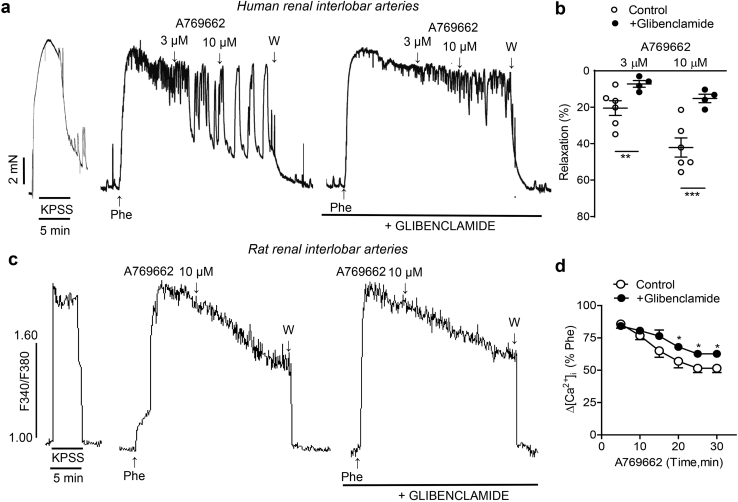
AMP-activated protein kinase (AMPK) is a cellular energy sensor activated during energy stress to stimulate ATP production pathways and restore homeostasis. AMPK is widely expressed in the kidney and involved in mitochondrial protection and biogenesis upon acute renal ischemia, AMPK activity being blunted in metabolic disease-associated kidney disease. Since little is known about AMPK in the regulation of renal blood flow, the present study aimed to assess the role of AMPK in renal vascular function. Functional responses to the selective AMPK activator A769662 were assessed in intrarenal small arteries isolated from the kidney of renal tumour patients and Wistar rats and mounted in microvascular myographs to perform simultaneous measurements of intracellular calcium [Ca] and tension. Superoxide (O) and hydrogen peroxide (HO) production were measured by chemiluminescence and fluorescence and protein expression by Western blot. Activation of AMPK with A769662 increased AMPK phosphorylation at Thr-172 and induced potent relaxations compared to AICAR in isolated human and rat intrarenal arteries, through both endothelium-dependent mechanisms involving nitric oxide (NO) and intermediate-conductance calcium-activated potassium (IK) channels, as well as activation of ATP-sensitive (K) channels and sarcoplasmic reticulum Ca-ATP (SERCA) in vascular smooth muscle (VSM). Furthermore, AMPK activator reduced NADPH oxidase 4 (Nox4) and Nox2-derived reactive oxygen species (ROS) production. These results demonstrate that A769662 has potent vasodilator and antioxidant effects in intrarenal arteries. The benefits of AMPK activation in rat kidney are reproduced in human arteries and therefore vascular AMPK activation might be a therapeutic target in the treatment of metabolic disease-associated kidney injury.
腺苷酸活化蛋白激酶 (AMPK) 是一种细胞能量传感器,在能量应激时被激活,以刺激 ATP 生成途径并恢复体内平衡。AMPK 在肾脏中广泛表达,在急性肾缺血时参与线粒体保护和生物发生,而在代谢性疾病相关的肾脏疾病中,AMPK 活性减弱。由于人们对 AMPK 在调节肾血流量中的作用知之甚少,本研究旨在评估 AMPK 在肾血管功能中的作用。在从肾肿瘤患者和 Wistar 大鼠肾脏分离的肾内小动脉中评估了选择性 AMPK 激活剂 A769662 的功能反应,并将其安装在微血管肌动描记器中,以同时进行细胞内钙 [Ca] 和张力的测量。通过化学发光和荧光测量超氧化物 (O) 和过氧化氢 (HO) 的产生,并通过 Western blot 测量蛋白质表达。与 AICAR 相比,A769662 激活 AMPK 可增加 Thr-172 的磷酸化,并在分离的人及大鼠肾内动脉中诱导强烈的舒张作用,这是通过涉及一氧化氮 (NO) 和中电导钙激活钾 (IK) 通道的内皮依赖性机制以及血管平滑肌 (VSM) 中 ATP 敏感 (K) 通道和肌浆网 Ca-ATP (SERCA) 的激活来实现的。此外,AMPK 激活剂可减少 NADPH 氧化酶 4 (Nox4) 和 Nox2 衍生的活性氧 (ROS) 的产生。这些结果表明,A769662 在肾内动脉中具有强烈的血管舒张和抗氧化作用。AMPK 激活在大鼠肾脏中的益处在人动脉中得到重现,因此血管 AMPK 激活可能是治疗代谢性疾病相关肾脏损伤的治疗靶点。