Braz Leandro Gobbo, Morais Arthur Caus de, Sanchez Rafael, Porto Daniela de Sá Menezes, Pacchioni Mariana, Serafim Williany Dark Silva, Módolo Norma Sueli Pinheiro, Jr Paulo do Nascimento, Braz Mariana Gobbo, Braz José Reinaldo Cerqueira
Universidade Estadual Paulista (UNESP), Faculdade de Medicina de Botucatu, Departamento de Anestesiologia, Comissão de Estudo de Parada Cardíaca e de Mortalidade em Anestesia, Botucatu, SP, Brazil.
Universidade Estadual Paulista (UNESP), Faculdade de Medicina de Botucatu, Departamento de Anestesiologia, Comissão de Estudo de Parada Cardíaca e de Mortalidade em Anestesia, Botucatu, SP, Brazil.
Braz J Anesthesiol. 2020 Mar-Apr;70(2):82-89. doi: 10.1016/j.bjan.2020.02.004. Epub 2020 May 12.
The perioperative cardiac arrest (CA) and mortality rates in Brazil, a developing country, are higher than in developed countries. The hypothesis of this review was that knowledge of the epidemiology of perioperative CA and mortality in Brazil enables the comparison with developed countries. The systematic review aimed to verify, in studies conducted in Brazil, the epidemiology of perioperative CA and mortality.
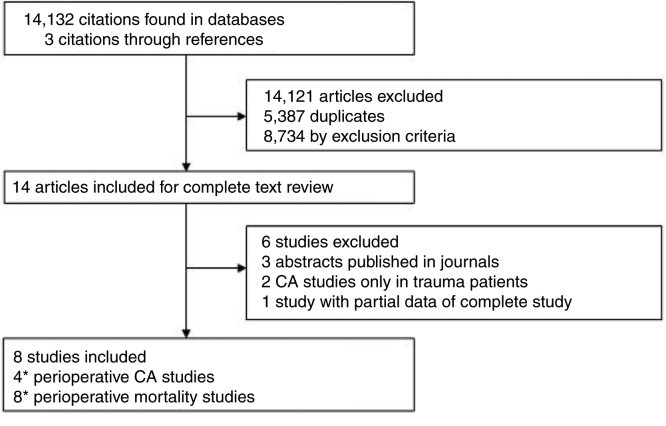
A search strategy was carried out on different databases (PubMed, EMBASE, SciELO and LILACS) to identify observational studies that reported perioperative CA and/or mortality up to 48 hours postoperatively in Brazil. The primary outcomes were data on epidemiology of perioperative CA and mortality. In 8 Brazilian studies, there was a higher occurrence of perioperative CA and mortality in males; in extremes of age; in patients in worse physical status according to the American Society of Anesthesiologists (ASA); in emergency surgeries; in general anesthesia; and in cardiac, thoracic, vascular, abdominal and neurological surgeries. The patient's disease/condition was the main triggering factor, with sepsis and trauma as the main causes.
The epidemiology of both perioperative CA and mortality events reported in Brazilian studies does not show important differences and, in general, is similar to studies in developed countries. However, sepsis represents one of the major causes of perioperative CA and mortality in Brazilian studies, contrasting with studies in developed countries in which sepsis is a secondary cause.
在发展中国家巴西,围手术期心脏骤停(CA)和死亡率高于发达国家。本综述的假设是,了解巴西围手术期CA和死亡率的流行病学情况有助于与发达国家进行比较。该系统综述旨在核实巴西开展的研究中围手术期CA和死亡率的流行病学情况。
在不同数据库(PubMed、EMBASE、SciELO和LILACS)上执行检索策略,以识别报告巴西围手术期CA和/或术后48小时内死亡率的观察性研究。主要结局是围手术期CA和死亡率的流行病学数据。在8项巴西研究中,围手术期CA和死亡率在男性、极端年龄、根据美国麻醉医师协会(ASA)身体状况较差的患者、急诊手术、全身麻醉以及心脏、胸科、血管、腹部和神经外科手术中发生率更高。患者的疾病/状况是主要触发因素,脓毒症和创伤是主要原因。
巴西研究中报告的围手术期CA和死亡事件的流行病学情况没有显示出重要差异,总体上与发达国家的研究相似。然而,脓毒症是巴西研究中围手术期CA和死亡的主要原因之一,这与发达国家的研究不同,在发达国家脓毒症是次要原因。