Department of Anesthesiology, Botucatu Medical School, Sao Paulo State University-UNESP, São Paulo, Brazil.
Department of Biostatistics, Institute of Biosciences, Sao Paulo State University-UNESP, São Paulo, Brazil.
PLoS One. 2020 Nov 2;15(11):e0241751. doi: 10.1371/journal.pone.0241751. eCollection 2020.
Studies have shown that both perioperative and anesthesia-related cardiac arrest (CA) and mortality rates are much higher in developing countries than in developed countries. This review aimed to compare the rates of perioperative and anesthesia-related CA and mortality during 2 time periods in Brazil.
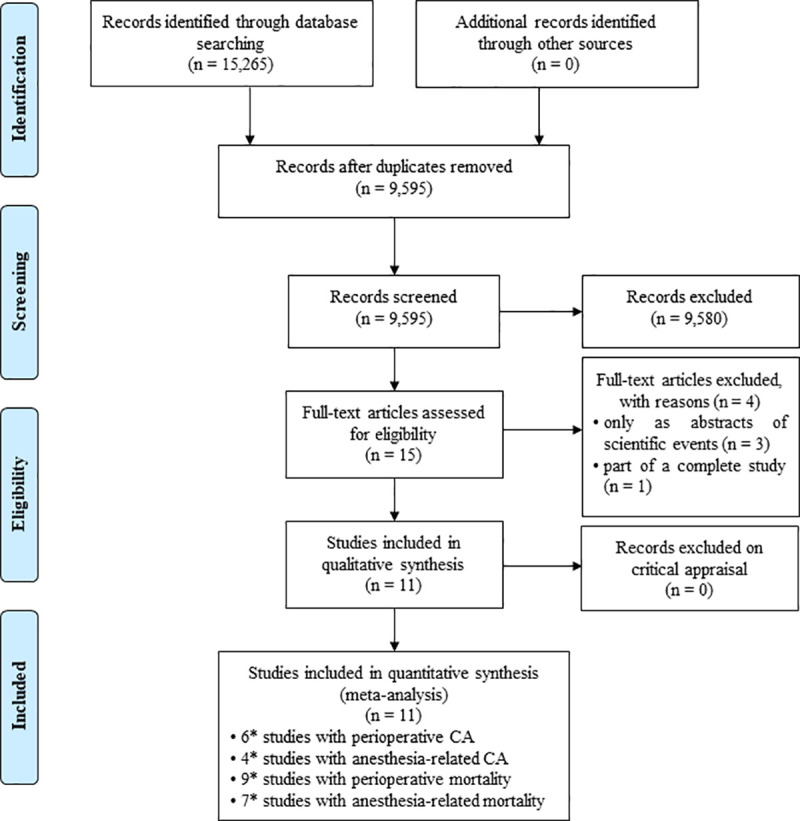
A systematic review with meta-analysis of full-text Brazilian observational studies was conducted by searching the Medline, EMBASE, LILACS and SciELO databases up to January 29, 2020. The primary outcomes were perioperative CA and mortality rates and the secondary outcomes included anesthesia-related CA and mortality events rates up to 48 postoperative hours.
Eleven studies including 719,273 anesthetic procedures, 962 perioperative CAs, 134 anesthesia-related CAs, 1,239 perioperative deaths and 29 anesthesia-related deaths were included. The event rates were evaluated in 2 time periods: pre-1990 and 1990-2020. Perioperative CA rates (per 10,000 anesthetics) decreased from 39.87 (95% confidence interval [CI]: 34.60-45.50) before 1990 to 17.61 (95% CI: 9.21-28.68) in 1990-2020 (P < 0.0001), while the perioperative mortality rate did not alter (from 19.25 [95% CI: 15.64-23.24] pre-1990 to 25.40 [95% CI: 13.01-41.86] in 1990-2020; P = 0.1984). Simultaneously, the anesthesia-related CA rate decreased from 14.39 (95% CI: 11.29-17.86) to 3.90 (95% CI: 2.93-5.01; P < 0.0001), while there was no significant difference in the anesthesia-related mortality rate (from 1.75 [95% CI: 0.76-3.11] to 0.67 [95% CI: 0.09-1.66; P = 0.5404).
This review demonstrates an important reduction in the perioperative CA rate over time in Brazil, with a large and consistent decrease in the anesthesia-related CA rate; however, there were no significant differences in perioperative and anesthesia-related mortality rates between the assessed time periods.
研究表明,发展中国家围手术期和与麻醉相关的心脏骤停(CA)及死亡率均远高于发达国家。本研究旨在比较巴西两个时期围手术期和与麻醉相关的 CA 及死亡率。
对巴西观察性研究的全文进行系统评价和荟萃分析,检索 Medline、EMBASE、LILACS 和 SciELO 数据库,检索时间截至 2020 年 1 月 29 日。主要结局指标为围手术期 CA 和死亡率,次要结局指标包括术后 48 小时内与麻醉相关的 CA 和死亡率事件发生率。
共纳入 11 项研究,包括 719273 例麻醉程序、962 例围手术期 CA、134 例与麻醉相关的 CA、1239 例围手术期死亡和 29 例与麻醉相关的死亡。评估了两个时间段的事件发生率:1990 年前和 1990-2020 年。围手术期 CA 发生率(每 10000 例麻醉)从 1990 年前的 39.87(95%置信区间:34.60-45.50)降至 1990-2020 年的 17.61(95%置信区间:9.21-28.68)(P<0.0001),而围手术期死亡率没有变化(从 1990 年前的 19.25(95%置信区间:15.64-23.24)到 1990-2020 年的 25.40(95%置信区间:13.01-41.86);P=0.1984)。同时,与麻醉相关的 CA 发生率从 14.39(95%置信区间:11.29-17.86)降至 3.90(95%置信区间:2.93-5.01;P<0.0001),而与麻醉相关的死亡率无显著差异(从 1.75(95%置信区间:0.76-3.11)到 0.67(95%置信区间:0.09-1.66;P=0.5404)。
本研究表明,巴西围手术期 CA 发生率随时间呈重要下降趋势,与麻醉相关的 CA 发生率呈大幅且持续下降;然而,评估时间段之间的围手术期和与麻醉相关的死亡率无显著差异。