Muhammad Jibran Sualeh, Bajbouj Khuloud, Shafarin Jasmin, Hamad Mawieh
Department of Basic Medical Sciences, College of Medicine, University of Sharjah , Sharjah, United Arab Emirates.
Iron Biology Group, Sharjah Institute for Medical Research, University of Sharjah , Sharjah, United Arab Emirates.
Epigenetics. 2020 Dec;15(12):1302-1318. doi: 10.1080/15592294.2020.1770917. Epub 2020 Jun 1.
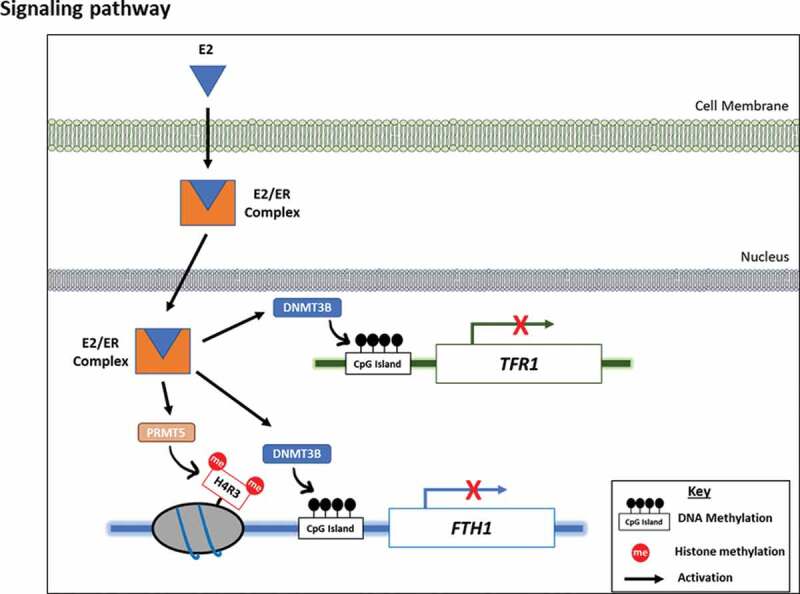
Estrogen (E2) regulates hundreds of genes involved in cell metabolism and disrupts iron homoeostasis in various cell types. Herein, we addressed whether E2-induced epigenetic modifications are involved in modulating the expression of iron-regulatory genes. Epigenetic status of and genes was assessed in E2-treated cancer cells. E2-induced DNA methylation was associated with decreased and expression in Hep-G2 and Huh7 cells, but not in AGS or MCF7 cells. Demethylation with 5-Aza-2-deoxycytidine upregulated the expression of both these genes in Hep-G2 cells. The expression of DNMT3B, PRMT5, and H4R3me2s increased in E2-treated cells. Chromatin immunoprecipitation showed that E2 treatment recruited PRMT5 and H4R3me2s on but not on . Knockdown of PRMT5, DNMT3B, and Estrogen-receptor alpha rescued from E2-induced silencing. However, knockdown of DNMT3B alone blocked the inhibitory effects of E2 on . Analysis of human liver tissues in publicly available datasets showed that and are highly expressed in primary liver tumours, but a lower expression is associated with better survival. Interestingly, we showed that the silencing of and/or inhibited carcinogenesis in Hep-G2 cells. For the first time, our findings uncovered the novel signalling pathway involved in the protective effects of E2 against liver cancer.
雌激素(E2)调节数百个参与细胞代谢的基因,并破坏多种细胞类型中的铁稳态。在此,我们探讨了E2诱导的表观遗传修饰是否参与调节铁调节基因的表达。在E2处理的癌细胞中评估了[具体基因名称1]和[具体基因名称2]基因的表观遗传状态。E2诱导的DNA甲基化与Hep-G2和Huh7细胞中[具体基因名称1]和[具体基因名称2]的表达降低有关,但在AGS或MCF7细胞中并非如此。用5-氮杂-2'-脱氧胞苷去甲基化上调了Hep-G2细胞中这两个基因的表达。在E2处理的细胞中,DNMT3B、PRMT5和H4R3me2s的表达增加。染色质免疫沉淀表明,E2处理在[具体基因名称1]上募集了PRMT5和H4R3me2s,但在[具体基因名称2]上没有。敲低PRMT5、DNMT3B和雌激素受体α可使[具体基因名称1]从E2诱导的沉默中恢复。然而,单独敲低DNMT3B可阻断E2对[具体基因名称2]的抑制作用。对公开可用数据集中的人类肝脏组织分析表明,[具体基因名称1]和[具体基因名称2]在原发性肝癌中高表达,但较低的表达与更好的生存率相关。有趣的是,我们表明[具体基因名称1]和/或[具体基因名称2]的沉默抑制了Hep-G2细胞中的致癌作用。我们的研究结果首次揭示了E2对肝癌保护作用所涉及的新信号通路。