Yilmaz Dilay, Tharehalli Umesh, Paganoni Rossana, Knoop Paul, Gruber Andreas, Chen Yuexin, Dong Rui, Leithäuser Frank, Seufferlein Thomas, Leopold Kerstin, Lechel André, Vujić Spasić Maja
Institute of Comparative Molecular Endocrinology, Ulm University, 89081, Ulm, Germany.
Department of Internal Medicine I, University Hospital Ulm, Albert-Einstein-Allee 23, 89081, Ulm, Germany.
Sci Rep. 2025 Jan 16;15(1):2180. doi: 10.1038/s41598-025-86486-x.
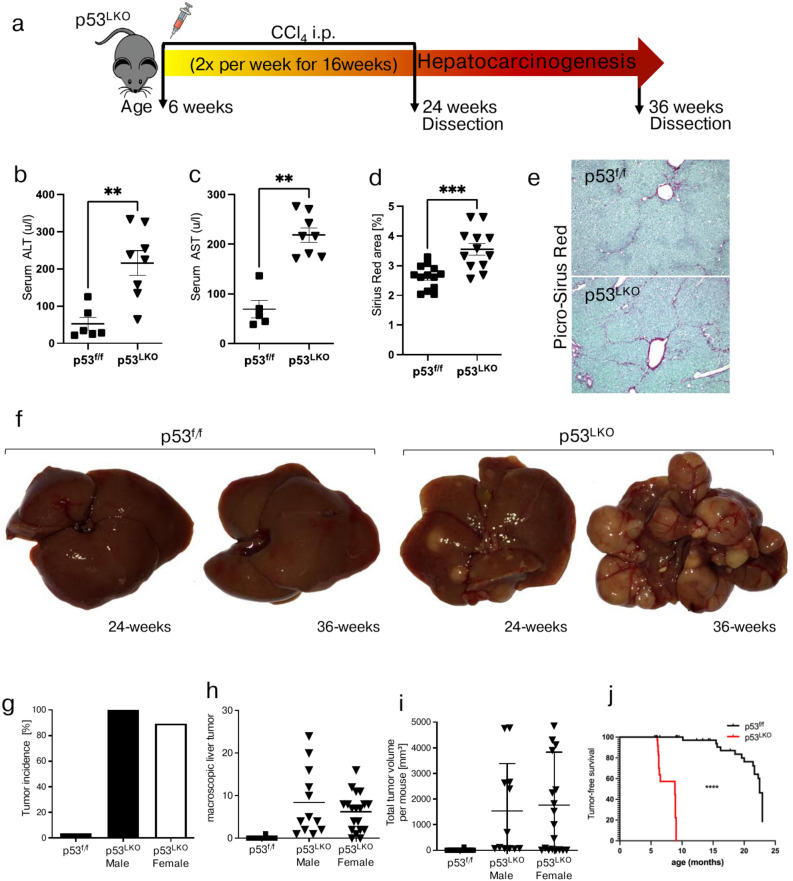
Hepatocellular carcinoma (HCC) remains the most prevalent type of primary liver cancer worldwide. p53 is one of the most frequently mutated tumor-suppressor genes in HCC and its deficiency in hepatocytes triggers tumor formation in mice. To investigate iron metabolism during liver carcinogenesis, we employed a model of chronic carbon tetrachloride injections in liver-specific p53-deficient mice to induce liver fibrosis, cirrhosis and subsequent carcinogenesis. A transcriptome analysis of liver carcinoma was employed to identify p53-dependent gene expression signatures with subsequent in-depth analysis of iron metabolic parameters being conducted locally within liver cancers and at systemic levels. We show that all mutant mice developed liver cancer by 36-weeks of age in contrast to 3.4% tumors identified in control mice. All liver cancers with a p53-deficient background exhibited a local iron-poor phenotype with a "high transferrin receptor 1 (Tfr1) and low hepcidin (Hamp)" signature. At systemic levels, iron deficiency was restricted to female mice. Additionally, liver tumorigenesis correlated with selective deficits of selenium, zinc and manganese. Our data show that iron deficiency is a prevalent phenomenon in p53-deficient liver cancers, which is associated with alterations in Hamp and Tfr1 and a poor prognosis in mice and patients.
肝细胞癌(HCC)仍然是全球最常见的原发性肝癌类型。p53是HCC中最常发生突变的肿瘤抑制基因之一,其在肝细胞中的缺失会引发小鼠肿瘤形成。为了研究肝癌发生过程中的铁代谢,我们采用在肝脏特异性p53缺陷小鼠中慢性注射四氯化碳的模型来诱导肝纤维化、肝硬化及随后的癌变。对肝癌进行转录组分析以鉴定p53依赖性基因表达特征,随后在肝癌局部和全身水平对铁代谢参数进行深入分析。我们发现,与对照小鼠中3.4%的肿瘤发生率相比,所有突变小鼠在36周龄时均发生了肝癌。所有具有p53缺陷背景的肝癌均表现出局部缺铁表型,具有“高转铁蛋白受体1(Tfr1)和低铁调素(Hamp)”特征。在全身水平,缺铁仅限于雌性小鼠。此外,肝脏肿瘤发生与硒、锌和锰的选择性缺乏相关。我们的数据表明,缺铁是p53缺陷型肝癌中的普遍现象,这与Hamp和Tfr1的改变以及小鼠和患者的预后不良有关。