Gupta Neeti A, Mahajan Shivani, Sumankumar A, Saklani Avanish, Engineer Reena, Baheti Akshay D
Department of Radio Diagnosis, Tata Memorial Hospital, Mumbai, Maharashtra, India.
Department of Colo-rectal Surgery, Tata Memorial Hospital, Mumbai, Maharashtra, India.
Indian J Radiol Imaging. 2020 Jan-Mar;30(1):7-12. doi: 10.4103/ijri.IJRI_308_19. Epub 2020 Mar 30.
Besides providing a surgical roadmap, rectal MRI plays a major role in treatment planning. We recently started using a structured template for reporting rectal cancer via MRI. We study the impact of using this template at our hospital in terms of number of essential imaging parameters described in the reports as compared to the pre-template free-text reports.
A structured rectal MRI reporting template was created in consensus with members of the colorectal tumour board and was introduced in the department, which included 14 essential parameters to be mentioned in the reports. We conducted a retrospective analysis of rectal MRI reports of 100 cases with histologically proven rectal cancer, comprising 50 consecutive free-text reports before the template was introduced and 50 consecutive structured reports after its introduction, checking for the presence or absence of inclusion of the 14 parameters. An anonymous online feedback survey was conducted as well after the introduction of the template for the members of the colorectal tumour board.
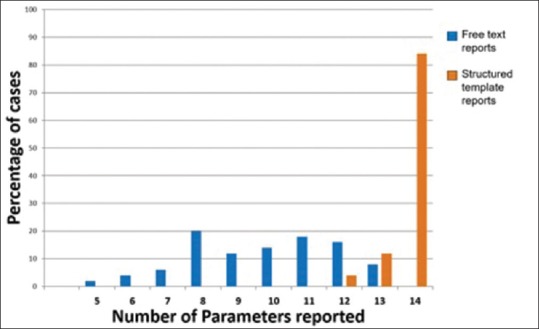
Overall, the total number of parameters reported increased from a median value of 10 (range 6-13) to 14 (range 12-14). The common unreported parameters prior to template introduction included T staging, presence or absence of restricted diffusion, anterior peritoneal reflection (APR) involvement, and presence or absence of extramural vascular invasion; these were reported in 16%, 22%, 30% and 50% respectively. These improved to 98-100% reporting after template introduction. Maximum improvement was in T staging (16% to 98%) ( < 0.0001), restricted diffusion on DWI (from 22% to 100%) ( < 0.0001) and APR involvement (from 30% to 100%) ( < 0.0001). The most common unreported parameter after template introduction was the "tumoral T2 signal intensity" (unreported in 4% cases). The results of the survey were as follows: 100% felt a decreased need to talk to the radiologist to clarify the report, 81.8% felt an improvement in the quality of reporting as compared to free style reports, and 91% felt that the new template is easier to interpret.
The introduction of a structured template for rectal cancer significantly improved the quality of rectal MRI reports, along with the satisfaction of referring providers.
直肠MRI除了提供手术路线图外,在治疗规划中也起着重要作用。我们最近开始使用结构化模板通过MRI报告直肠癌。我们研究了在我院使用该模板对报告中描述的基本影像参数数量的影响,并与模板使用前的自由文本报告进行比较。
与结直肠肿瘤委员会成员协商创建了一个结构化直肠MRI报告模板,并引入该科室,报告中应提及14个基本参数。我们对100例经组织学证实的直肠癌患者的直肠MRI报告进行了回顾性分析,包括在引入模板前连续的50份自由文本报告和引入后连续的50份结构化报告,检查14个参数是否包含在内。在引入模板后,还对结直肠肿瘤委员会成员进行了匿名在线反馈调查。
总体而言,报告的参数总数从中位数10(范围6 - 13)增加到14(范围12 - 14)。模板引入前常见的未报告参数包括T分期、是否存在扩散受限、前腹膜反折(APR)受累以及是否存在壁外血管侵犯;这些参数的报告率分别为16%、22%、30%和50%。模板引入后这些参数的报告率提高到了98 - 100%。改善最大的是T分期(从16%提高到98%)(< 0.0001)、DWI上的扩散受限(从22%提高到100%)(< 0.0001)和APR受累(从30%提高到100%)(< 0.0001)。模板引入后最常见的未报告参数是“肿瘤T2信号强度”(4%的病例未报告)。调查结果如下:100%的人认为与放射科医生沟通以澄清报告的需求减少,81.8%的人认为与自由格式报告相比报告质量有所提高,91%的人认为新模板更易于解读。
直肠癌结构化模板的引入显著提高了直肠MRI报告的质量以及转诊医生的满意度。