Li Wen, Peng Xinhao, Lang Jinyi, Xu Chuan
Cancer Clinical Research Center & Integrative Cancer Center, Sichuan Cancer Hospital & Institute Sichuan Cancer Center, School of Medicine, University of Electronic Science and Technology of China, Chengdu, China.
Radiation Oncology Key Laboratory of Sichuan Province, Sichuan Cancer Hospital & Institute Sichuan Cancer Center, School of Medicine, University of Electronic Science and Technology of China, Chengdu, China.
Front Pharmacol. 2020 May 7;11:631. doi: 10.3389/fphar.2020.00631. eCollection 2020.
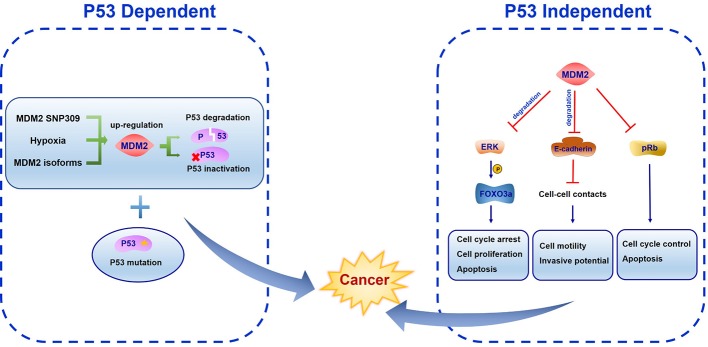
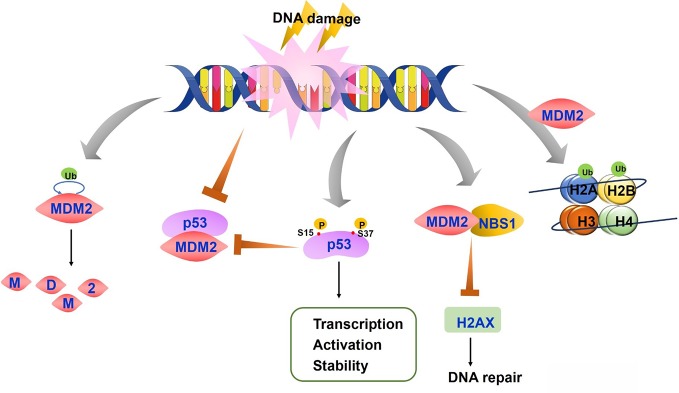
Defects in DNA damage repair may cause genome instability and cancer development. The tumor suppressor gene p53 regulates cell cycle arrest to allow time for DNA repair. The oncoprotein mouse double minute 2 (MDM2) promotes cell survival, proliferation, invasion, and therapeutic resistance in many types of cancer. The major role of MDM2 is to inhibit p53 activity and promote its degradation. In this review, we describe the influence of MDM2 on genomic instability, the role of MDM2 on releasing p53 and binding DNA repair proteins to inhibit repair, and the regulation network of MDM2 including its transcriptional modifications, protein stability, and localization following DNA damage in genome integrity maintenance and in MDM2-p53 axis control. We also discuss p53-dependent and p53 independent oncogenic function of MDM2 and the outcomes of clinical trials that have been used with clinical inhibitors targeting p53-MDM2 to treat certain cancers.
DNA损伤修复缺陷可能导致基因组不稳定和癌症发展。肿瘤抑制基因p53调节细胞周期停滞,以便为DNA修复留出时间。癌蛋白小鼠双微体2(MDM2)在多种癌症中促进细胞存活、增殖、侵袭和治疗抗性。MDM2的主要作用是抑制p53活性并促进其降解。在本综述中,我们描述了MDM2对基因组不稳定的影响、MDM2在释放p53和结合DNA修复蛋白以抑制修复方面的作用,以及MDM2在维持基因组完整性和MDM2-p53轴控制中DNA损伤后的转录修饰、蛋白质稳定性和定位的调控网络。我们还讨论了MDM2的p53依赖性和p53非依赖性致癌功能,以及使用靶向p53-MDM2的临床抑制剂治疗某些癌症的临床试验结果。