Rojas-Carvajal Mijail, Sequeira-Cordero Andrey, Brenes Juan C
Neuroscience Research Center, University of Costa Rica, San Pedro, Costa Rica.
Institute for Psychological Research, University of Costa Rica, San Pedro, Costa Rica.
Front Pharmacol. 2020 May 12;11:674. doi: 10.3389/fphar.2020.00674. eCollection 2020.
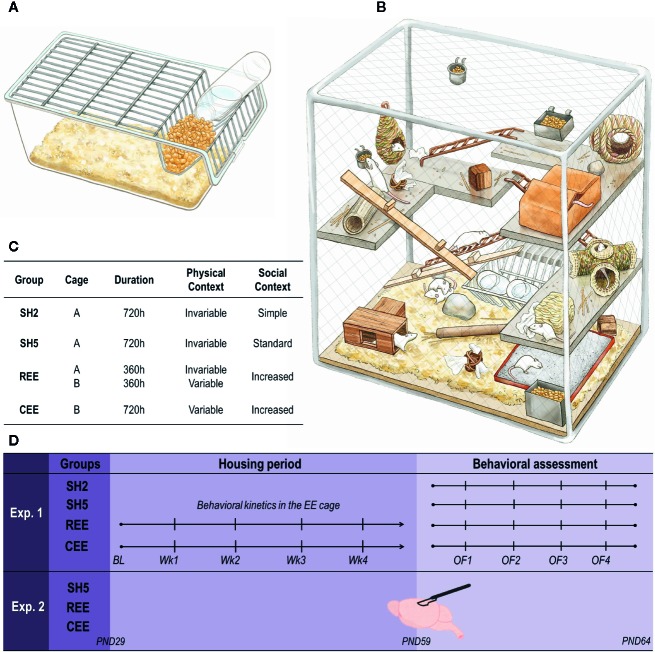
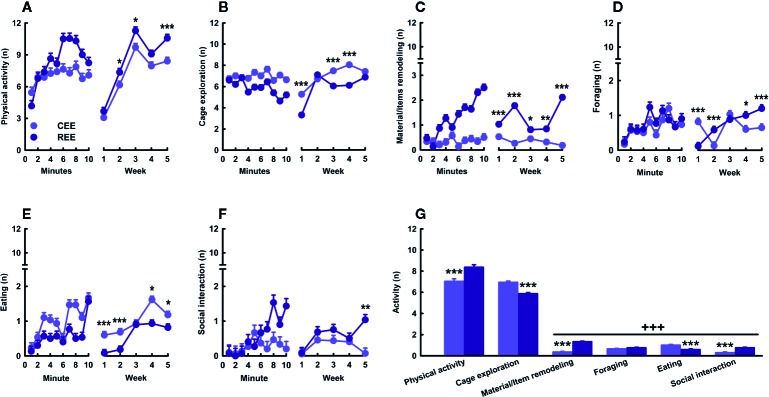
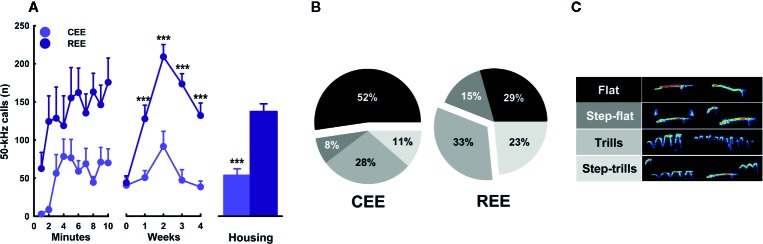
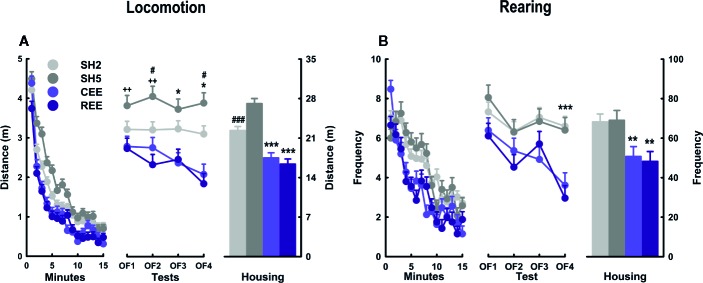
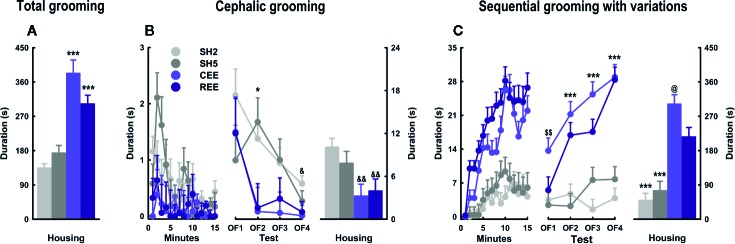
To study how motivational factors modulate experience-dependent neurobehavioral plasticity, we modify a protocol of environmental enrichment (EE) in rats. We assumed that the benefits derived from EE might vary according to the level of incentive salience attributed to it. To enhance the rewarding properties of EE, access to the EE cage varied randomly from 2 to 48 h for 30 days (REE). The REE group was enriched only 50% of the time and was compared to standard housing and continuous EE (CEE) groups. As behavioral readout, we analyzed the spontaneous activity and the ultrasonic vocalizations (USVs) within the EE cage weekly, and in the open field test at the end of the experiment. In the cage, REE increased the utilization of materials, physical activity, and the rate of appetitive USVs. In the OF, the CEE-induced enhancements in novelty habituation and social signaling were equaled by the REE. At the neural level, we measured the expression of genes related to neural plasticity and epigenetic regulations in different brain regions. In the dorsal striatum and hippocampus, REE upregulated the expression of the brain-derived neurotrophic factor, its tropomyosin kinase B receptor, and the DNA methyltransferase 3A. Altogether, our results suggest that the higher activity within the cage and the augmented incentive motivation provoked by the REE boosted its neurobehavioral effects equaling or surpassing those observed in the CEE condition. As constant exposures to treatments or stimulating environments are virtually impossible for humans, restricted EE protocols would have greater translational value than traditional ones.
为了研究动机因素如何调节经验依赖的神经行为可塑性,我们对大鼠的环境富集(EE)方案进行了修改。我们假设从EE中获得的益处可能会根据赋予它的激励显著性水平而有所不同。为了增强EE的奖励特性,进入EE笼的时间在2至48小时之间随机变化,持续30天(REE)。REE组仅在50%的时间内处于富集环境,并与标准饲养组和持续EE(CEE)组进行比较。作为行为读数,我们每周分析EE笼内的自发活动和超声波发声(USV),并在实验结束时进行旷场试验。在笼子里,REE增加了材料的利用率、身体活动以及食欲性USV的发生率。在旷场试验中,REE在新奇习惯化和社交信号方面产生的增强效果与CEE相当。在神经水平上,我们测量了不同脑区中与神经可塑性和表观遗传调控相关的基因表达。在背侧纹状体和海马体中,REE上调了脑源性神经营养因子、其原肌球蛋白激酶B受体以及DNA甲基转移酶3A的表达。总之,我们的结果表明,笼子内更高的活动水平以及REE引发的增强的激励动机增强了其神经行为效应,等同于或超过了在CEE条件下观察到的效果。由于人类几乎不可能持续暴露于治疗或刺激环境中,受限的EE方案比传统方案具有更大的转化价值。