Liu Chengwei, Chen Liang, Chen Sanmei
School of Education, Hunan University of Science and Technology, Xiangtan, China.
School of Marxism, University of Science and Technology Liaoning, Anshan, China.
Front Psychiatry. 2020 May 14;11:420. doi: 10.3389/fpsyt.2020.00420. eCollection 2020.
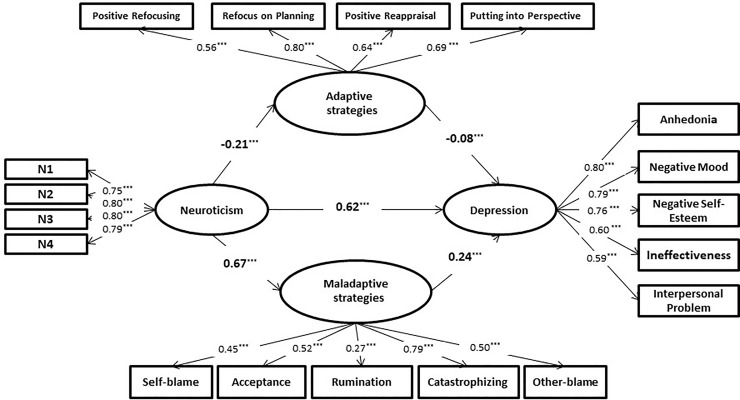
This study aims to explore the multilevel mediation effects of cognitive emotion regulation strategies (CERS) on the link between neuroticism and depressive symptoms among Chinese adolescents.
A total of 1,265 Chinese adolescents were surveyed using the Chinese version of the Cognitive Emotion Regulation Questionnaire (CERQ-C), the neuroticism scale of the Chinese children's version of the Eysenck Personality Questionnaire (EPQ-Ck), and the Chinese Children's Depressive symptoms Inventory (CDI-C). Partial correlation analyses, multigroup confirmatory factor analyses, and structural equation modeling were used.
(1) Neuroticism had significant, positive correlations with maladaptive CERS strategies (self-blame, acceptance, rumination, catastrophizing, and other-blame) and depressive symptoms ( < 0.001). Adaptive CERS strategies (positive refocusing, refocus on planning, positive reappraisal, and putting into perspective) had significant, negative correlations with neuroticism and depressive symptoms ( < 0.001). (2) Neuroticism and CERS strategies significantly predicted depressive symptoms. CERS strategies played partially mediating roles in the relationship between adolescents' neuroticism and depressive symptoms.
CERS strategies have partial multilevel mediation effects on the link between neuroticism and depressive symptoms.
本研究旨在探讨认知情绪调节策略(CERS)在中国青少年中对神经质与抑郁症状之间联系的多层次中介作用。
使用中文版认知情绪调节问卷(CERQ-C)、中国儿童版艾森克人格问卷(EPQ-Ck)的神经质量表以及中国儿童抑郁症状量表(CDI-C)对1265名中国青少年进行了调查。采用了偏相关分析、多组验证性因素分析和结构方程模型。
(1)神经质与适应不良的CERS策略(自责、接受、沉思、灾难化和责备他人)以及抑郁症状呈显著正相关(<0.001)。适应性CERS策略(积极重新聚焦、聚焦计划、积极重新评价和正确看待)与神经质和抑郁症状呈显著负相关(<0.001)。(2)神经质和CERS策略显著预测了抑郁症状。CERS策略在青少年神经质与抑郁症状之间的关系中起部分中介作用。
CERS策略在神经质与抑郁症状之间的联系上具有部分多层次中介作用。