Center for Experimental and Molecular Medicine (CEMM), Amsterdam University Medical Centers - Location AMC, University of Amsterdam, Amsterdam, Netherlands.
Department of Internal Medicine, BovenIJ Hospital, Amsterdam, Netherlands.
Front Immunol. 2020 May 6;11:796. doi: 10.3389/fimmu.2020.00796. eCollection 2020.
The nature and timing of the host immune response during infections remain uncertain and most knowledge is derived from critically ill sepsis patients. We aimed to test the hypothesis that community-acquired pneumonia (CAP) is associated with concurrent immune suppression and systemic inflammation.
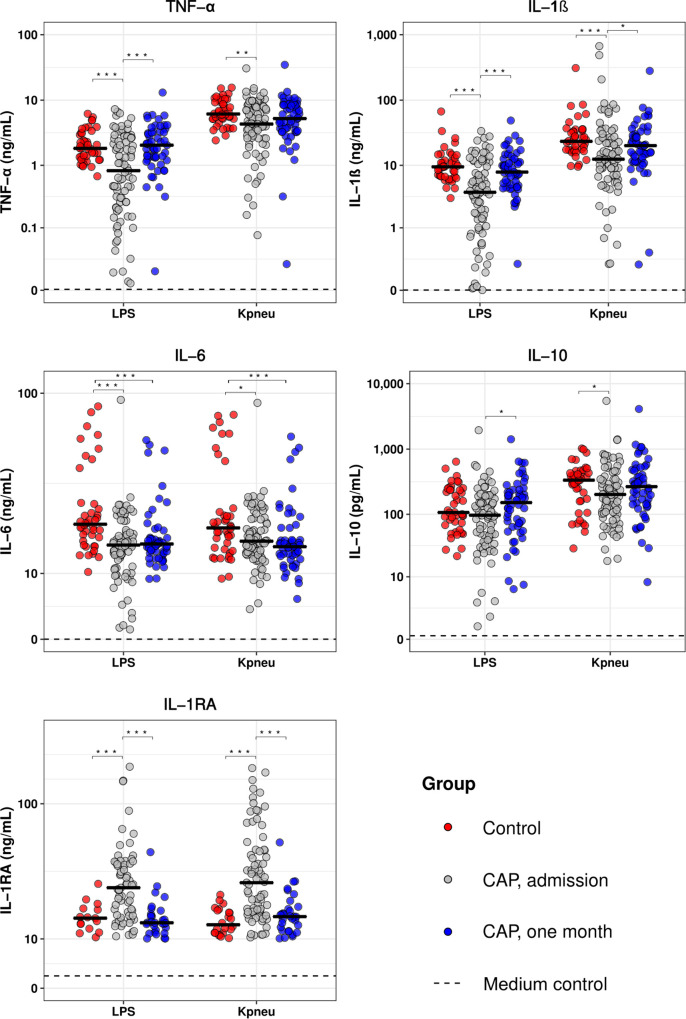
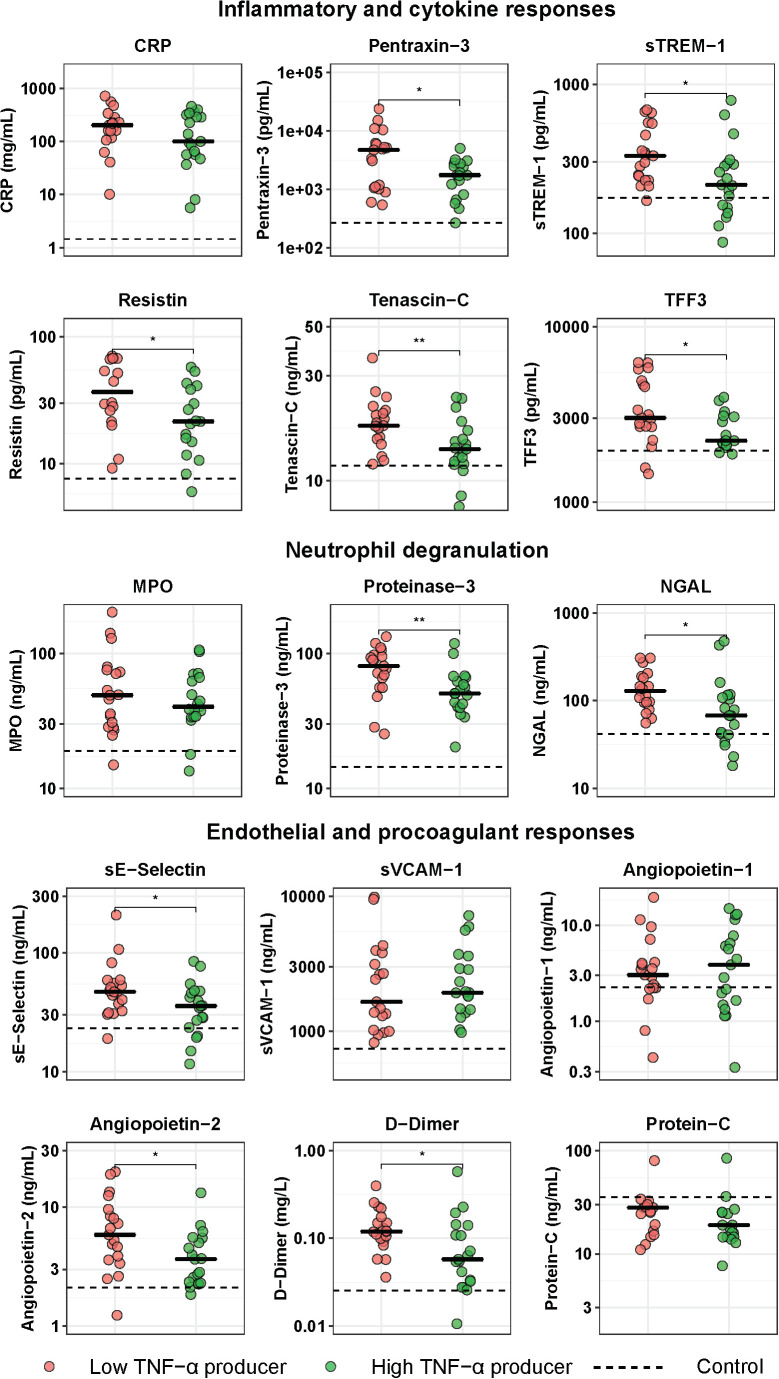
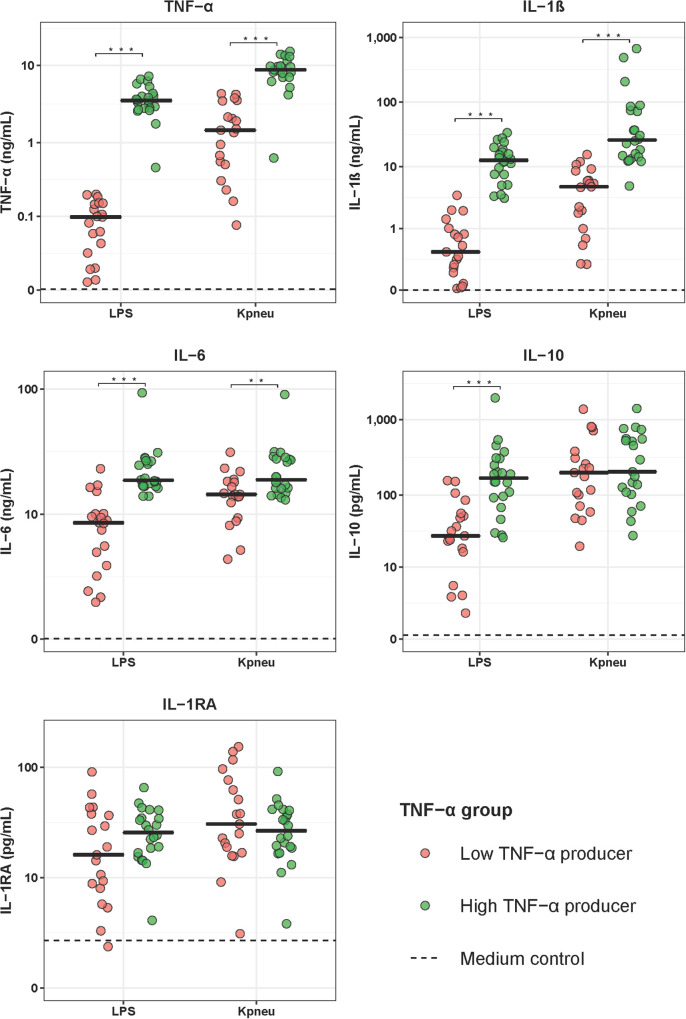
Blood was collected from 79 CAP patients within 24 h after hospitalization and 1 month after discharge; 42 age- and sex-matched subjects without acute infection served as controls. Blood leukocytes were stimulated with lipopolysaccharide (LPS) or , and cytokines were measured in supernatants. Fifteen plasma biomarkers reflective of key host response pathways were compared between CAP patients with the strongest immune suppression (lowest 25% blood leukocyte tumor necrosis factor (TNF)-α production in response to LPS) and those with the least immune suppression (highest 25% of LPS-induced TNF-α production).
Blood leukocytes of CAP patients (relative to control subjects) showed a reduced capacity to release TNF-α, interleukin (IL)-1β, IL-6 and IL-10 upon stimulation with LPS or , with a concurrently enhanced ability to release the anti-inflammatory mediator IL-1 receptor antagonist, irrespective of the presence of sepsis (18.9% of cases). Low (relative to high) TNF-α producers displayed higher plasma levels of biomarkers reflecting systemic inflammation, neutrophil degranulation, endothelial cell activation, a disturbed vascular barrier function and coagulation activation.
CAP replicates a common feature of immune suppression in sepsis. The coexistence of immune suppression and hyperinflammation in CAP argues against the theory of two distinct phases during the host response to sepsis.
宿主免疫反应的性质和时机在感染过程中仍不确定,大多数知识都来自于重病脓毒症患者。我们旨在验证以下假说,即社区获得性肺炎(CAP)与同时存在的免疫抑制和全身炎症有关。
在住院后 24 小时内和出院后 1 个月内,从 79 例 CAP 患者中采集血液;42 名年龄和性别匹配的无急性感染的患者作为对照。用脂多糖(LPS)或刺激血液白细胞,并测量上清液中的细胞因子。比较 CAP 患者中免疫抑制最强(LPS 刺激后血液白细胞肿瘤坏死因子(TNF)-α生成最低的 25%)和免疫抑制最弱(LPS 诱导的 TNF-α生成最高的 25%)患者之间的 15 种反映宿主关键反应途径的血浆生物标志物。
与对照组相比,CAP 患者的血液白细胞在 LPS 或刺激下释放 TNF-α、白细胞介素(IL)-1β、IL-6 和 IL-10 的能力降低,同时释放抗炎介质 IL-1 受体拮抗剂的能力增强,而与脓毒症的存在与否无关(占病例的 18.9%)。低(相对于高)TNF-α产生者表现出更高的血浆标志物水平,反映全身炎症、中性粒细胞脱颗粒、内皮细胞激活、血管屏障功能障碍和凝血激活。
CAP 复制了脓毒症中常见的免疫抑制特征。CAP 中免疫抑制和过度炎症的共存,反驳了宿主对脓毒症反应存在两个不同阶段的理论。