Laboratory of Viral Immunopathology, Unit of Infectious Diseases and Hepatology, Azienda Ospedaliero-Universitaria di Parma, Parma, Italy.
Department of Medicine and Surgery, University of Parma, Parma, Italy.
Front Immunol. 2020 May 12;11:849. doi: 10.3389/fimmu.2020.00849. eCollection 2020.
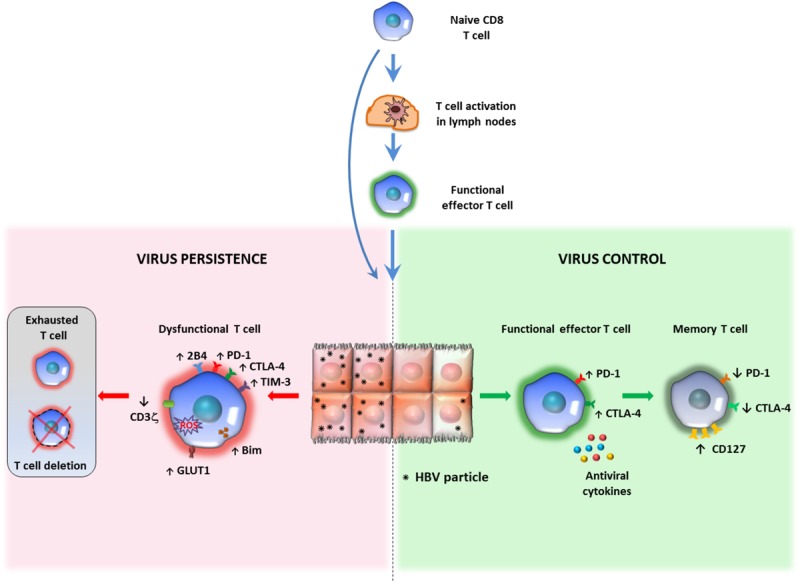
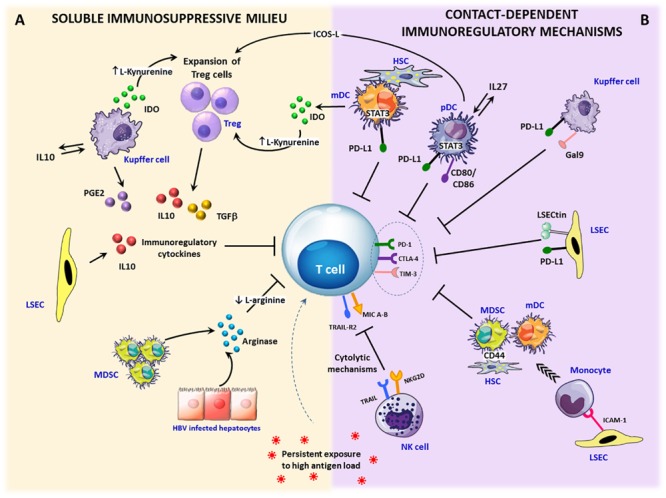
A great effort of research has been devoted in the last few years to developing new anti-HBV therapies of finite duration that also provide effective sustained control of virus replication and antigen production. Among the potential therapeutic strategies, immune-modulation represents a promising option to cure HBV infection and the adaptive immune response is a rational target for novel therapeutic interventions, in consideration of the key role played by T cells in the control of virus infections. HBV-specific T cells are severely dysfunctional in chronic HBV infection as a result of several inhibitory mechanisms which are simultaneously active within the chronically inflamed liver. Indeed, the liver is a tolerogenic organ harboring different non-parenchymal cell populations which can serve as antigen presenting cells (APC) but are poorly efficient in effector T cell priming, with propensity to induce T cell tolerance rather than T cell activation, because of a poor expression of co-stimulatory molecules, up-regulation of the co-inhibitory ligands PD-L1 and PD-L2 upon IFN stimulation, and production of immune regulatory cytokines, such as IL10 and TGF-β. They include resident dendritic cells (DCs), comprising myeloid and plasmacytoid DCs, liver sinusoidal endothelial cells (LSECs), Kupffer cells (KCs), hepatic stellate cells (HSCs) as well as the hepatocytes themselves. Additional regulatory mechanisms which contribute to T cell attrition in the chronically infected liver are the high levels of soluble mediators, such as arginase, indoleamine 2,3-dioxygenase (IDO) and suppressive cytokines, the up-regulation of inhibitory checkpoint receptor/ligand pairs, the expansion of regulatory cells, such as CD4+FOXp3+ Treg cells, myeloid-derived suppressor cells and NK cells. This review will deal with the interactions between immune cells and liver environment discussing the different mechanisms which contribute to T cell dysfunction in chronic hepatitis B, some of which are specifically activated in HBV infection and others which are instead common to chronic inflammatory liver diseases in general. Therapeutic interventions targeting dysregulated pathways and cellular functions will be also delineated.
在过去的几年中,研究人员投入了大量精力来开发新的有限疗程的抗 HBV 疗法,这些疗法还能有效持续控制病毒复制和抗原产生。在潜在的治疗策略中,免疫调节是治愈 HBV 感染的一种很有前途的选择,适应性免疫反应是新型治疗干预的合理靶点,这考虑到了 T 细胞在控制病毒感染中的关键作用。在慢性 HBV 感染中,HBV 特异性 T 细胞由于几种同时在慢性炎症肝内活跃的抑制机制而严重功能失调。事实上,肝脏是一个耐受器官,其中存在不同的非实质细胞群体,这些细胞可以作为抗原呈递细胞 (APC),但在效应 T 细胞的启动中效率较低,倾向于诱导 T 细胞耐受而不是 T 细胞激活,这是由于共刺激分子表达较差、IFN 刺激后共抑制配体 PD-L1 和 PD-L2 的上调以及免疫调节细胞因子(如 IL10 和 TGF-β)的产生。这些细胞包括驻留树突状细胞 (DC),包括髓样和浆细胞样 DC、肝窦内皮细胞 (LSEC)、库普弗细胞 (KC)、肝星状细胞 (HSC) 以及肝细胞本身。导致慢性感染肝中 T 细胞耗竭的其他调节机制包括高水平的可溶性介质,如精氨酸酶、吲哚胺 2,3-双加氧酶 (IDO) 和抑制性细胞因子、抑制性检查点受体/配体对的上调、调节性细胞(如 CD4+FOXP3+Treg 细胞、髓源性抑制细胞和 NK 细胞)的扩增。这篇综述将讨论免疫细胞与肝脏环境之间的相互作用,讨论导致慢性乙型肝炎 T 细胞功能障碍的不同机制,其中一些机制在 HBV 感染中特异性激活,而另一些机制则是慢性炎症性肝病的共同机制。还将描绘针对失调途径和细胞功能的治疗干预。