Pradhan Swetalina, Sinha Ruchi, Sharma Preeti, Sinha Upasna
Department of Dermatology, AIIMS Patna, Bihar, India.
Department of Pathology, AIIMS Patna, Bihar, India.
Indian Dermatol Online J. 2020 Mar 9;11(2):235-238. doi: 10.4103/idoj.IDOJ_205_19. eCollection 2020 Mar-Apr.
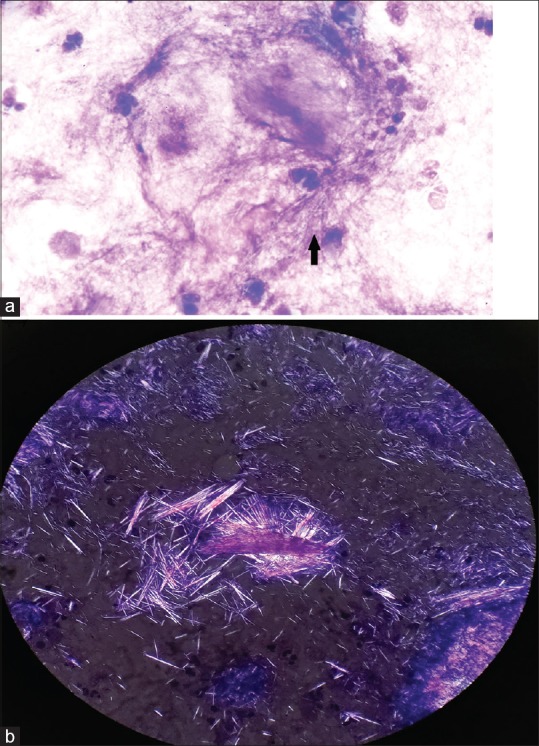
Gout is a metabolic disease that occurs either because of increased uric acid production or decreased uric acid secretion. It most commonly affects middle-aged to elderly men and postmenopausal women. Chronic tophaceous gout frequently occurs after 10 years or more of recurrent polyarticular gout. Gouty tophi are deposition of monosodium urate (MSU) crystals in and around joints as well as soft tissues. We present a case of chronic tophaceous gout in a 21-year-old male, which occurred after 4 years of onset of gouty arthritis. The patient presented with tophaceous gout in four forms, that is, periarticular subcutaneous tophi, disseminated intradermal tophi, ulcerative form, and miliarial tophi along with multiple sinuses discharging chalky white material. The case was diagnosed as chronic tophaceous gout on the basis of raised serum uric acid, imprint smear showing needle-shaped crystals and negatively birefringent crystals on polarized microscopy. The case is interesting for varied morphological forms of tophaceous gout in a patient at an early age and shorter interval between onset of gouty arthritis and tophaceous gout.
痛风是一种代谢性疾病,其发生原因要么是尿酸生成增加,要么是尿酸分泌减少。它最常影响中年至老年男性以及绝经后女性。慢性痛风石性痛风常发生在复发性多关节痛风发作10年或更长时间之后。痛风石是单钠尿酸盐(MSU)晶体在关节及其周围以及软组织中的沉积。我们报告一例21岁男性慢性痛风石性痛风病例,该病例在痛风性关节炎发病4年后出现。患者呈现出四种痛风石形式,即关节周围皮下痛风石、播散性皮内痛风石、溃疡性痛风石和粟粒状痛风石,同时伴有多个排出灰白色物质的窦道。根据血清尿酸升高、印片涂片显示针状晶体以及偏振显微镜下的负性双折射晶体,该病例被诊断为慢性痛风石性痛风。该病例很有趣,因为在一名年轻患者中出现了多种形态的痛风石性痛风,且痛风性关节炎发病与痛风石性痛风之间的间隔较短。