Ibáñez-Fonseca Arturo, Santiago Maniega Silvia, Gorbenko Del Blanco Darya, Catalán Bernardos Benedicta, Vega Castrillo Aurelio, Álvarez Barcia Ángel José, Alonso Matilde, Aguado Héctor J, Rodríguez-Cabello José Carlos
BIOFORGE (Group for Advanced Materials and Nanobiotechnology), CIBER-BBN, University of Valladolid, Valladolid, Spain.
Servicio de Traumatología, Hospital Clínico de Valladolid, Valladolid, Spain.
Front Bioeng Biotechnol. 2020 May 14;8:413. doi: 10.3389/fbioe.2020.00413. eCollection 2020.
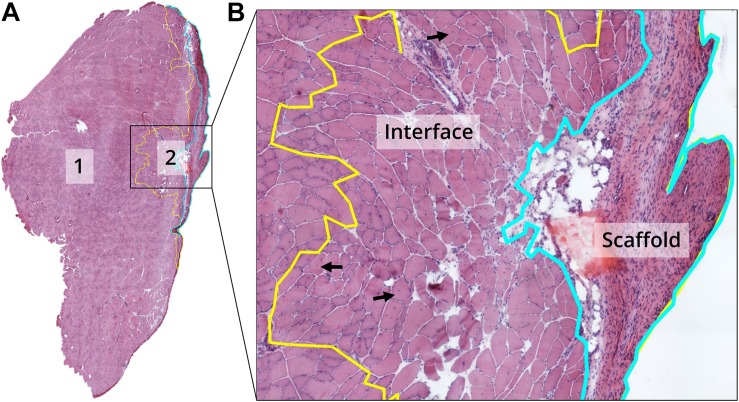
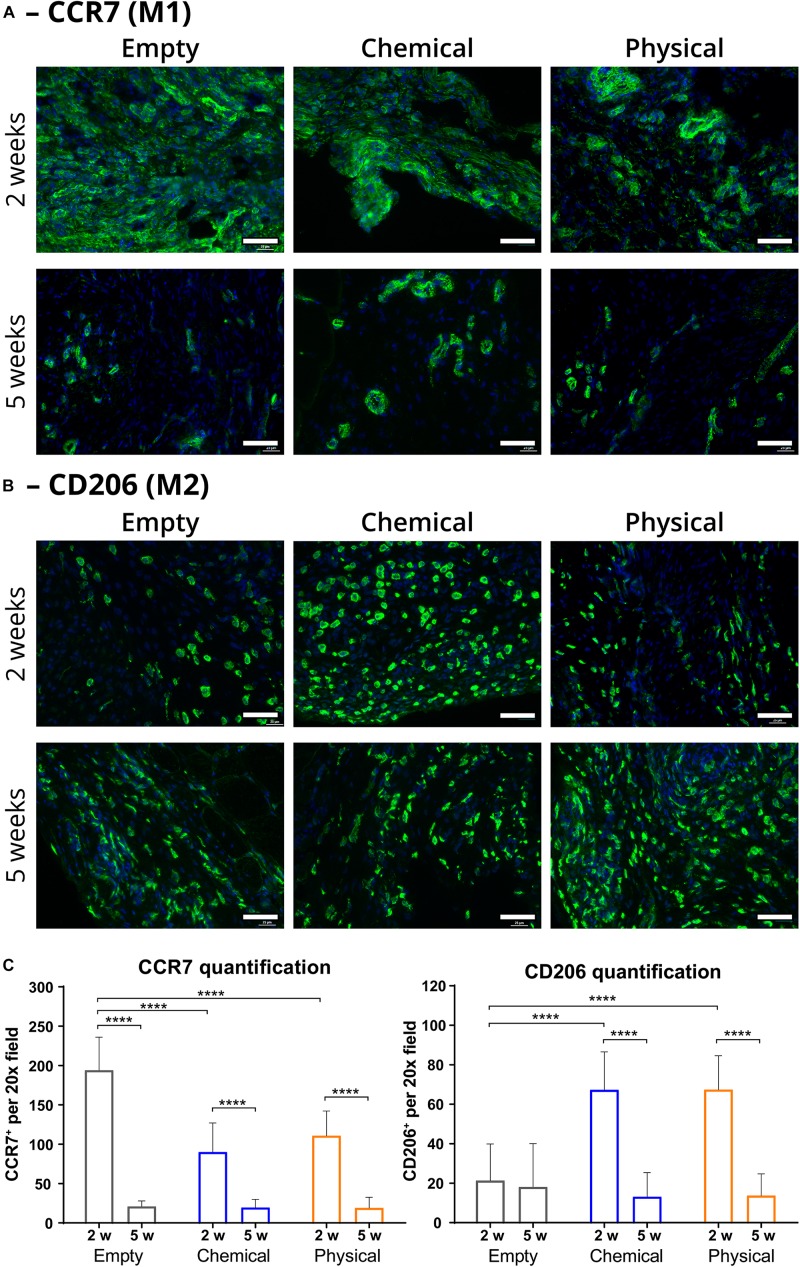
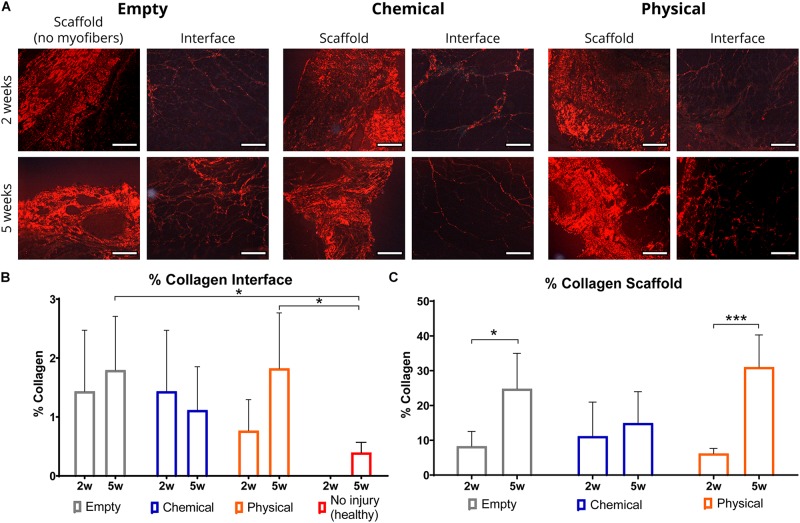
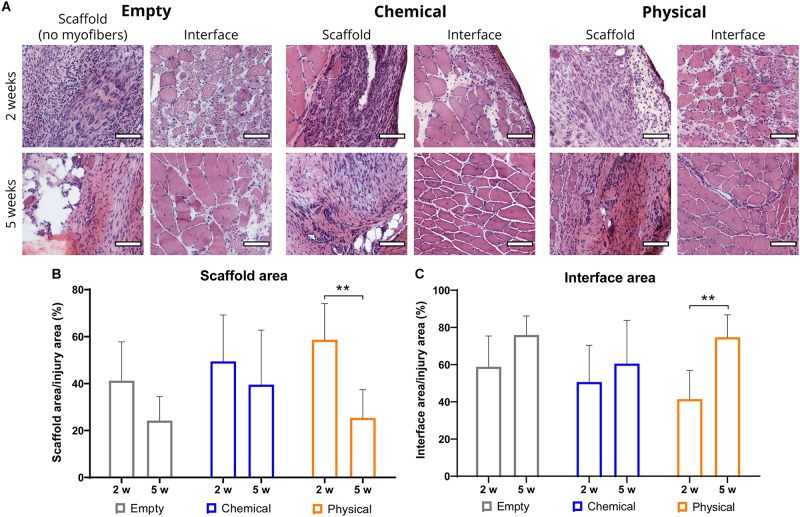
Large skeletal muscle injuries, such as a volumetric muscle loss (VML), often result in an incomplete regeneration due to the formation of a non-contractile fibrotic scar tissue. This is, in part, due to the outbreak of an inflammatory response, which is not resolved over time, meaning that type-1 macrophages (M1, pro-inflammatory) involved in the initial stages of the process are not replaced by pro-regenerative type-2 macrophages (M2). Therefore, biomaterials that promote the shift from M1 to M2 are needed to achieve optimal regeneration in VML injuries. In this work, we used elastin-like recombinamers (ELRs) as biomaterials for the formation of non- (physical) and covalently (chemical) crosslinked bioactive and biodegradable hydrogels to fill the VML created in the tibialis anterior (TA) muscles of rats. These hydrogels promoted a higher infiltration of M2 within the site of injury in comparison to the non-treated control after 2 weeks (<0.0001), indicating that the inflammatory response resolves faster in the presence of both types of ELR-based hydrogels. Moreover, there were not significant differences in the amount of collagen deposition between the samples treated with the chemical ELR hydrogel at 2 and 5 weeks, and this same result was found upon comparison of these samples with healthy tissue after 5 weeks, which implies that this treatment prevents fibrosis. The macrophage modulation also translated into the formation of myofibers that were morphologically more similar to those present in healthy muscle. Altogether, these results highlight that ELR hydrogels provide a friendly niche for infiltrating cells that biodegrades over time, leaving space to new muscle tissue. In addition, they orchestrate the shift of macrophage population toward M2, which resulted in the prevention of fibrosis in the case of the chemical hydrogel treatment and in a more healthy-like myofiber phenotype for both types of hydrogels. Further studies should focus in the assessment of the regeneration of skeletal muscle in larger animal models, where a more critical defect can be created and additional methods can be used to evaluate the functional recovery of skeletal muscle.
大型骨骼肌损伤,如大面积肌肉缺损(VML),由于形成了无收缩功能的纤维化瘢痕组织,常常导致不完全再生。部分原因是炎症反应的爆发,且这种反应不会随时间消退,这意味着参与该过程初始阶段的1型巨噬细胞(M1,促炎性)不会被促再生的2型巨噬细胞(M2)取代。因此,需要能促进从M1向M2转变的生物材料,以实现VML损伤的最佳再生。在这项研究中,我们使用类弹性蛋白重组体(ELR)作为生物材料,形成非共价(物理)和共价(化学)交联的生物活性和可生物降解水凝胶,以填充大鼠胫前肌(TA)中造成的VML缺损。与2周后未处理的对照组相比,这些水凝胶促进了损伤部位M2的更高浸润(<0.0001),表明在两种基于ELR的水凝胶存在的情况下,炎症反应消退得更快。此外,化学ELR水凝胶处理的样本在2周和5周时胶原沉积量没有显著差异,并且在5周后将这些样本与健康组织进行比较时也得到了相同的结果,这意味着这种处理可预防纤维化。巨噬细胞调节还转化为形态上与健康肌肉中更相似的肌纤维的形成。总之,这些结果突出表明,ELR水凝胶为随着时间推移会生物降解的浸润细胞提供了一个友好的微环境,为新的肌肉组织留出空间。此外,它们协调巨噬细胞群体向M2的转变,在化学水凝胶处理的情况下可预防纤维化,并且两种类型的水凝胶都能产生更接近健康的肌纤维表型。进一步的研究应侧重于评估更大动物模型中骨骼肌的再生情况,在这种模型中可以制造出更严重的缺损,并且可以使用额外的方法来评估骨骼肌的功能恢复。