Social, Genetic and Developmental Psychiatry Centre, Institute of Psychiatry, Psychology & Neuroscience, King's College London, London, United Kingdom.
Icahn School of Medicine at Mount Sinai, New York, New York, United States of America.
PLoS Med. 2020 Jun 1;17(6):e1003137. doi: 10.1371/journal.pmed.1003137. eCollection 2020 Jun.
Identifying causal risk factors for self-harm is essential to inform preventive interventions. Epidemiological studies have identified risk factors associated with self-harm, but these associations can be subject to confounding. By implementing genetically informed methods to better account for confounding, this study aimed to better identify plausible causal risk factors for self-harm.
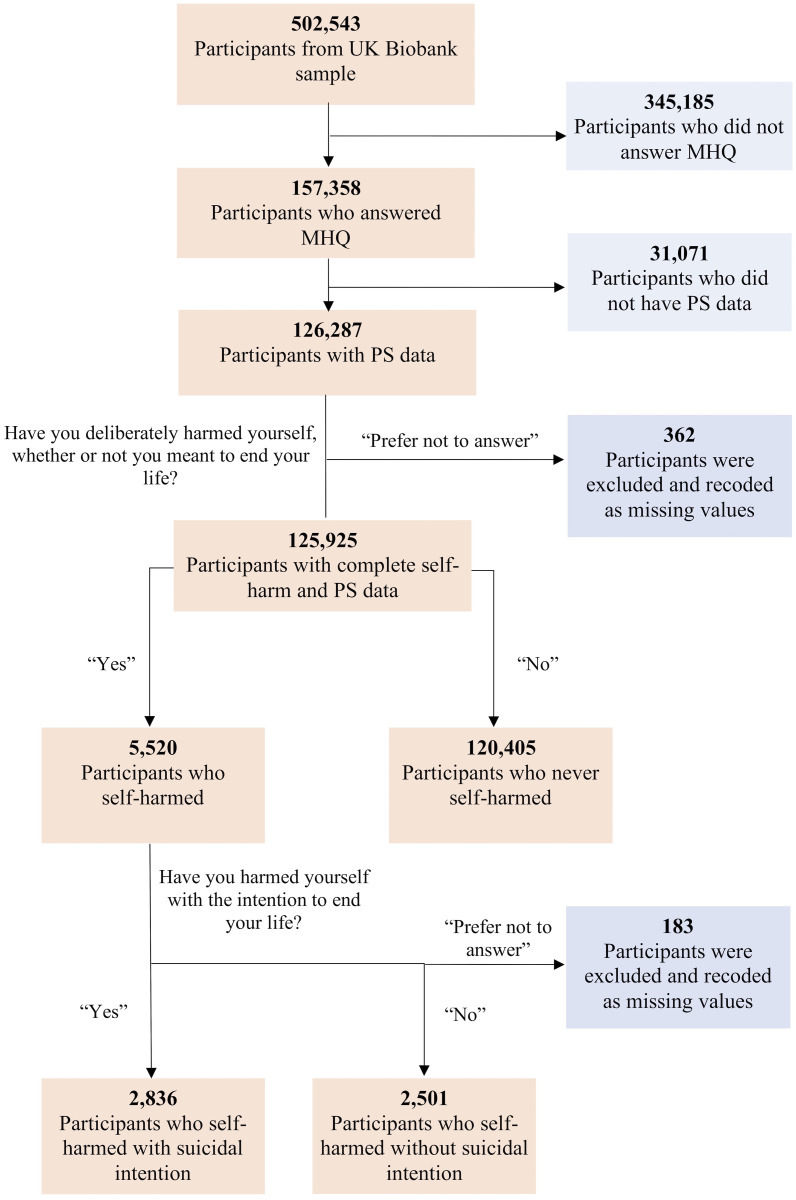
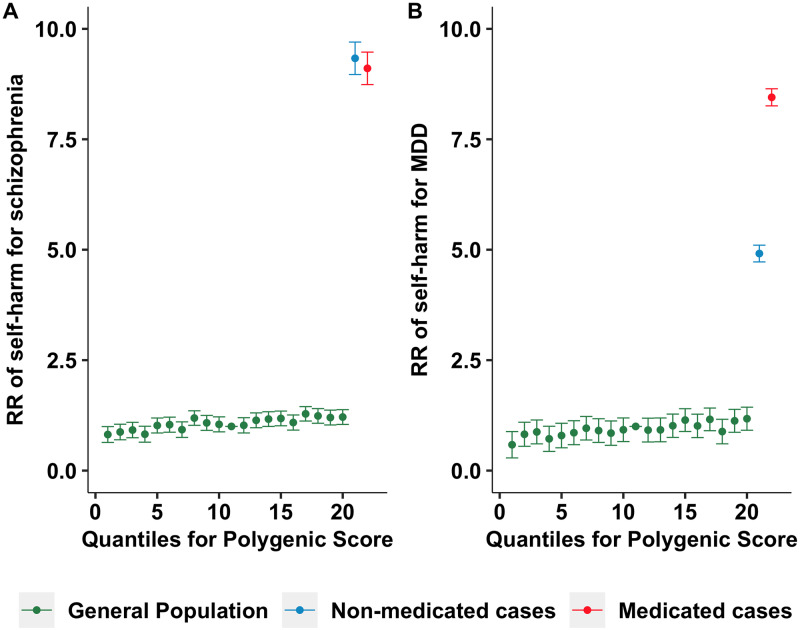
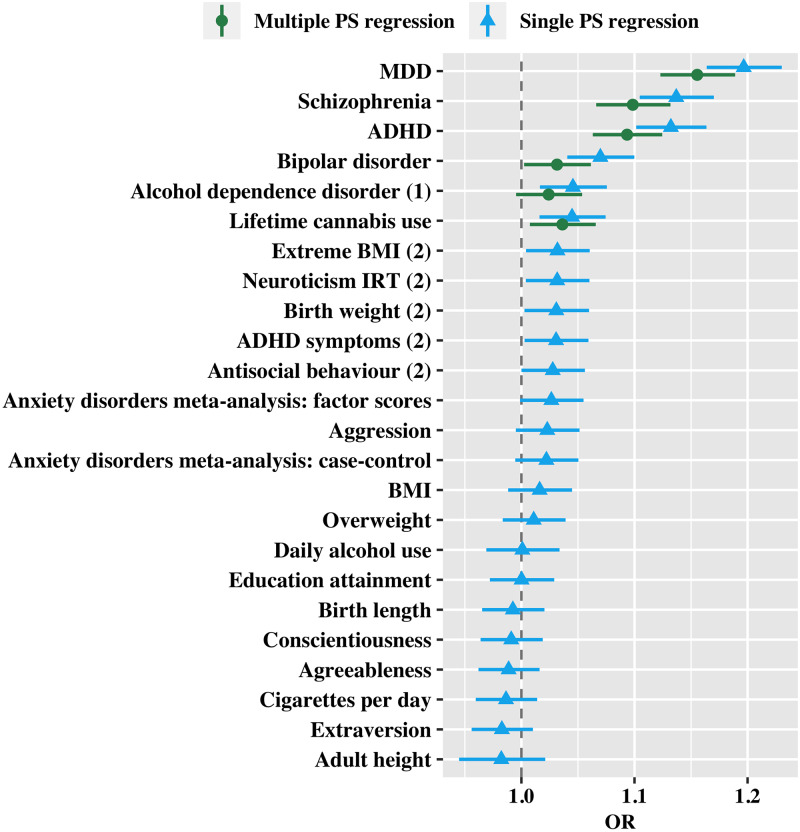
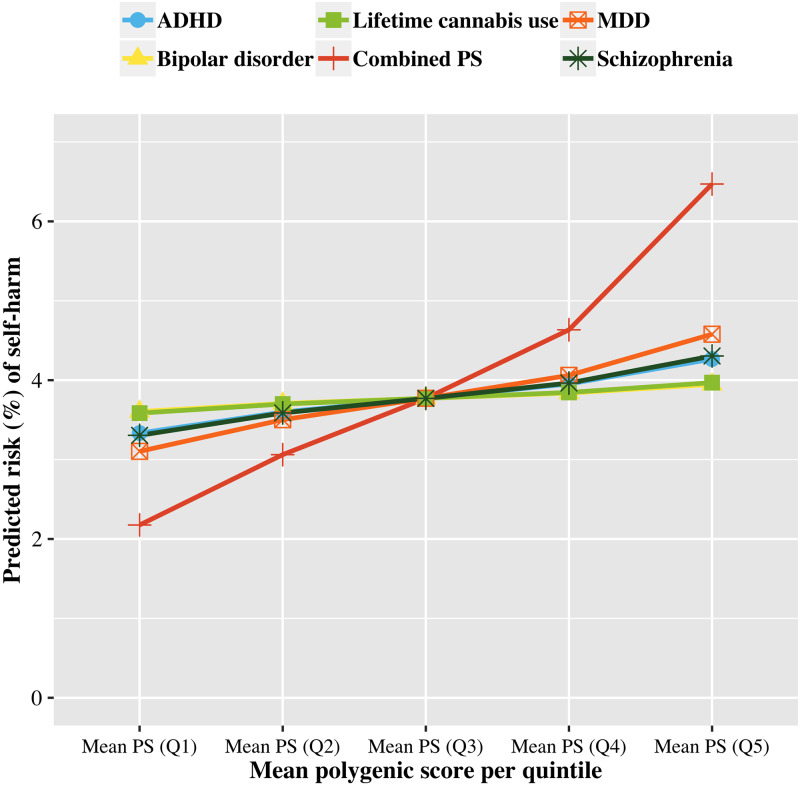
Using summary statistics from 24 genome-wide association studies (GWASs) comprising 16,067 to 322,154 individuals, polygenic scores (PSs) were generated to index 24 possible individual risk factors for self-harm (i.e., mental health vulnerabilities, substance use, cognitive traits, personality traits, and physical traits) among a subset of UK Biobank participants (N = 125,925, 56.2% female) who completed an online mental health questionnaire in the period from 13 July 2016 to 27 July 2017. In total, 5,520 (4.4%) of these participants reported having self-harmed in their lifetime. In binomial regression models, PSs indexing 6 risk factors (major depressive disorder [MDD], attention deficit/hyperactivity disorder [ADHD], bipolar disorder, schizophrenia, alcohol dependence disorder, and lifetime cannabis use) predicted self-harm, with effect sizes ranging from odds ratio (OR) = 1.05 (95% CI 1.02 to 1.07, q = 0.008) for lifetime cannabis use to OR = 1.20 (95% CI 1.16 to 1.23, q = 1.33 × 10⁻³⁵) for MDD. No systematic differences emerged between suicidal and non-suicidal self-harm. To further probe causal relationships, two-sample Mendelian randomisation (MR) analyses were conducted, with MDD, ADHD, and schizophrenia emerging as the most plausible causal risk factors for self-harm. The genetic liabilities for MDD and schizophrenia were associated with self-harm independently of diagnosis and medication. Main limitations include the lack of representativeness of the UK Biobank sample, that self-harm was self-reported, and the limited power of some of the included GWASs, potentially leading to possible type II error.
In addition to confirming the role of MDD, we demonstrate that ADHD and schizophrenia likely play a role in the aetiology of self-harm using multivariate genetic designs for causal inference. Among the many individual risk factors we simultaneously considered, our findings suggest that systematic detection and treatment of core psychiatric symptoms, including psychotic and impulsivity symptoms, may be beneficial among people at risk for self-harm.
确定自我伤害的因果风险因素对于信息预防干预至关重要。 流行病学研究已经确定了与自我伤害相关的风险因素,但这些关联可能受到混杂因素的影响。 通过实施遗传信息方法更好地解释混杂因素,本研究旨在更好地确定自我伤害的合理因果风险因素。
利用包含 16067 至 322154 个人的 24 项全基因组关联研究(GWAS)的汇总统计数据,在英国生物库(UK Biobank)参与者的一部分(N = 125925,56.2%为女性)中生成了索引 24 个可能的个体自我伤害风险因素的多基因评分(PS),他们在 2016 年 7 月 13 日至 2017 年 7 月 27 日期间完成了在线心理健康问卷。在这些参与者中,共有 5520 人(4.4%)报告在其一生中曾有过自我伤害行为。在二项式回归模型中,索引 6 个风险因素(重度抑郁症[MDD]、注意力缺陷/多动障碍[ADHD]、双相情感障碍、精神分裂症、酒精依赖障碍和终生大麻使用)的 PS 预测了自我伤害,其效果大小范围从终生大麻使用的比值比(OR)= 1.05(95%CI 1.02 至 1.07,q = 0.008)到 MDD 的 OR = 1.20(95%CI 1.16 至 1.23,q = 1.33×10⁻³⁵)。自杀性和非自杀性自伤之间没有出现系统性差异。为了进一步探究因果关系,进行了两样本 Mendelian 随机化(MR)分析,结果显示 MDD、ADHD 和精神分裂症是自我伤害的最合理的因果风险因素。MDD 和精神分裂症的遗传易感性与自我伤害有关,独立于诊断和药物治疗。主要限制包括英国生物库样本代表性不足、自我伤害是自我报告的,以及一些包含的 GWAS 功率有限,这可能导致可能的 II 型错误。
除了证实 MDD 的作用外,我们还使用多变量遗传设计进行因果推理,证明了 ADHD 和精神分裂症可能在自我伤害的发病机制中发挥作用。在我们同时考虑的许多个体风险因素中,我们的研究结果表明,在有自我伤害风险的人群中,系统地检测和治疗核心精神症状,包括精神病和冲动症状,可能是有益的。