Zhang Qiongshuai, Wang Yufeng, Ji Guangcheng, Cao Fang, Hu Guanyu, Cong Deyu, Xu Xiaohong, Song Bailin
Department of Acupuncture and Tuina, Changchun University of Chinese Medicine.
Department of Tuina, Traditional Chinese Medicine Hospital of Jilin Province.
Medicine (Baltimore). 2020 May 22;99(21):e20368. doi: 10.1097/MD.0000000000020368.
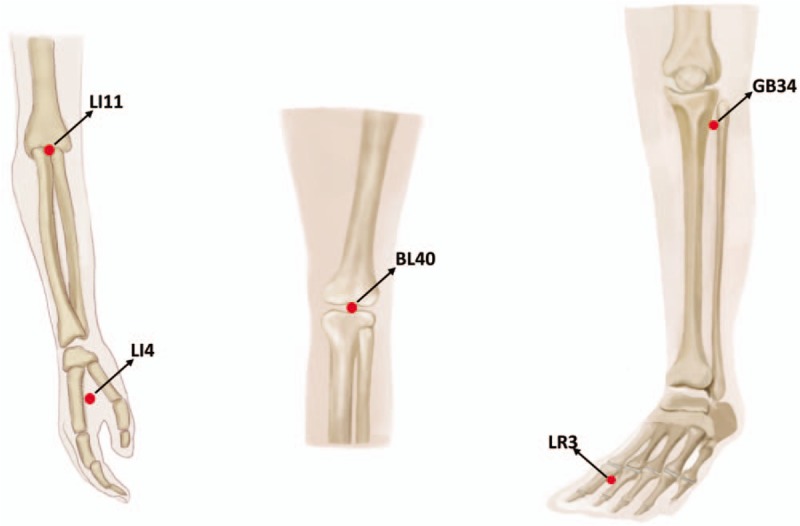
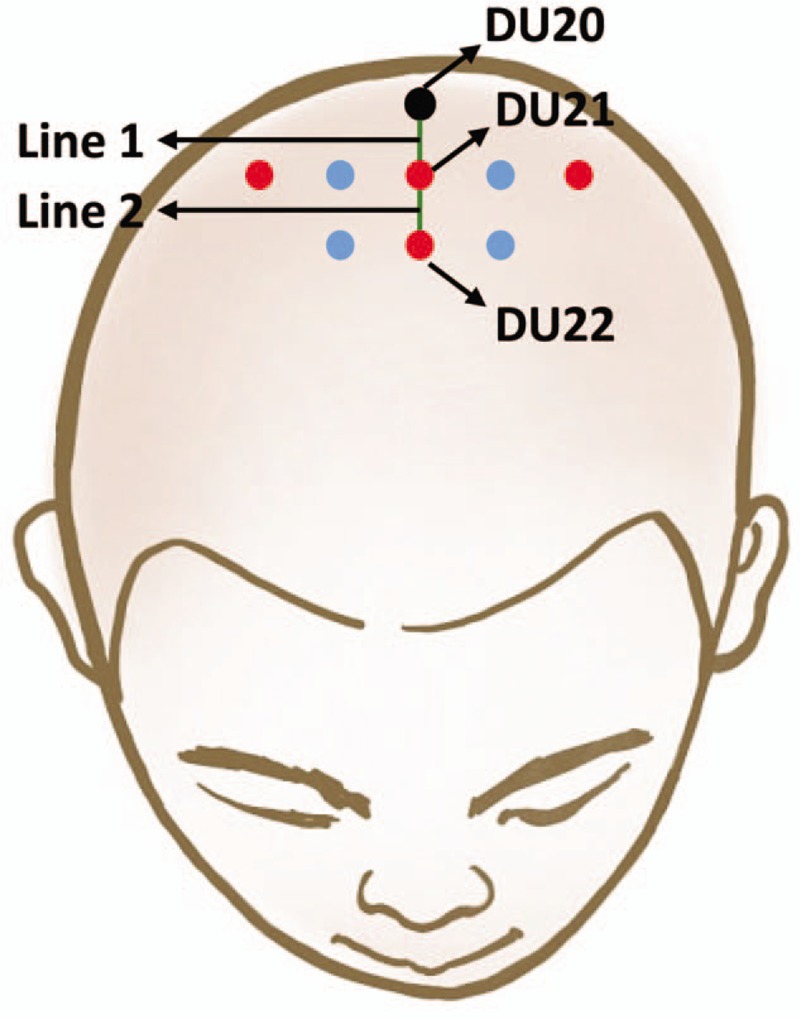
Tong Jing Tiao Xing tuina (TJTX) is a Chinese massage method. Excising with scalp acupuncture (ESA) is a treatment combining scalp electroacupuncture with physical therapy (PT), and yinao fujian formula (YNFJ) is a Chinese oral herbal granule medicine. The combination of the 3 methods is called the "Zhishen Tiaoxing" (ZSTX) rehabilitation program, which is used as an alternative of limb spasm after stroke. There is little available evidence demonstrating its safety and efficacy.
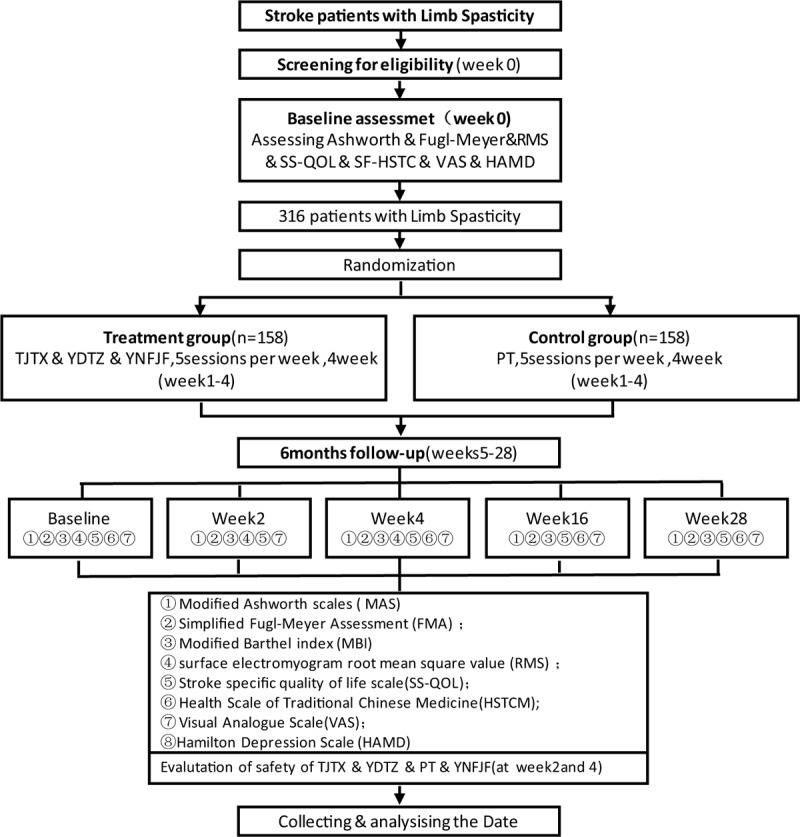
This will be a subject-blind, randomized controlled trial conducted in 3 medical centers. It will strictly follow the Standards for Reporting Interventions in Clinical Trials of Acupuncture, 2010. We will recruit 316 patients with limb spasm after stroke, 200 from the Affiliated Hospital of Changchun University of Chinese Medicine, Changchun, China, 80 from the Second Affiliated Hospital of Heilongjiang University of Chinese medicine, Harbin, China, and 36 from Huashan Hospital of Fudan University, Shanghai, China. A block randomization sequence stratified by centers will be generated using SAS Version 9.2 software (SAS Institute, Cary, NC, USA), which was performed at the Guangdong Provincial Hospital of Chinese Medicine's Key Unit of Methodology in Clinical Research. The treatment group is treated with TJTX (once a day), ESA (once a day), and oral YNFJ (twice a day). The control group will be treated with PT. Two groups of patients will be treated 5 sessions a week for 4 weeks, and there will be 6-month follow-up. The outcome evaluators will be blinded to patient grouping. The primary outcome will be modified Ashworth scales. The secondary outcome indexes will be the simplified Fugl-Meyer assessment scale, surface electromyogram root mean square value, modified Barthel index, stroke-specific quality of life scale, health scale of traditional Chinese medicine, visual analogue scale (VAS), and the Hamilton depression scale.
The Randomized Controlled Trial (RCT) mainly aim to evaluate the effectiveness and safety of traditional Chinese medicine rehabilitation program, by comparing the treatment of ZSTX with the PT for the treatment of limb spasm after stroke.
Chinese Clinical Trial Registry: ChiCTR 1900024255. Registered on July 3, 2019.
通经调行推拿是一种中医按摩方法。头皮针穴位埋线是一种将头皮电针与物理治疗相结合的疗法,而益脑复健方是一种中药口服颗粒剂。这三种方法的联合应用被称为“治神调行”康复方案,用于中风后肢体痉挛的替代治疗。目前几乎没有证据证明其安全性和有效性。
这将是一项在3个医疗中心进行的受试者盲法随机对照试验。它将严格遵循《针刺临床试验报告规范(2010年版)》。我们将招募316例中风后肢体痉挛患者,其中200例来自长春中医药大学附属医院,80例来自黑龙江中医药大学附属第二医院,36例来自上海复旦大学附属华山医院。将使用SAS 9.2版软件(美国北卡罗来纳州卡里市SAS研究所)生成按中心分层的区组随机序列,该软件由广东省中医院临床研究方法学重点单位执行。治疗组采用通经调行推拿(每日1次)、头皮针穴位埋线(每日1次)和口服益脑复健方(每日2次)治疗。对照组采用物理治疗。两组患者每周治疗5次,共治疗4周,并进行6个月的随访。结果评估者将对患者分组情况不知情。主要结局指标为改良Ashworth量表。次要结局指标将包括简化Fugl-Meyer评估量表、表面肌电图均方根值、改良Barthel指数、中风特异性生活质量量表、中医健康量表、视觉模拟量表(VAS)和汉密尔顿抑郁量表。
本随机对照试验主要目的是通过比较“治神调行”方案与物理治疗对中风后肢体痉挛的治疗效果,评估中医康复方案的有效性和安全性。
中国临床试验注册中心:ChiCTR 1900024255。于2019年7月3日注册。