Department of Neurology, The Affiliated Hospital of Guizhou Medical University, Guizhou, 550004, China.
Department of Neurology, The First Affiliated Hospital of Chongqing Medical University, Chongqing, 400016, China.
Mol Med. 2021 Apr 9;27(1):37. doi: 10.1186/s10020-021-00297-0.
Ovarian tumour domain deubiquitinase with linear linkage specificity (OTULIN) is a potent negative regulator of the nuclear factor-κB (NF-κB) signalling pathway, and it plays a strong neuroprotective role following acute ischemic stroke. Electroacupuncture (EA) is an effective adjuvant treatment for reducing brain injury and neuroinflammation via the inhibition of NF-κB p65 nuclear translocation, but the underlying mechanism is not clear. The present study investigated whether OTULIN was necessary for EA to mitigate brain injury and glial cell activation in a transient middle cerebral artery occlusion (tMCAO) model in rats.
An acute ischaemic stroke model was established via tMCAO surgery in Sprague-Dawley (SD) rats. EA was performed once daily at "Baihui (GV 20)", "Hegu (LI 4)", and "Taichong (LR 3)" acupoints. The effect of EA on the spatiotemporal expression of OTULIN in the ischaemic penumbra of the cerebral cortex was detected within 7 days after reperfusion. The effects of OTULIN gene silencing on EA neurological deficits, cerebral infarct volume, neuronal damage, the activation of microglia and astrocytes, the contents of tumour necrosis factor alpha (TNF-α), interleukin-1 beta (IL-1β) and interleukin-6 (IL-6), and the expression of p-IκBa, IκBa and nucleus/cytoplasm NF-κB p65 protein were assessed.
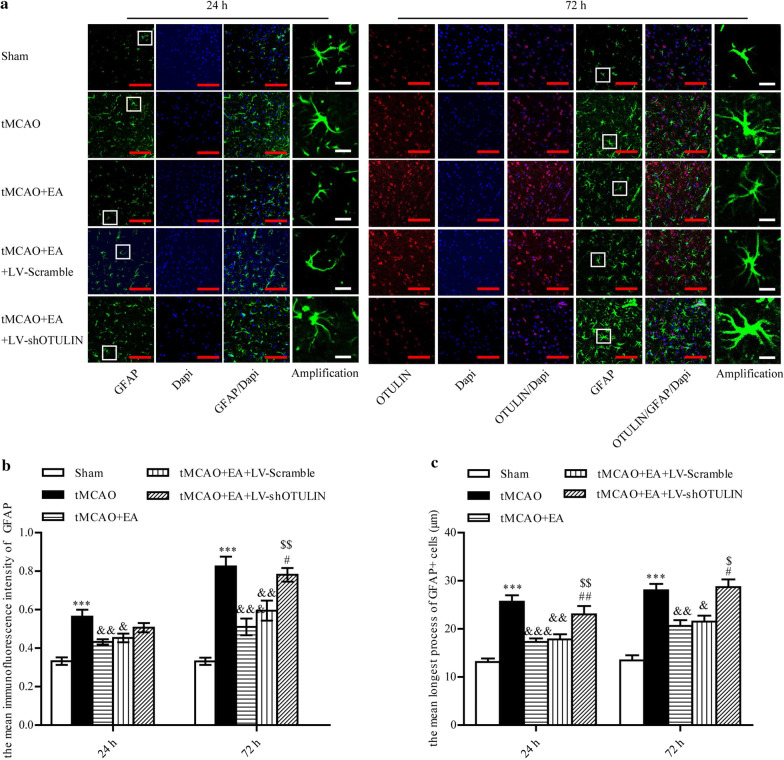
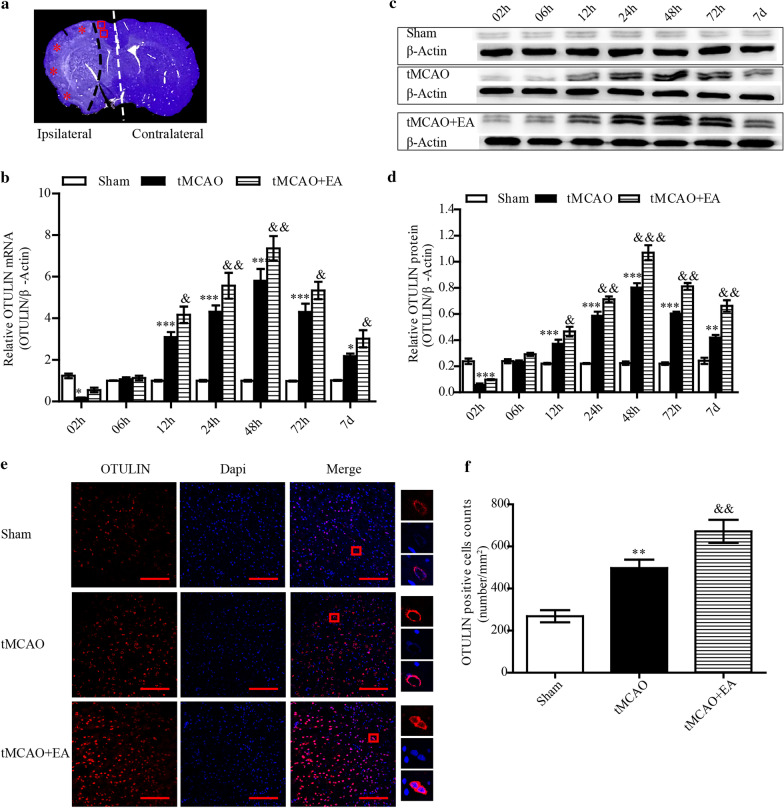
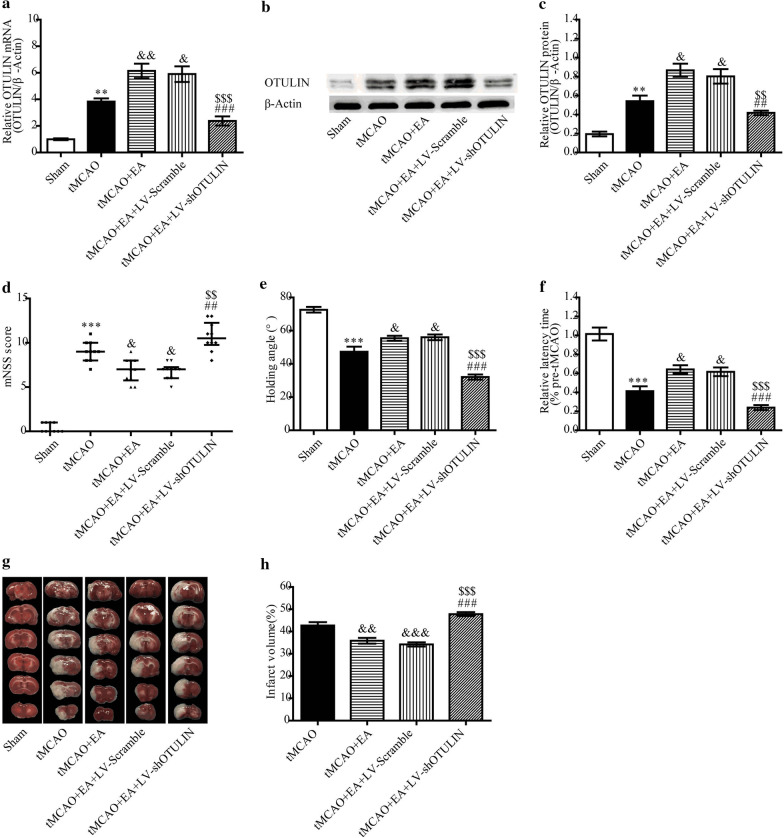
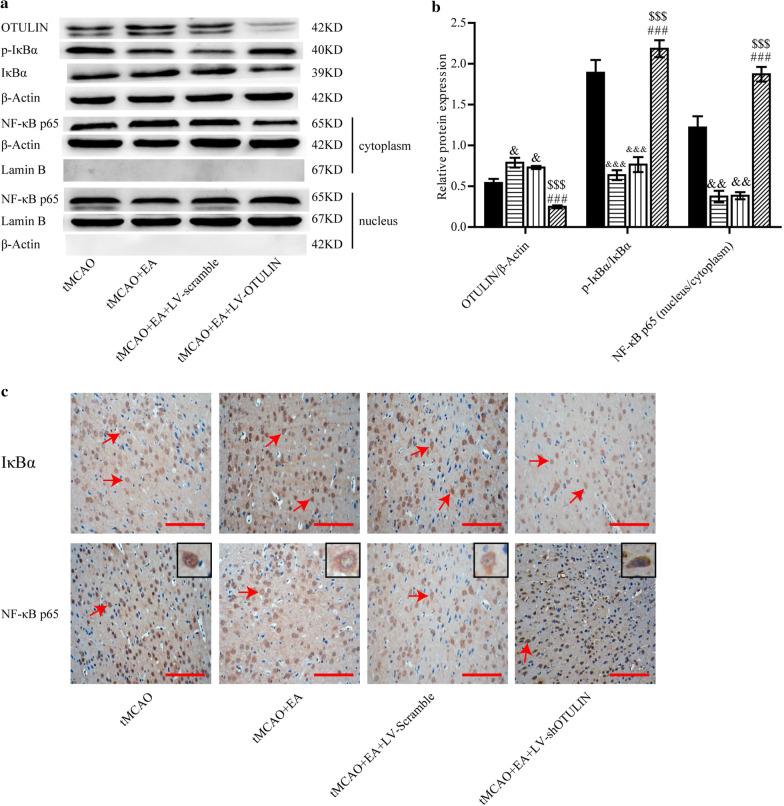
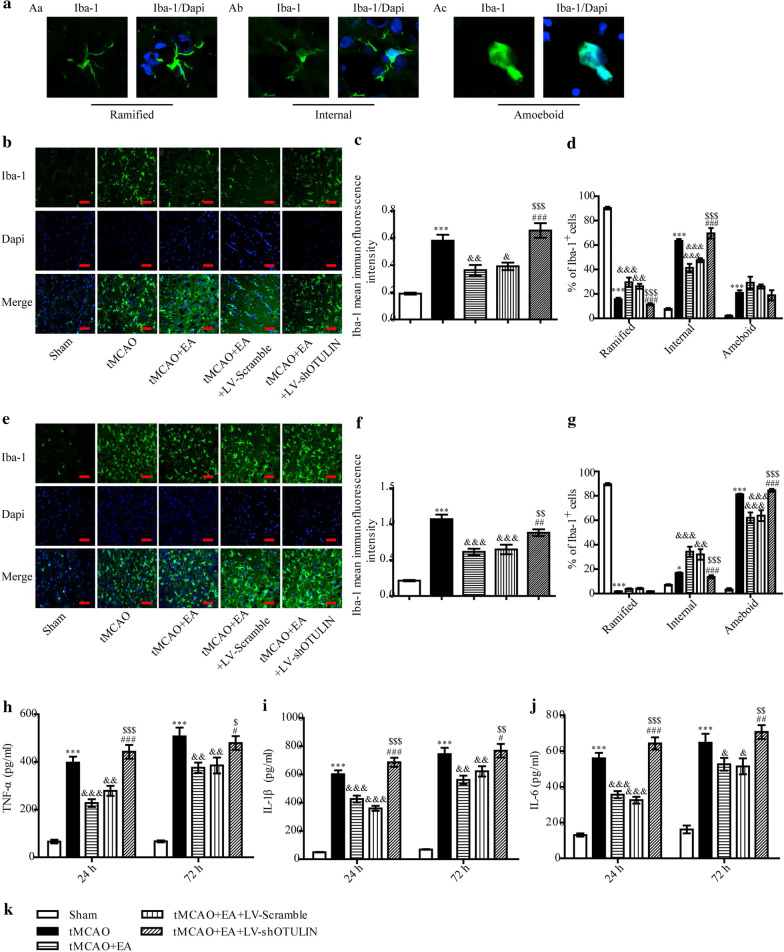
EA treatment increased endogenous OTULIN expression, which peaked at 48 h. Enhanced OTULIN was primarily located in neurons, but a small amount of OTULIN was detected in microglia. OTULIN silencing obviously reversed EA neuroprotection, which was demonstrated by worsened neurobehavioural performance, cerebral infarct volume and neuronal injury. The inhibitory effect of EA on the NF-κB pathway was also attenuated by enhanced IκBα phosphorylation and NF-κB p65 nuclear translocation. EA partially inhibited the transformation of microglia and astrocytes from resting states to activated states and reduced the secretion of TNF-α, IL-1β and IL-6. However, these preventive effects were reversed after the silencing of OTULIN expression.
OTULIN provides a new potential therapeutic target for EA to alleviate acute ischaemic stroke-induced brain injury and the activation of glial cells, which are related to suppression of the NF-κB signalling pathway.
卵巢肿瘤结构域去泛素化酶与线性连接特异性(OTULIN)是核因子-κB(NF-κB)信号通路的有效负调控因子,在急性缺血性脑卒中后具有强烈的神经保护作用。电针(EA)是一种有效的辅助治疗方法,可通过抑制 NF-κB p65 核易位来减轻脑损伤和神经炎症,但具体机制尚不清楚。本研究探讨了 OTULIN 是否是 EA 减轻大鼠短暂性大脑中动脉闭塞(tMCAO)模型中脑损伤和神经胶质细胞激活所必需的。
通过 tMCAO 手术在 Sprague-Dawley(SD)大鼠中建立急性缺血性脑卒中模型。EA 每天在“百会(GV 20)”、“合谷(LI 4)”和“太冲(LR 3)”穴位进行一次。检测再灌注后 7 天内缺血半影区 OTULIN 的时空表达。检测 OTULIN 基因沉默对 EA 神经功能缺损、脑梗死体积、神经元损伤、小胶质细胞和星形胶质细胞激活、肿瘤坏死因子-α(TNF-α)、白细胞介素-1β(IL-1β)和白细胞介素-6(IL-6)含量以及 p-IκBa、IκBa 和核/细胞质 NF-κB p65 蛋白表达的影响。
EA 治疗增加了内源性 OTULIN 的表达,在 48 h 时达到峰值。增强的 OTULIN 主要位于神经元中,但在小胶质细胞中也检测到少量 OTULIN。OTULIN 沉默明显逆转了 EA 的神经保护作用,表现为神经行为学表现恶化、脑梗死体积和神经元损伤。EA 对 NF-κB 通路的抑制作用也被增强的 IκBα磷酸化和 NF-κB p65 核易位所减弱。EA 部分抑制了静息状态向激活状态转化的小胶质细胞和星形胶质细胞,并减少了 TNF-α、IL-1β 和 IL-6 的分泌。然而,在 OTULIN 表达沉默后,这些预防作用被逆转。
OTULIN 为 EA 减轻急性缺血性脑卒中引起的脑损伤和神经胶质细胞激活提供了一个新的潜在治疗靶点,这与抑制 NF-κB 信号通路有关。