Ban Ju Yeon, Park Hyun Kyung, Kim Su Kang
Department of Dental Pharmacology, College of Dentistry, Dankook University, Cheonan, Korea.
Department of Emergency Medicine, Seoul Medical Center, Seoul, Korea.
Int Neurourol J. 2020 May;24(Suppl 1):S48-55. doi: 10.5213/inj.2040154.077. Epub 2020 May 31.
Cognitive impairment is one of the main symptoms of Alzheimer disease and other dementias. Glycyrrhiza uralensis is a natural product that has a protective effect against cognitive impairment. In this study, we investigated whether glycyrrhizic acid, among the main bioactive components of Glycyrrhiza uralensis, has a neuroprotective effect on scopolamine-induced cognitive impairment.
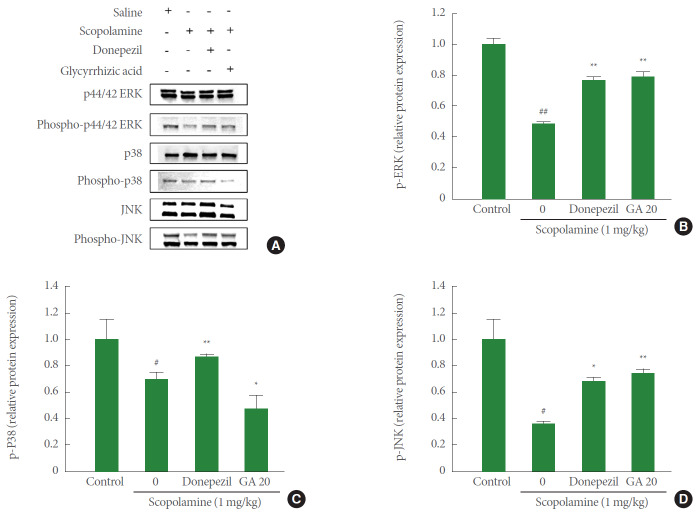
Twenty-week-old male Institute of Cancer Research mice were used in this study. The scopolamine-induced cognitive impairment mice model was used. Glycyrrhizic acid was orally administered to mice once daily for 21 days, while scopolamine (1 mg/kg) treatment was delivered 30 minutes before behavioral tests. Donepezil (2 mg/kg) was used as a positive drug control. To evaluate the effect of glycyrrhizic acid, the following assessments were performed on hippocampal tissue: Y-maze test, acetylcholinesterase activity, antioxidant enzymes' activity (superoxide dismutase, catalase). Western blotting for phosphor-extracellular signal-regulated kinase, P38, and c-Jun NH2-terminal kinase was conducted.
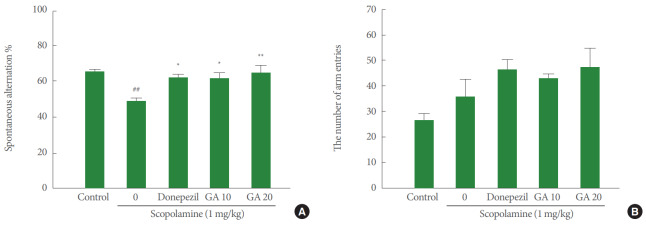
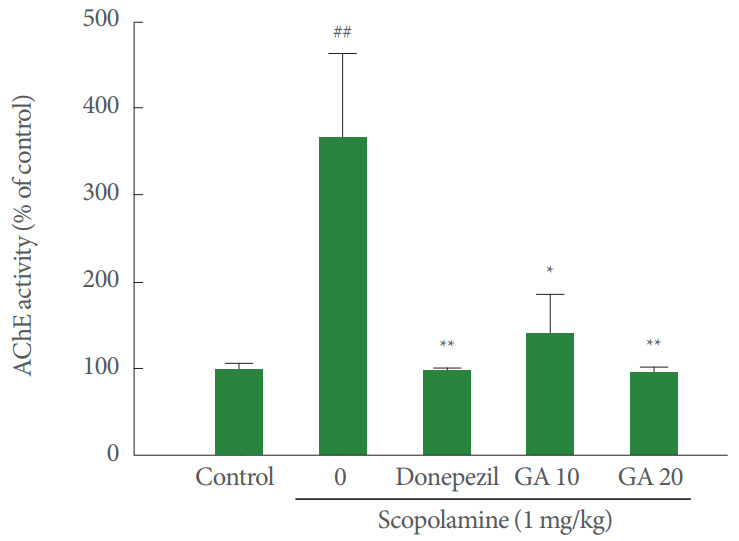
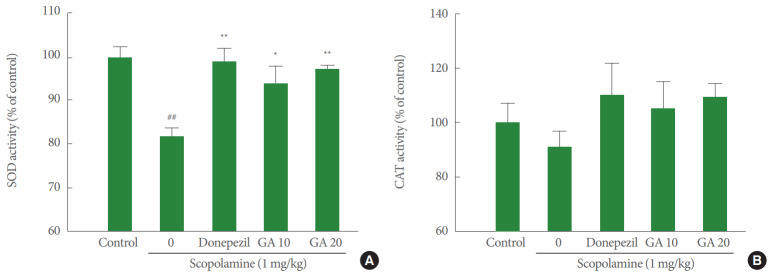
We found that glycyrrhizic acid administration significantly improved scopolamine-induced cognitive impairment in the Y-maze test. The acetylcholinesterase activity, superoxide dismutase, and catalase activity in the glycyrrhizic acid-treated group showed a significant reversal of cognitive impairment compared with the scopolamine-treated group.
Our results suggest that glycyrrhizic acid has a neuroprotective effect on cognitive function in scopolamine-induced cognitive impairment.
认知障碍是阿尔茨海默病和其他痴呆症的主要症状之一。甘草是一种对认知障碍具有保护作用的天然产物。在本研究中,我们调查了甘草的主要生物活性成分之一甘草酸对东莨菪碱诱导的认知障碍是否具有神经保护作用。
本研究使用20周龄雄性癌症研究所小鼠。采用东莨菪碱诱导的认知障碍小鼠模型。甘草酸每日口服给药小鼠一次,持续21天,而在行为测试前30分钟给予东莨菪碱(1mg/kg)治疗。多奈哌齐(2mg/kg)用作阳性药物对照。为了评估甘草酸的作用,对海马组织进行了以下评估:Y迷宫试验、乙酰胆碱酯酶活性、抗氧化酶活性(超氧化物歧化酶、过氧化氢酶)。进行了磷酸化细胞外信号调节激酶、P38和c-Jun氨基末端激酶的蛋白质免疫印迹分析。
我们发现,在Y迷宫试验中,给予甘草酸可显著改善东莨菪碱诱导的认知障碍。与东莨菪碱治疗组相比,甘草酸治疗组的乙酰胆碱酯酶活性、超氧化物歧化酶和过氧化氢酶活性显示出认知障碍的显著逆转。
我们的结果表明,甘草酸对东莨菪碱诱导的认知障碍中的认知功能具有神经保护作用。