School of Earth and Environmental Sciences, University of St Andrews, St Andrews KY16 9AL, Scotland, United Kingdom;
School of Earth and Environmental Sciences, University of St Andrews, St Andrews KY16 9AL, Scotland, United Kingdom.
Proc Natl Acad Sci U S A. 2020 Jun 16;117(24):13314-13320. doi: 10.1073/pnas.2003090117. Epub 2020 Jun 1.
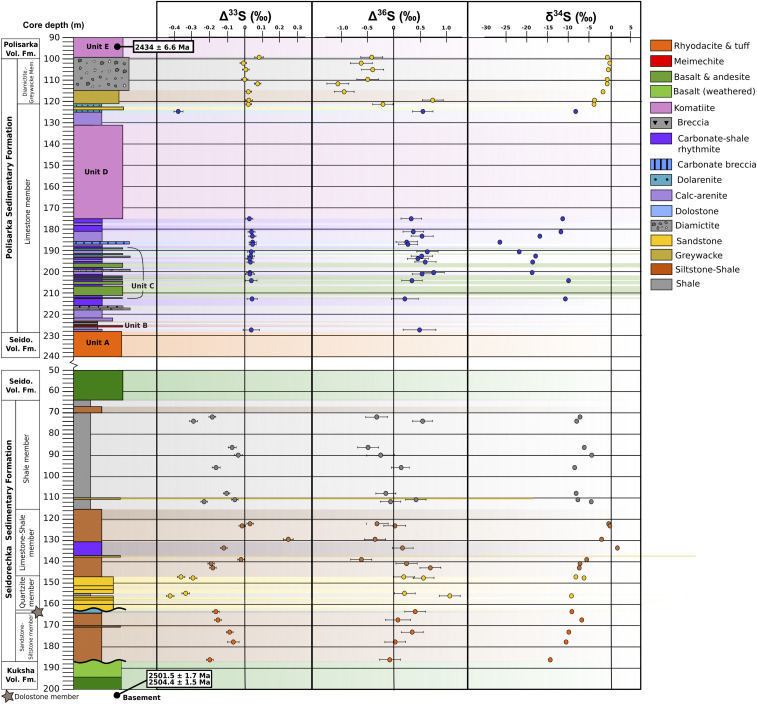
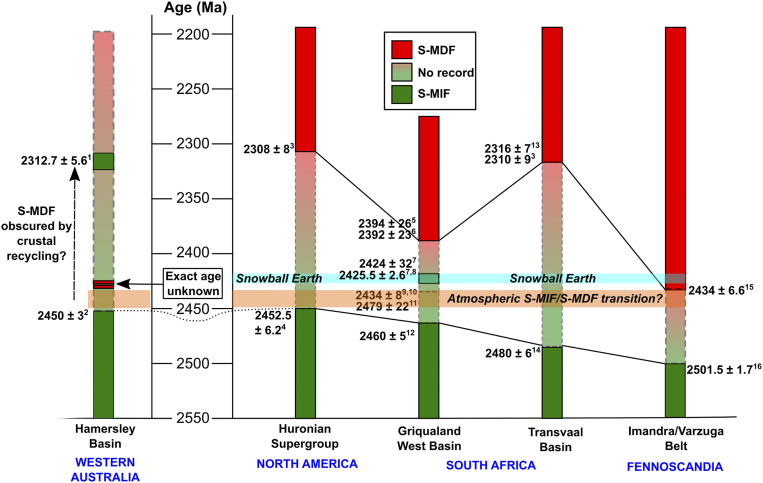
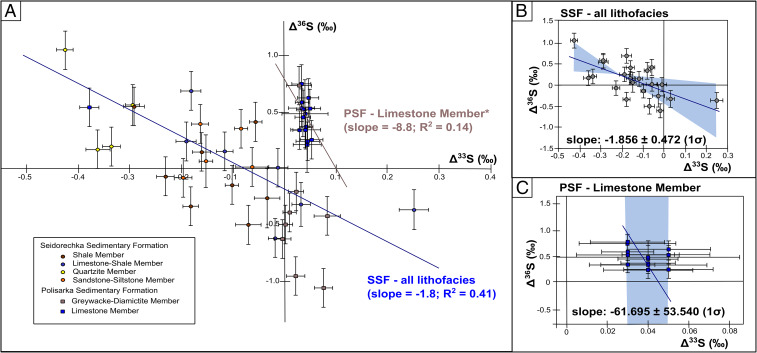
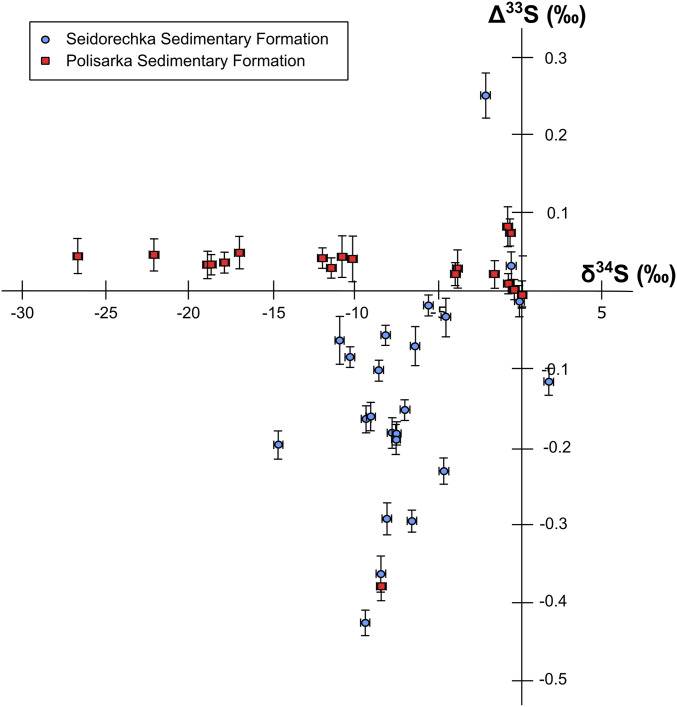
The inability to resolve the exact temporal relationship between two pivotal events in Earth history, the Paleoproterozoic Great Oxidation Event (GOE) and the first "snowball Earth" global glaciation, has precluded assessing causality between changing atmospheric composition and ancient climate change. Here we present temporally resolved quadruple sulfur isotope measurements (δS, ∆S, and ∆S) from the Paleoproterozoic Seidorechka and Polisarka Sedimentary Formations on the Fennoscandian Shield, northwest Russia, that address this issue. Sulfides in the former preserve evidence of mass-independent fractionation of sulfur isotopes (S-MIF) falling within uncertainty of the Archean reference array with a ∆S/∆S slope of -1.8 and have small negative ∆S values, whereas in the latter mass-dependent fractionation of sulfur isotopes (S-MDF) is evident, with a ∆S/∆S slope of -8.8. These trends, combined with geochronological constraints, place the S-MIF/S-MDF transition, the key indicator of the GOE, between 2,501.5 ± 1.7 Ma and 2,434 ± 6.6 Ma. These are the tightest temporal and stratigraphic constraints yet for the S-MIF/S-MDF transition and show that its timing in Fennoscandia is consistent with the S-MIF/S-MDF transition in North America and South Africa. Further, the glacigenic part of the Polisarka Formation occurs 60 m above the sedimentary succession containing S-MDF signals. Hence, our findings confirm unambiguously that the S-MIF/S-MDF transition preceded the Paleoproterozoic snowball Earth. Resolution of this temporal relationship constrains cause-and-effect drivers of Earth's oxygenation, specifically ruling out conceptual models in which global glaciation precedes or causes the evolution of oxygenic photosynthesis.
无法确定地球历史上两个关键事件——古元古代大氧化事件(GOE)和第一次“雪球地球”全球冰川作用——的确切时间关系,这使得评估大气成分变化与古代气候变化之间的因果关系变得困难。在这里,我们提出了来自俄罗斯西北部芬诺斯堪的亚盾上的 Paleoproterozoic Seidorechka 和 Polisarka 沉积地层的时间分辨的四重硫同位素测量(δS、∆S 和 ∆S),这些测量解决了这个问题。前者的硫化物保留了硫同位素(S-MIF)的质量独立分馏的证据,其落在太古宙参考数组的不确定性范围内,∆S/∆S 斜率为-1.8,并且具有较小的负 ∆S 值,而后者则存在明显的硫同位素质量依赖分馏(S-MDF),∆S/∆S 斜率为-8.8。这些趋势,加上地质年代学的限制,将 GOE 的关键指标 S-MIF/S-MDF 转换,定位在 2,501.5±1.7Ma 和 2,434±6.6Ma 之间。这是迄今为止对 S-MIF/S-MDF 转换最严格的时间和地层限制,表明其在芬诺斯堪的亚的时间与北美和南非的 S-MIF/S-MDF 转换一致。此外,Polisarka 地层的冰川成因部分位于含有 S-MDF 信号的沉积序列之上 60m。因此,我们的发现明确证实了 S-MIF/S-MDF 转换先于古元古代雪球地球。这种时间关系的解决限制了地球氧化的因果驱动因素,特别是排除了全球冰川作用先于或导致产氧光合作用演变的概念模型。