Radboud University Medical Centre, Donders Institute for Brain, Cognition and Behaviour, Cognitive Neuroscience Department, Nijmegen, The Netherlands.
Royal Dutch Visio, Nijmegen, The Netherlands.
Sci Rep. 2020 Jun 1;10(1):8873. doi: 10.1038/s41598-020-65789-1.
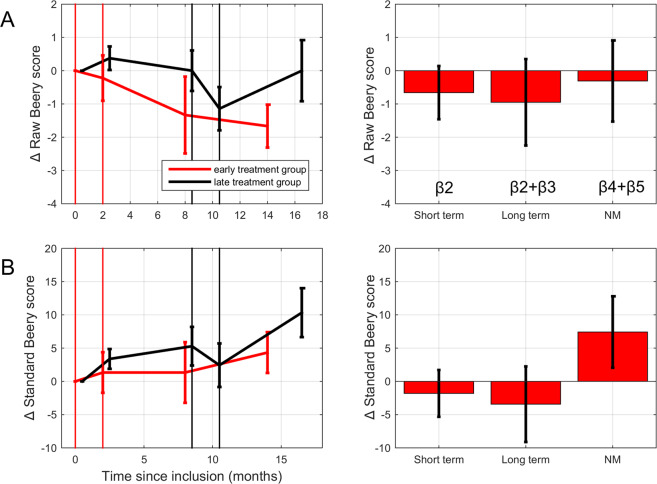
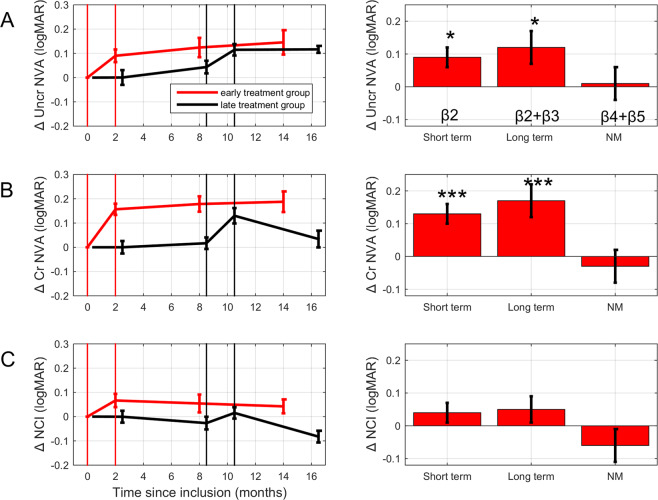
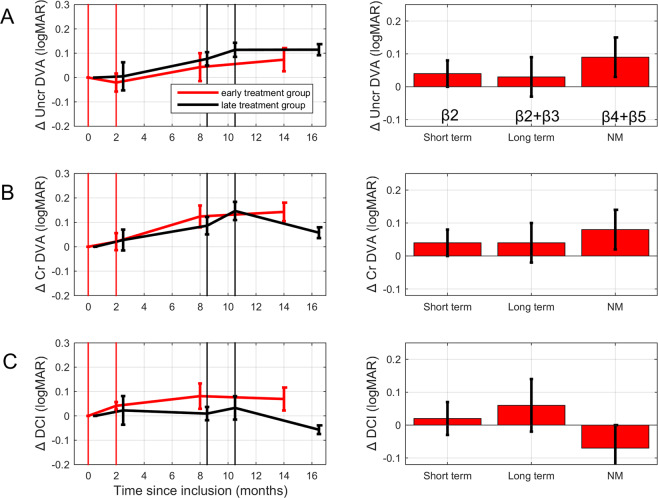
There is evidence that a pen-and-paper training based on perceptual learning principles improves near visual acuity in young children with visual impairment. The aim of the present study is to measure specificity and retention of its training effects during one year. Sixteen visually impaired children aged 4-8 years were divided in two age- and acuity-matched groups: an early (n = 9) and late treatment group (n = 7). Training consisted of 12 sessions (2× per week for 6 weeks). Studied variables were uncrowded and crowded binocular near visual acuity (40 cm), distance visual acuity (3.0 m) and fine motor skills (Beery VMI, subtest Motor Control). In the early treatment group, we measured at 0 months (pre-training), at 2 months (post-training), at 8 months (6 months post-training) and at 14 months (12 months post-training) since inclusion. In the late treatment group, three pre-training measurements were performed at 0, 2 and 8 months, and two measurements at 0 and 6 months post-training. In the short term, training improved uncrowded and crowded near visual acuity at 0.4 m by 0.13 ± 0.03 and 0.09 ± 0.03 logMAR, respectively (mean ± SEM). Training did not affect distance acuities or Beery scores. Learning effects on uncrowded and crowded near visual acuities remained intact 6-12 months after training. We conclude that the pen-and-paper training specifically improves near visual acuities but does not transfer to distance acuities or fine motor skills. Improvements in near visual acuity are retained over time, bolstering its clinical value.
有证据表明,基于感知学习原理的纸笔训练可以提高视力受损的幼儿的近视力。本研究的目的是测量其训练效果在一年中的特异性和保持性。将 16 名 4-8 岁的视力受损儿童分为两个年龄和视力匹配的组:早期(n=9)和晚期治疗组(n=7)。训练包括 12 个疗程(每周 2 次,共 6 周)。研究变量为不拥挤和拥挤的双眼近视力(40cm)、远视力(3.0m)和精细运动技能(Beery VMI,运动控制子测验)。在早期治疗组中,我们在 0 个月(训练前)、2 个月(训练后)、8 个月(训练后 6 个月)和 14 个月(训练后 12 个月)进行测量。在晚期治疗组中,在 0、2 和 8 个月进行了三次训练前测量,并在 0 和 6 个月进行了两次训练后测量。在短期训练中,不拥挤和拥挤的近视力在 0.4m 处分别提高了 0.13±0.03 和 0.09±0.03 logMAR(平均值±SEM)。训练对远视力或 Beery 评分没有影响。训练后 6-12 个月,不拥挤和拥挤的近视力的学习效果保持不变。我们得出结论,纸笔训练可以特异性地提高近视力,但不会转移到远视力或精细运动技能。近视力的提高可以长期保持,增强了其临床价值。