Tsai Li-Ting, Hsu Jung-Lung, Wu Chien-Te, Chen Chia-Ching, Su Yu-Chin
School of Occupational Therapy, College of Medicine, National Taiwan UniversityTaipei, Taiwan; Occupational Therapy-Low Vision Rehabilitation, University of Alabama, BirminghamAL, USA.
Section of Dementia and Cognitive Impairment, Department of Neurology, Chang Gung Memorial HospitalLinkou, Taiwan; Graduate Institute of Humanities in Medicine, Taipei Medical UniversityTaipei, Taiwan.
Front Hum Neurosci. 2016 Apr 18;10:157. doi: 10.3389/fnhum.2016.00157. eCollection 2016.
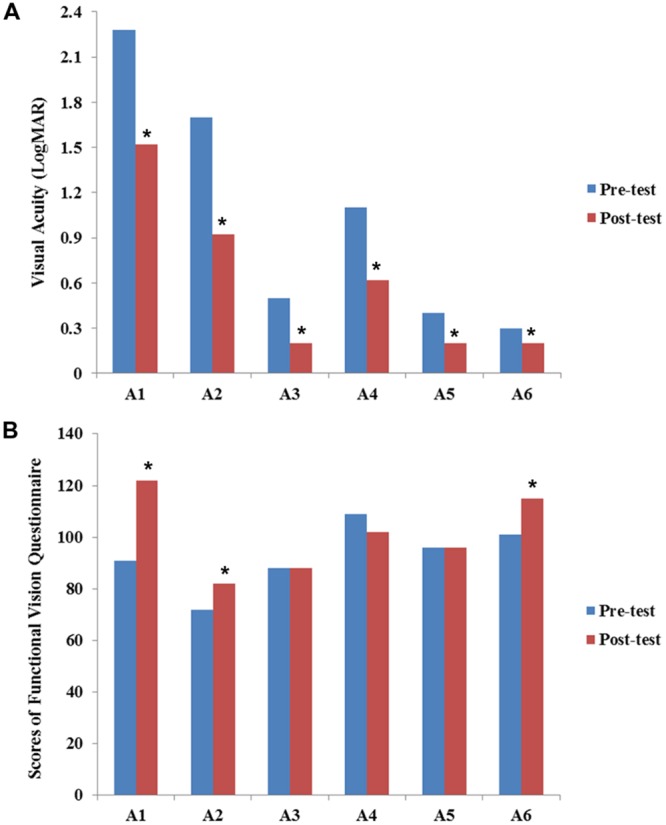
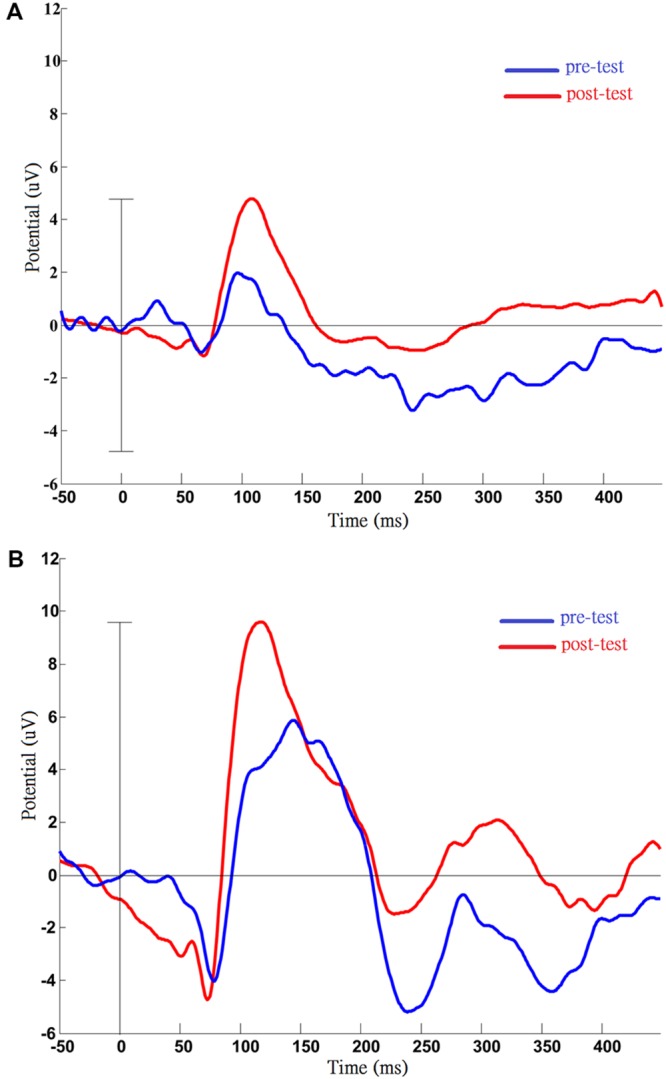
The purpose of this study was to investigate the effectiveness of visual rehabilitation of a computer-based visual stimulation (VS) program combining checkerboard pattern reversal (passive stimulation) with oddball stimuli (attentional modulation) for improving the visual acuity (VA) of visually impaired (VI) children and children with amblyopia and additional developmental problems. Six children (three females, three males; mean age = 3.9 ± 2.3 years) with impaired VA caused by deficits along the anterior and/or posterior visual pathways were recruited. Participants received eight rounds of VS training (two rounds per week) of at least eight sessions per round. Each session consisted of stimulation with 200 or 300 pattern reversals. Assessments of VA (assessed with the Lea symbol VA test or Teller VA cards), visual evoked potential (VEP), and functional vision (assessed with the Chinese-version Functional Vision Questionnaire, FVQ) were carried out before and after the VS program. Significant gains in VA were found after the VS training [VA = 1.05 logMAR ± 0.80 to 0.61 logMAR ± 0.53, Z = -2.20, asymptotic significance (2-tailed) = 0.028]. No significant changes were observed in the FVQ assessment [92.8 ± 12.6 to 100.8 ±SD = 15.4, Z = -1.46, asymptotic significance (2-tailed) = 0.144]. VEP measurement showed improvement in P100 latency and amplitude or integration of the waveform in two participants. Our results indicate that a computer-based VS program with passive checkerboard stimulation, oddball stimulus design, and interesting auditory feedback could be considered as a potential intervention option to improve the VA of a wide age range of VI children and children with impaired VA combined with other neurological disorders.
本研究的目的是调查一种基于计算机的视觉刺激(VS)程序的视觉康复效果,该程序将棋盘格图案反转(被动刺激)与奇偶数刺激(注意力调节)相结合,以提高视力受损(VI)儿童、弱视儿童及伴有其他发育问题儿童的视力(VA)。招募了6名因视觉通路前后段缺陷导致视力受损的儿童(3名女性,3名男性;平均年龄 = 3.9 ± 2.3岁)。参与者接受了8轮VS训练(每周两轮),每轮至少8节。每节包括200次或300次图案反转刺激。在VS程序前后进行了视力(用Lea符号视力测试或泰勒视力卡评估)、视觉诱发电位(VEP)和功能性视力(用中文版功能性视力问卷,FVQ评估)的评估。VS训练后视力有显著提高[视力 = 从1.05 logMAR ± 0.80提高到0.61 logMAR ± 0.53,Z = -2.20,双侧渐近显著性 = 0.028]。FVQ评估未观察到显著变化[从92.8 ± 12.6到100.8 ±标准差 = 15.4,Z = -1.46,双侧渐近显著性 = 0.144]。VEP测量显示两名参与者的P100潜伏期、波幅或波形整合有所改善。我们的结果表明,一种具有被动棋盘格刺激、奇偶数刺激设计和有趣听觉反馈的基于计算机的VS程序可被视为改善广泛年龄范围的视力受损儿童及合并其他神经系统疾病的视力受损儿童视力的潜在干预选择。