Cardiovascular Division, University of Minnesota, Minneapolis, MN, USA.
Sci Rep. 2020 Jun 1;10(1):8870. doi: 10.1038/s41598-020-65697-4.
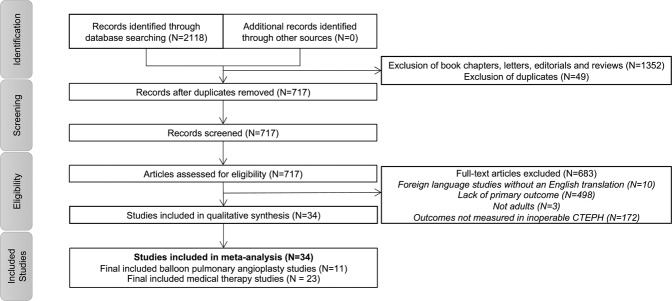
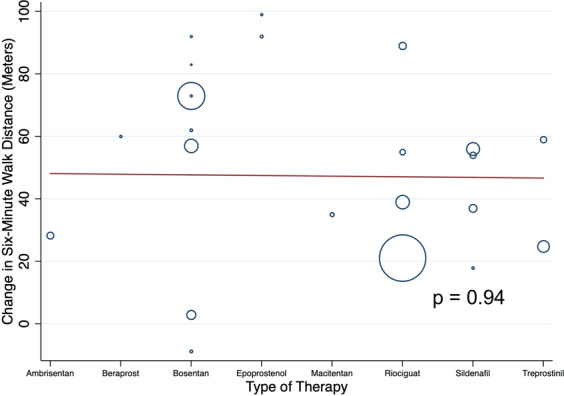
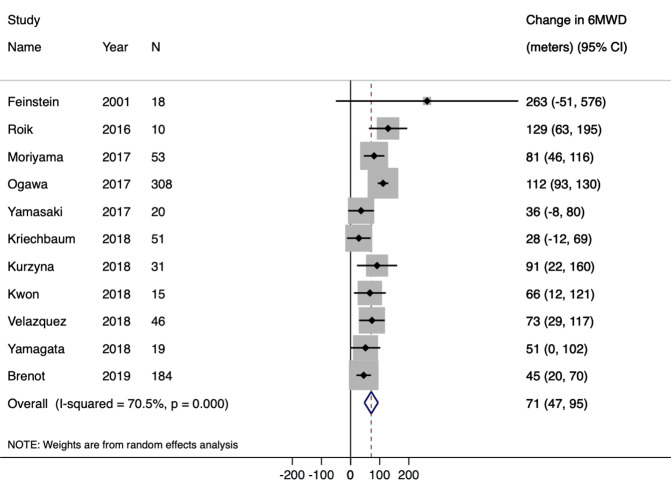
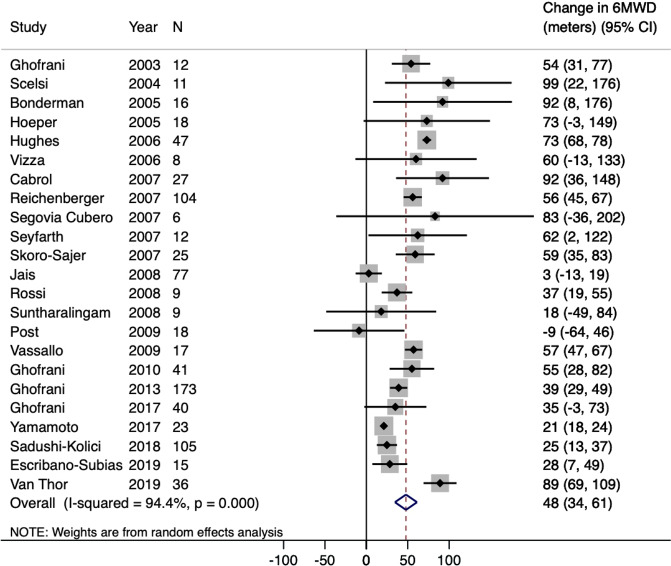
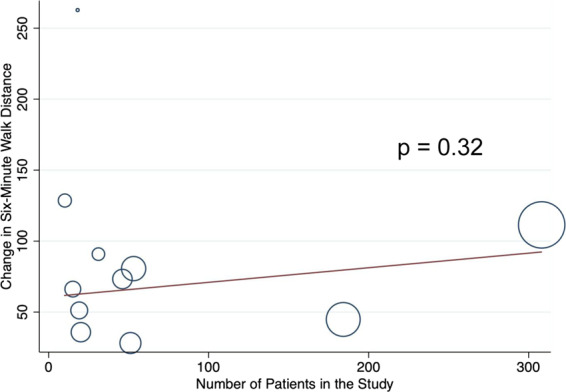
Treatment options for chronic thromboembolic pulmonary hypertension (CTEPH) that is not amenable to thromboendarterectomy or is recurrent/persistent after thromboendarterectomy (inoperable CTEPH) include pulmonary vasodilators or balloon pulmonary angioplasty (BPA). We compared efficacy and safety outcomes of BPA with or without pulmonary vasodilators to pulmonary vasodilator therapy alone in patients with inoperable CTEPH. Observational and randomized trial data reporting outcomes for >5 patients with inoperable CTEPH were sought. Single-arm random effects meta-analyses were performed. The primary outcome was change in six-minute walk distance (6MWD). Secondary outcomes included safety; World Health Organization functional class (WHO FC); and change in mean pulmonary arterial pressure (mPAP), pulmonary vascular resistance (PVR), and cardiac index. Thirty-four studies with 1604 patients were eligible for analyses. Both treatments resulted in significant improvement in 6MWD (71.0 meters, 95% CI: 47.4-94.5 meters with BPA versus 47.8 meters, 95% CI: 34.5-61.2 meters with pulmonary vasodilators), PVR [-3.1 Wood Units (WU), 95% CI: -4.9 to -1.4 WU versus -1.6 WU, 95% CI: -2.4 to -0.8 WU] and mPAP (-14.8 mmHg, 95% CI: -18.2 to -11.5 mmHg versus -4.9 mmHg, 95% CI: -6.9 to -2.8 mmHg). Cardiac index was similar and most patients were WHO FC II and III after their respective interventions. More complications occurred in the BPA arm. In conclusion, BPA and pulmonary vasodilators both improve 6MWD and hemodynamics in patients with inoperable CTEPH. While BPA may offer greater functional and hemodynamic improvements, this technique carries the accompanying risks of an invasive procedure.
无法进行血栓内膜切除术或血栓内膜切除术后复发/持续存在(不可手术的 CTEPH)的慢性血栓栓塞性肺动脉高压(CTEPH)的治疗选择包括肺血管扩张剂或球囊肺动脉成形术(BPA)。我们比较了不可手术的 CTEPH 患者中 BPA 联合或不联合肺血管扩张剂与单独肺血管扩张剂治疗的疗效和安全性结局。寻找了报告>5 例不可手术的 CTEPH 患者结局的观察性和随机试验数据。进行了单臂随机效应荟萃分析。主要结局是 6 分钟步行距离(6MWD)的变化。次要结局包括安全性;世界卫生组织功能分类(WHO FC);以及平均肺动脉压(mPAP)、肺血管阻力(PVR)和心指数的变化。34 项研究中有 1604 例患者符合分析条件。两种治疗方法均显著改善 6MWD(BPA 为 71.0 米,95%CI:47.4-94.5 米;肺血管扩张剂为 47.8 米,95%CI:34.5-61.2 米)、PVR[-3.1 伍德单位(WU),95%CI:-4.9 至-1.4 WU 与-1.6 WU,95%CI:-2.4 至-0.8 WU]和 mPAP(-14.8mmHg,95%CI:-18.2 至-11.5mmHg 与-4.9mmHg,95%CI:-6.9 至-2.8mmHg)。心指数相似,大多数患者在各自干预后均为 WHO FC II 和 III。BPA 组发生更多并发症。总之,BPA 和肺血管扩张剂均可改善不可手术的 CTEPH 患者的 6MWD 和血液动力学。虽然 BPA 可能提供更大的功能和血液动力学改善,但该技术具有侵袭性手术的伴随风险。