Department of Cardiology, Heart Vascular Stroke Institute, Samsung Medical Center, Sungkyunkwan University School of Medicine, Seoul, Korea.
Department of Critical Care Medicine, Samsung Medical Center, Sungkyunkwan University School of Medicine, Seoul, Korea.
J Korean Med Sci. 2018 Jan 22;33(4):e24. doi: 10.3346/jkms.2018.33.e24.
The treatment of choice for chronic thromboembolic pulmonary hypertension (CTEPH) is pulmonary endarterectomy (PEA). However, not all patients are eligible for PEA, and some patients experience recurrence of pulmonary hypertension even after PEA.
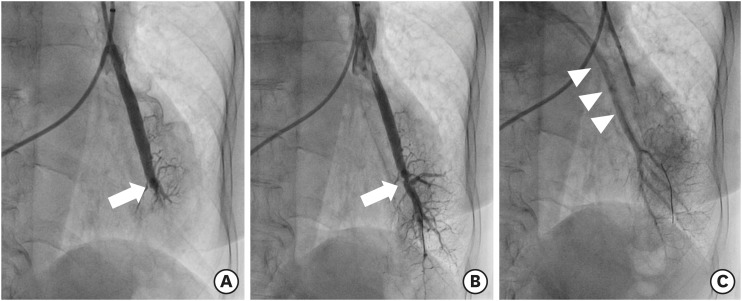
Patients who underwent balloon pulmonary angioplasty (BPA) between December 2015 and April 2017 were enrolled from the Samsung Medical Center CTEPH registry. Enrolled patients underwent right heart catheterization, echocardiography, and 6-minute walk distance (6MWD) at baseline, 4 and 24 weeks after their first BPA session. We compared clinical and hemodynamic parameters at the baseline and last BPA session.
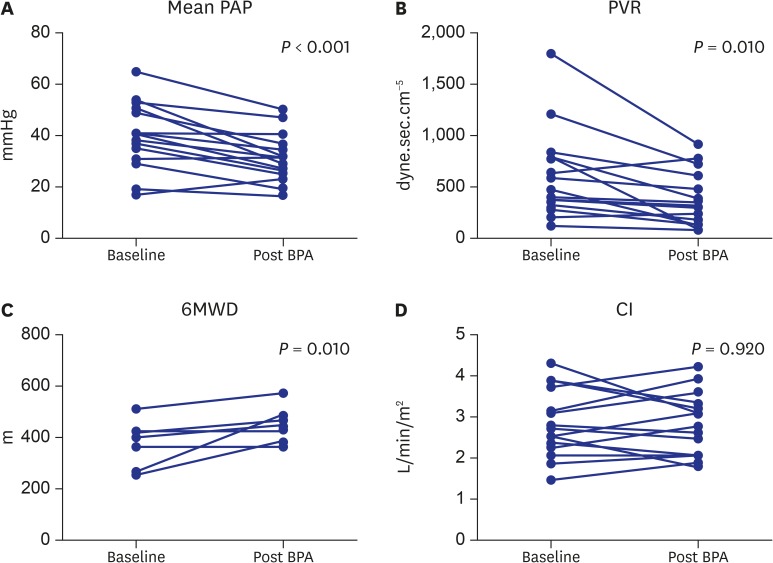
Fifty-two BPA sessions were performed in 15 patients, six of whom had a history of PEA. BPA resulted in improvements in World Health Organization (WHO) functional class (2.9 ± 0.8 to 1.7 ± 0.6, P = 0.002), 6MWD (387.0 ± 86.4 to 453.4 ± 64.8 m, P = 0.01), tricuspid annular plane systolic excursion (14.1 ± 3.6 to 15.6 ± 4.3 mm, P = 0.03) and hemodynamics, including a decline in mean pulmonary artery pressure (41.1 ± 13.1 to 32.1 ± 9.5 mmHg, P < 0.001) and in pulmonary vascular resistance (607.4 ± 452.3 to 406.7 ± 265.4 dyne.sec.cm⁻⁵, P = 0.01) but not in cardiac index (2.94 ± 0.79 to 2.96 ± 0.93 L/min/m², P = 0.92). Six cases of complications were recorded, including two cases of reperfusion injury.
BPA might be a safe and effective treatment strategy for both inoperable CTEPH patients and patients with residual pulmonary hypertension after PEA.
慢性血栓栓塞性肺动脉高压(CTEPH)的治疗选择是肺动脉内膜切除术(PEA)。然而,并非所有患者都适合 PEA,一些患者甚至在 PEA 后仍会出现肺动脉高压复发。
本研究从三星医疗中心 CTEPH 注册处招募了 2015 年 12 月至 2017 年 4 月期间接受球囊肺动脉成形术(BPA)的患者。纳入的患者在基线时、首次 BPA 治疗后 4 周和 24 周时接受右心导管检查、超声心动图和 6 分钟步行距离(6MWD)检查。我们比较了基线时和最后一次 BPA 时的临床和血流动力学参数。
15 名患者共进行了 52 次 BPA,其中 6 名患者有 PEA 病史。BPA 治疗后,患者的世界卫生组织(WHO)功能分级(2.9 ± 0.8 至 1.7 ± 0.6,P = 0.002)、6MWD(387.0 ± 86.4 至 453.4 ± 64.8 m,P = 0.01)、三尖瓣环平面收缩期位移(14.1 ± 3.6 至 15.6 ± 4.3 mm,P = 0.03)和血流动力学参数(平均肺动脉压从 41.1 ± 13.1 至 32.1 ± 9.5 mmHg,P < 0.001;肺血管阻力从 607.4 ± 452.3 至 406.7 ± 265.4 dyne.sec.cm⁻⁵,P = 0.01)均得到改善,但心输出量指数(2.94 ± 0.79 至 2.96 ± 0.93 L/min/m²,P = 0.92)未得到改善。记录了 6 例并发症,包括 2 例再灌注损伤。
BPA 可能是一种安全有效的治疗策略,适用于不能手术的 CTEPH 患者和 PEA 后仍存在肺动脉高压的患者。