School of Life Science and Technology, Tokyo Institute of Technology, Tokyo, 152-8550, Japan.
Department of Informatics, National Institute of Genetics, Shizuoka, 411-8540, Japan.
ISME J. 2020 Sep;14(9):2288-2301. doi: 10.1038/s41396-020-0688-1. Epub 2020 Jun 1.
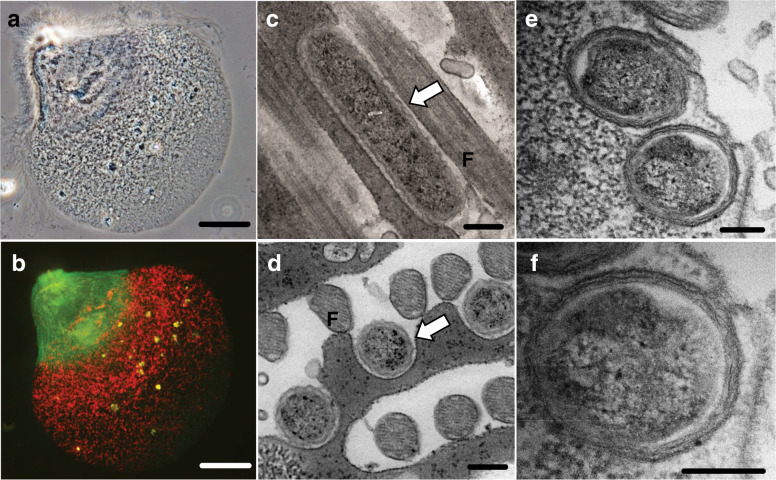
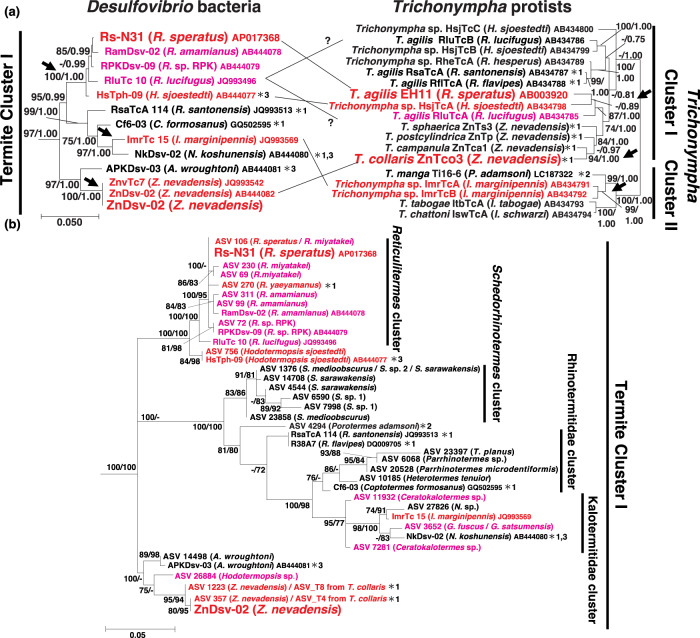
Several Trichonympha protist species in the termite gut have independently acquired Desulfovibrio ectosymbionts in apparently different stages of symbiosis. Here, we obtained the near-complete genome sequence of Desulfovibrio phylotype ZnDsv-02, which attaches to the surface of Trichonympha collaris cells, and compared it with a previously obtained genome sequence of 'Candidatus Desulfovibrio trichonymphae' phylotype Rs-N31, which is almost completely embedded in the cytoplasm of Trichonympha agilis. Single-nucleotide polymorphism analysis indicated that although Rs-N31 is almost clonal, the ZnDsv-02 population on a single host cell is heterogeneous. Despite these differences, the genome of ZnDsv-02 has been reduced to 1.6 Mb, which is comparable to that of Rs-N31 (1.4 Mb), but unlike other known ectosymbionts of protists with a genome similar in size to their free-living relatives. Except for the presence of a lactate utilization pathway, cell-adhesion components and anti-phage defense systems in ZnDsv-02, the overall gene-loss pattern between the two genomes is very similar, including the loss of genes responsive to environmental changes. Our study suggests that genome reduction can occur in ectosymbionts, even when they can be transmitted horizontally and obtain genes via lateral transfer, and that the symbiont genome size depends heavily on their role in the symbiotic system.
几种原生动物在白蚁肠道中独立获得了脱硫弧菌外共生体,显然处于不同的共生阶段。在这里,我们获得了附着在 Collaris 细胞表面的脱硫弧菌 ZnDsv-02 近完整基因组序列,并将其与先前获得的几乎完全嵌入 Trichonympha agilis 细胞质中的“Candidatus Desulfovibrio trichonymphae” phylotype Rs-N31 基因组序列进行了比较。单核苷酸多态性分析表明,尽管 Rs-N31 几乎是克隆的,但单个宿主细胞上的 ZnDsv-02 群体是异质的。尽管存在这些差异,但 ZnDsv-02 的基因组已减少到 1.6 Mb,与 Rs-N31(1.4 Mb)相当,但与其他具有与自由生活相关体相似大小的已知原生动物外共生体不同。除了存在乳酸利用途径、细胞粘附成分和抗噬菌体防御系统外,两个基因组之间的总体基因缺失模式非常相似,包括对环境变化有反应的基因的缺失。我们的研究表明,即使外共生体可以水平传播并通过横向转移获得基因,基因组的减少也可能发生在它们身上,并且共生体的基因组大小在很大程度上取决于它们在共生系统中的作用。