Guembe-García Marta, Peredo-Guzmán Patricia D, Santaolalla-García Victoria, Moradillo-Renuncio Natalia, Ibeas Saturnino, Mendía Aranzazu, García Félix Clemente, García José Miguel, Vallejos Saúl
Departamento de Química, Facultad de Ciencias, Universidad de Burgos, Plaza de Misael Bañuelos s/n, 09001 Burgos, Spain.
Complejo Asistencial Universitario de Burgos, 09001 Burgos, Spain.
Polymers (Basel). 2020 May 29;12(6):1249. doi: 10.3390/polym12061249.
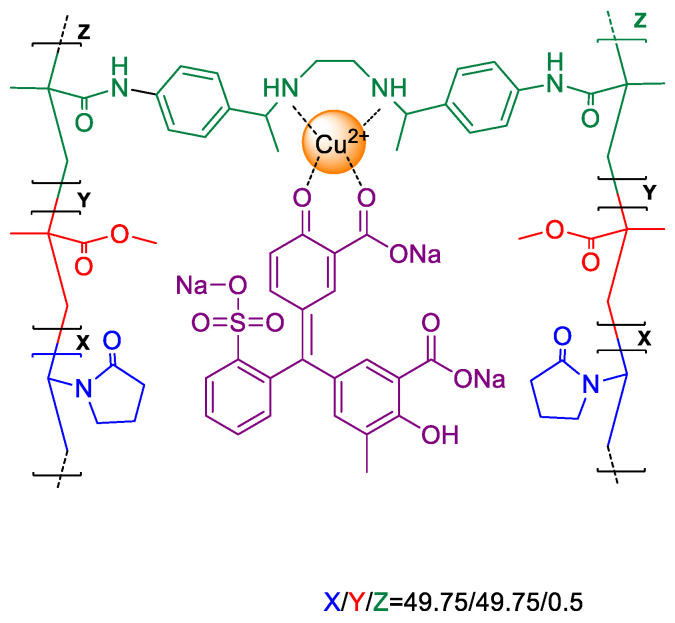
We anchored a colourimetric probe, comprising a complex containing copper (Cu(II)) and a dye, to a polymer matrix obtaining film-shaped chemosensors with induced selectivity toward glycine. This sensory material is exploited in the selectivity detection of glycine in complex mixtures of amino acids mimicking elastin, collagen and epidermis, and also in following the protease activity in a beefsteak and chronic human wounds. We use the term inducing because the probe in solution is not selective toward any amino acid and we get selectivity toward glycine using the solid-state. Overall, we found that the chemical behaviour of a chemical probe can be entirely changed by changing its chemical environment. Regarding its behaviour in solution, this change has been achieved by isolating the probe by anchoring the motifs in a polymer matrix, in an amorphous state, avoiding the interaction of one sensory motif with another. Moreover, this selectivity change can be further tuned because of the effectiveness of the transport of targets both by the physical nature of the interface of the polymer matrix/solution, where the target chemicals are dissolved, for instance, and inside the matrix where the recognition takes place. The interest in chronic human wounds is related to the fact that our methods are rapid and inexpensive, and also considering that the protease activity can correlate with the evolution of chronic wounds.
我们将一种比色探针(由含铜(Cu(II))的配合物和一种染料组成)固定在聚合物基质上,得到了对甘氨酸具有诱导选择性的膜状化学传感器。这种传感材料被用于在模拟弹性蛋白、胶原蛋白和表皮的氨基酸复杂混合物中选择性检测甘氨酸,还用于监测牛排和慢性人类伤口中的蛋白酶活性。我们使用“诱导”这个术语是因为溶液中的探针对任何氨基酸都没有选择性,而在固态时我们获得了对甘氨酸的选择性。总体而言,我们发现化学探针的化学行为可以通过改变其化学环境而完全改变。关于其在溶液中的行为,这种改变是通过将基序固定在聚合物基质中以非晶态隔离探针来实现的,避免了一个传感基序与另一个传感基序之间的相互作用。此外,由于目标物质传输的有效性,这种选择性变化可以进一步调整,例如,目标化学物质溶解在聚合物基质/溶液界面的物理性质以及识别发生的基质内部。对慢性人类伤口研究的兴趣在于我们的方法快速且廉价,同时考虑到蛋白酶活性可能与慢性伤口的发展相关。