Department for Early Prehistory and Quaternary Ecology, The University of Tübingen, Tübingen 72070, Germany.
Centre for Biological Diversity, School of Biology, University of St Andrews, St Andrews KY16 9TH, UK.
Biol Lett. 2020 Jun;16(6):20200122. doi: 10.1098/rsbl.2020.0122. Epub 2020 Jun 3.
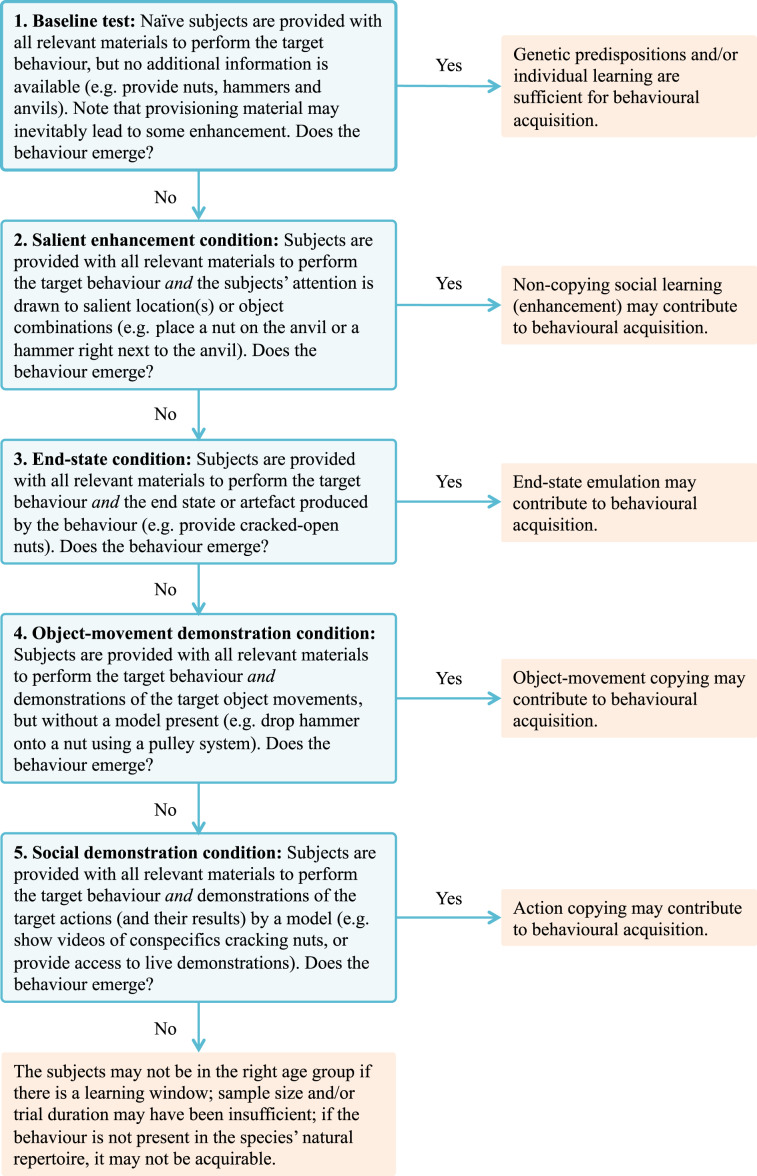
Despite major advances in the study of animal tool behaviour, researchers continue to debate how exactly certain behaviours are acquired. While specific mechanisms, such as genetic predispositions or action copying, are sometimes suspected to play a major role in behavioural acquisition, controlled experiments are required to provide conclusive evidence. In this opinion piece, we refer to classic ethological methodologies to emphasize the need for studying the relative contributions of different factors to the emergence of specific tool behaviours. We describe a methodology, consisting of a carefully staged series of baseline and social-learning conditions, that enables us to tease apart the roles of different mechanisms in the development of behavioural repertoires. Experiments employing our proposed methodology will not only advance our understanding of animal learning and culture, but as a result, will also help inform hypotheses about human cognitive, cultural and technological evolution. More generally, our conceptual framework is suitable for guiding the detailed investigation of other seemingly complex animal behaviours.
尽管动物工具行为的研究取得了重大进展,但研究人员仍在争论某些行为究竟是如何习得的。虽然某些特定的机制,如遗传倾向或动作模仿,有时被怀疑在行为习得中起主要作用,但需要进行对照实验来提供确凿的证据。在这篇观点文章中,我们参考了经典的行为学方法,强调需要研究不同因素对特定工具行为出现的相对贡献。我们描述了一种方法,包括一系列精心设计的基线和社会学习条件,可以帮助我们理清不同机制在行为组合发展中的作用。采用我们提出的方法的实验不仅将增进我们对动物学习和文化的理解,而且还将有助于验证关于人类认知、文化和技术进化的假说。更广泛地说,我们的概念框架适用于指导对其他看似复杂的动物行为的详细研究。