Tuberous Sclerosis Complex Unit, TSC unit, JR Tokyo General Hospital, 2-1-3 Yoyogi Shibuya-ku, Tokyo, 151-8528, Japan.
Department of Dermatology, JR Tokyo General Hospital, Tokyo, Japan.
Orphanet J Rare Dis. 2020 Jun 1;15(1):133. doi: 10.1186/s13023-020-01417-5.
Tuberous sclerosis complex (TSC) is a rare autosomal dominant disorder forming hamartomas throughout the body. Facial angiofibromas (FAs) occur in 75% of TSC patients, which are often enlarged, impairing the appearance of the face, and reducing the patient's quality of life (QOL). The aim of this study was to characterize the impact of topical sirolimus treatment on the health-related QOL in patients with FA associated with TSC.
We investigated a total of 33 patients who received sirolimus gel treatment for FA associated with TSC and assessed the changes in the health-related QOL using the Medical Outcomes Study 36-Item Short Form (SF-36) Health Survey. SF-36 surveys were performed before and after 3 months of treatment. The conditions of the patients after using the sirolimus gel were categorized into the following three categories: "improved," "unchanged," and "aggravated." Adverse events were investigated using the CTCAE v5.0-JCOG.
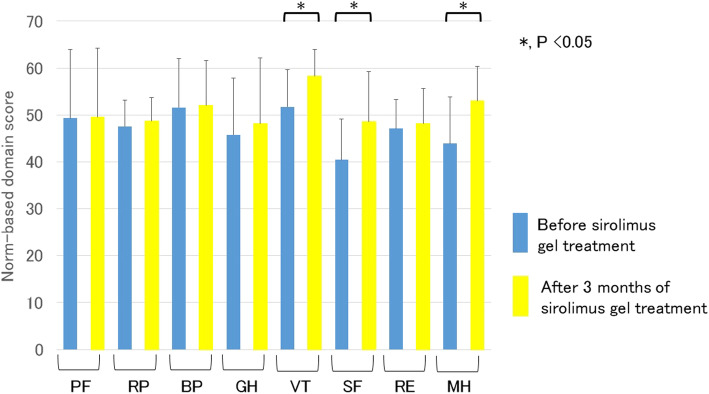
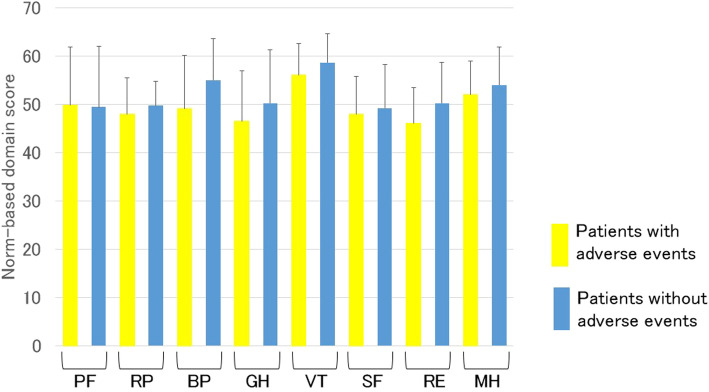
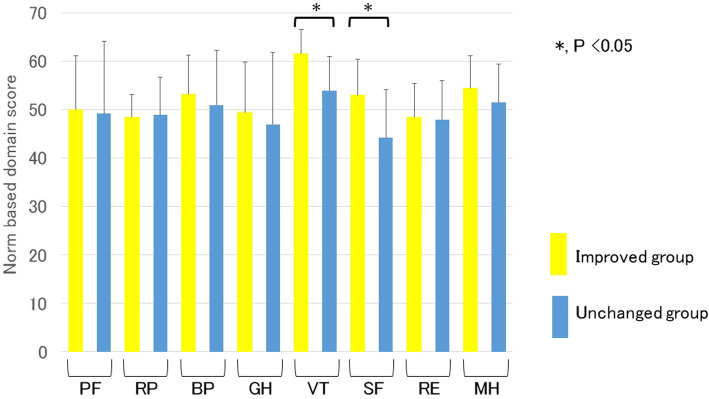
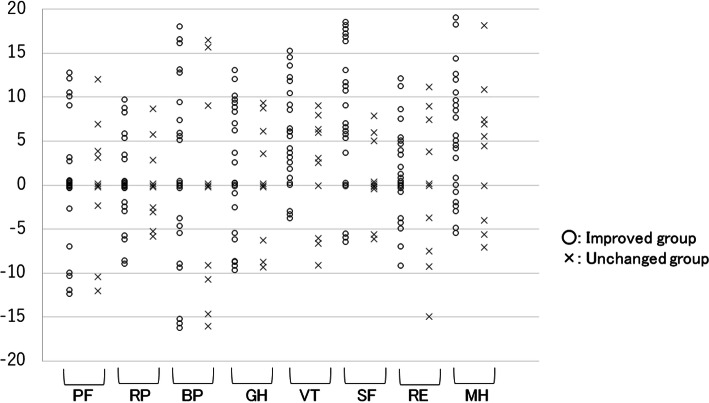
The median age of the patients was 25 (range 14-55) years. After 3 months of sirolimus gel treatment, three scale scores of the SF-36, vitality (VT), social function (SF), and mental health (MH), were significantly improved compared to before the treatment. The VT and SF in patients who had improved FA were significantly better than those in the other patients. There were no significant differences in any scale scores between patients with and without adverse events at 3 months after the initiation of sirolimus gel treatment.
This is the first report regarding improved health-related quality of life in patients treated with sirolimus gel for FA associated with TSC by using the SF-36. The three scale scores associated with mental health were significantly improved compared to before the treatment. The health-related QOL in patients receiving sirolimus gel treatment is more strongly affected by the treatment efficacy than adverse events. Sirolimus gel treatment improves the health-related QOL in patients with FA associated with TSC.
结节性硬化症(TSC)是一种罕见的常染色体显性遗传疾病,会导致全身出现错构瘤。75%的 TSC 患者会出现面部血管纤维瘤(FA),这些纤维瘤通常会增大,影响面部外观,并降低患者的生活质量(QOL)。本研究旨在描述外用西罗莫司治疗 TSC 相关 FA 对健康相关 QOL 的影响。
我们共调查了 33 名接受西罗莫司凝胶治疗 TSC 相关 FA 的患者,并使用医疗结局研究 36 项简短健康调查(SF-36)评估 QOL 的变化。在治疗 3 个月前后进行 SF-36 调查。根据西罗莫司凝胶使用后患者的病情,将其分为“改善”“无变化”和“恶化”三类。使用 CTCAE v5.0-JCOG 评估不良事件。
患者的中位年龄为 25 岁(14~55 岁)。与治疗前相比,西罗莫司凝胶治疗 3 个月后,SF-36 中的三个量表评分,即活力(VT)、社会功能(SF)和心理健康(MH),均显著改善。FA 改善的患者的 VT 和 SF 明显优于其他患者。西罗莫司凝胶治疗 3 个月后,发生与未发生不良事件的患者之间,任何量表评分均无显著差异。
这是首个关于 TSC 相关 FA 患者使用西罗莫司凝胶治疗后 SF-36 评估的健康相关生活质量改善的报告。与治疗前相比,与心理健康相关的三个量表评分均显著改善。接受西罗莫司凝胶治疗的患者的 QOL 受治疗效果的影响大于不良事件。西罗莫司凝胶治疗可改善 TSC 相关 FA 患者的 QOL。