Institute of Veterinary Medicine and Animal Sciences, Estonian University of Life Science, Kreutzwaldi 62, 51006, Tartu, Estonia.
Department of Clinical Sciences, Swedish University of Agricultural Sciences, SE-75007, Uppsala, Sweden.
BMC Vet Res. 2020 Jun 1;16(1):173. doi: 10.1186/s12917-020-02384-6.
Culling is a major cost for dairy farms but also an essential part in managing herd productivity. This study aimed to identify the culling rates of Estonian dairy cows, identify the farmers' stated reasons and risk factors for culling. This observational study used registry data of all cows from herds with ≥20 cow-years in 2013-2015. Cow lactation-level analyses included data of 86,373 primiparous cows from 409 herds and 177,561 lactations of 109,295 multiparous cows from 410 herds. Weibull proportional hazard regression models were used to identify risk factors for culling due to slaughter or death.
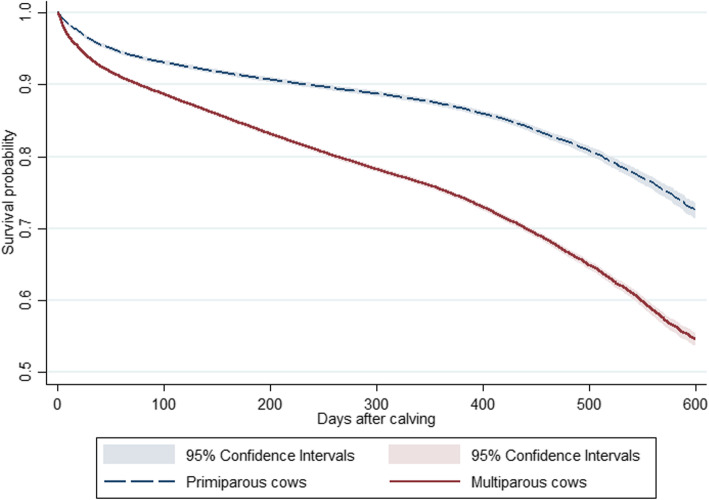
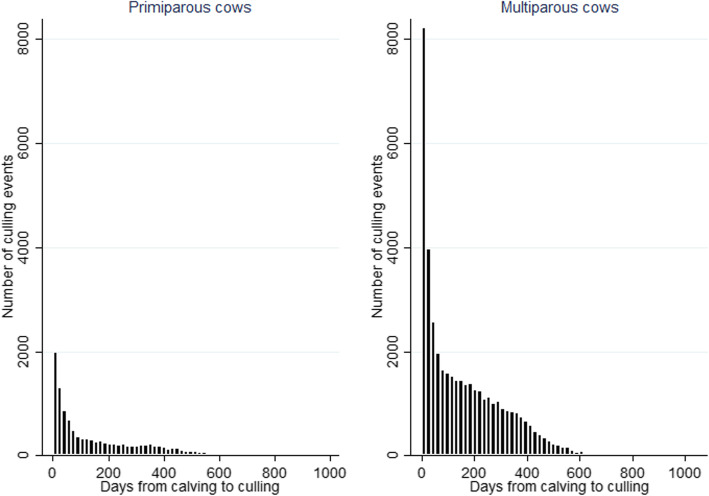
The overall culling rate of Estonian dairy cows was 26.24 (95% CI 26.02; 26.46) per 100 cow-years. The most common reasons farmers stated for culling were feet/claw disorders (26.4%), udder disorders (22.6%), metabolic and digestive disorders (18.1%) and fertility problems (12.5%). Animal-level risk factors for culling were Holstein breed, older parity, lower milk yield breeding value, older age at first calving, longer previous calving interval, having assisted calving, stillbirth and birth of twins/triplets. Lower milk yield, somatic cell count over 200,000 cells/ml and fat/protein ratio over 1.5 at first test-milking after calving were associated with greater culling hazard during the lactation. Cows from larger herds, herds with decreasing size and higher milk yields had a higher culling probability.
This study emphasises the need for improved management of hoof health and prevention of mastitis and metabolic diseases. It is essential to ensure easy calving and good health of cows around calving in order to lower the culling hazard.
淘汰是奶牛养殖场的主要成本,但也是管理牛群生产力的重要组成部分。本研究旨在确定爱沙尼亚奶牛的淘汰率,确定农民淘汰奶牛的原因和风险因素。本观察性研究使用了 2013-2015 年间所有牛群中≥20 个牛年的牛只登记数据。牛泌乳水平分析包括了来自 409 个牛群的 86,373 头初产牛的数据和来自 410 个牛群的 177,561 头经产牛的 109,295 个泌乳期的数据。威布尔比例风险回归模型用于确定因屠宰或死亡而淘汰的风险因素。
爱沙尼亚奶牛的总淘汰率为每 100 个牛年 26.24(95%CI 26.02;26.46)。农民表示淘汰的最常见原因是蹄/爪疾病(26.4%)、乳房疾病(22.6%)、代谢和消化疾病(18.1%)和生殖问题(12.5%)。动物水平的淘汰风险因素包括荷斯坦品种、更高的胎次、更低的产奶量育种值、首次产犊年龄更大、前次产犊间隔更长、助产分娩、死胎和双胞胎/三胞胎分娩。产后首次挤奶时产奶量较低、体细胞计数超过 200,000 个细胞/ml 和脂肪/蛋白质比例超过 1.5 与泌乳期间更高的淘汰风险相关。来自更大牛群、牛群规模减小和产奶量增加的奶牛淘汰概率更高。
本研究强调需要改善蹄部健康管理,预防乳腺炎和代谢疾病。确保奶牛在产犊前后容易分娩和保持健康,降低淘汰风险至关重要。