Department of Biological and Experimental Psychology, School of Biological and Chemical Sciences, Queen Mary University of London, London, UK.
Department of Psychology, Institute of Psychiatry Psychology and Neuroscience, King's College London, London, UK.
Mol Psychiatry. 2021 Sep;26(9):4896-4904. doi: 10.1038/s41380-020-0783-8. Epub 2020 Jun 3.
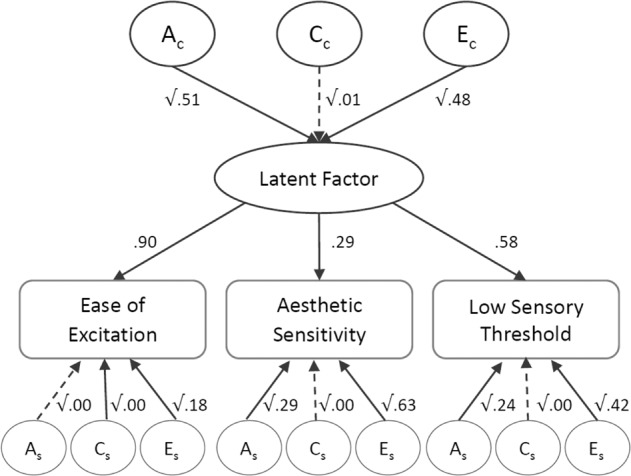
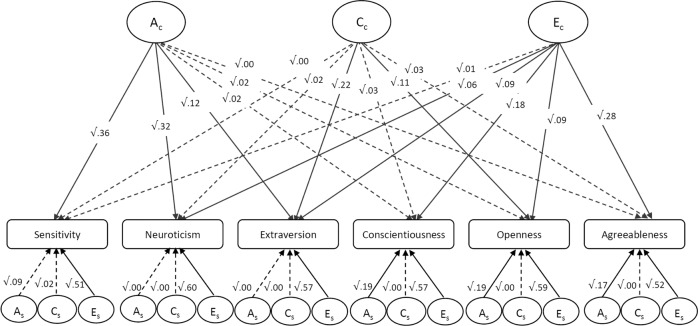
Humans differ substantially in how strongly they respond to similar experiences. Theory suggests that such individual differences in susceptibility to environmental influences have a genetic basis. The present study investigated the genetic architecture of Environmental Sensitivity (ES) by estimating its heritability, exploring the presence of multiple heritable components and its genetic overlap with common personality traits. ES was measured with the Highly Sensitive Child (HSC) questionnaire and heritability estimates were obtained using classic twin design methodology in a sample of 2868 adolescent twins. Results indicate that the heritability of sensitivity was 0.47, and that the genetic influences underlying sensitivity to negative experiences are relatively distinct from sensitivity to more positive aspects of the environment, supporting a multi-dimensional genetic model of ES. The correlation between sensitivity, neuroticism and extraversion was largely explained by shared genetic influences, with differences between these traits mainly attributed to unique environmental influences operating on each trait.
人类对相似经历的反应程度有很大差异。理论表明,这种对环境影响的易感性的个体差异有遗传基础。本研究通过估计环境敏感性(ES)的遗传结构来探讨其遗传结构,探索多个遗传成分的存在及其与常见人格特征的遗传重叠。ES 通过高度敏感儿童(HSC)问卷进行测量,并在 2868 名青少年双胞胎样本中使用经典的双胞胎设计方法来获得遗传率估计值。结果表明,敏感性的遗传率为 0.47,对负面经验的敏感性的遗传影响与对环境中更积极方面的敏感性相对不同,支持 ES 的多维遗传模型。敏感性、神经质和外向性之间的相关性主要是由共同的遗传影响解释的,这些特征之间的差异主要归因于每个特征上独特的环境影响。