Kotidis Pavlos, Kontoravdi Cleo
Department of Chemical Engineering, Imperial College London, South Kensington Campus, London, SW7 2AZ, United Kingdom.
Metab Eng Commun. 2020 May 15;10:e00131. doi: 10.1016/j.mec.2020.e00131. eCollection 2020 Jun.
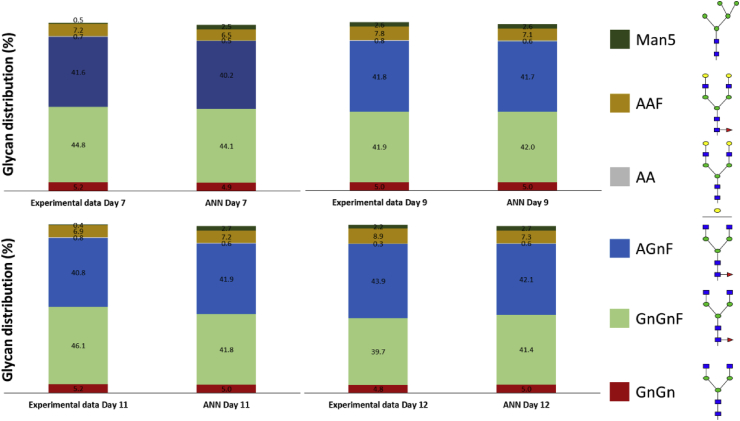
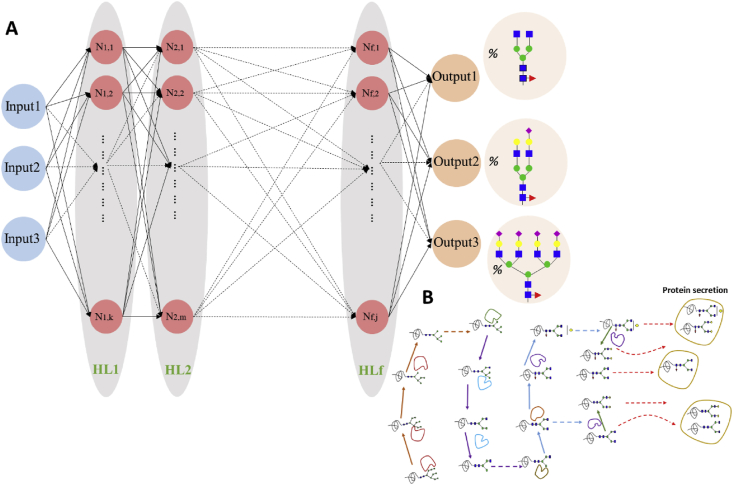
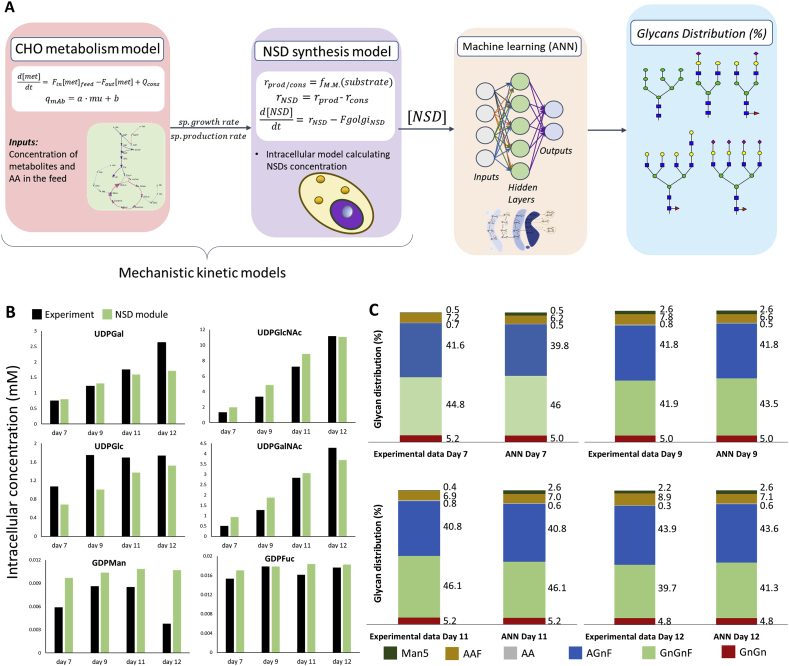
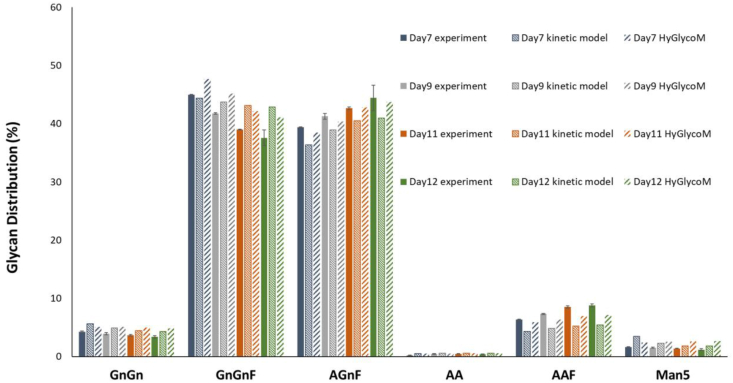
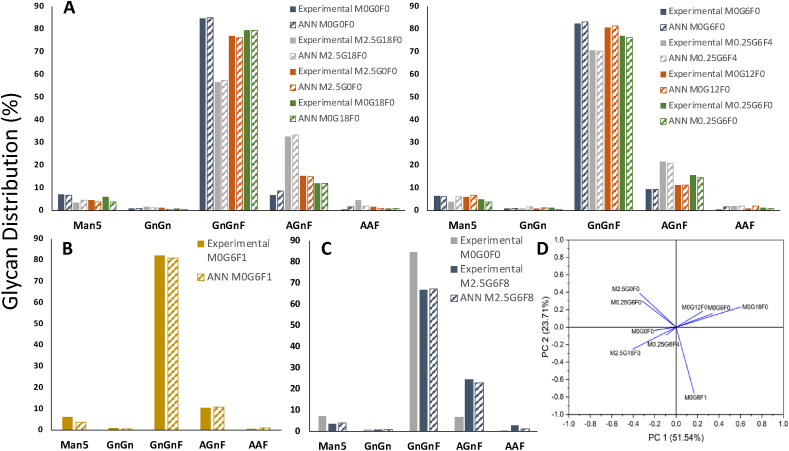
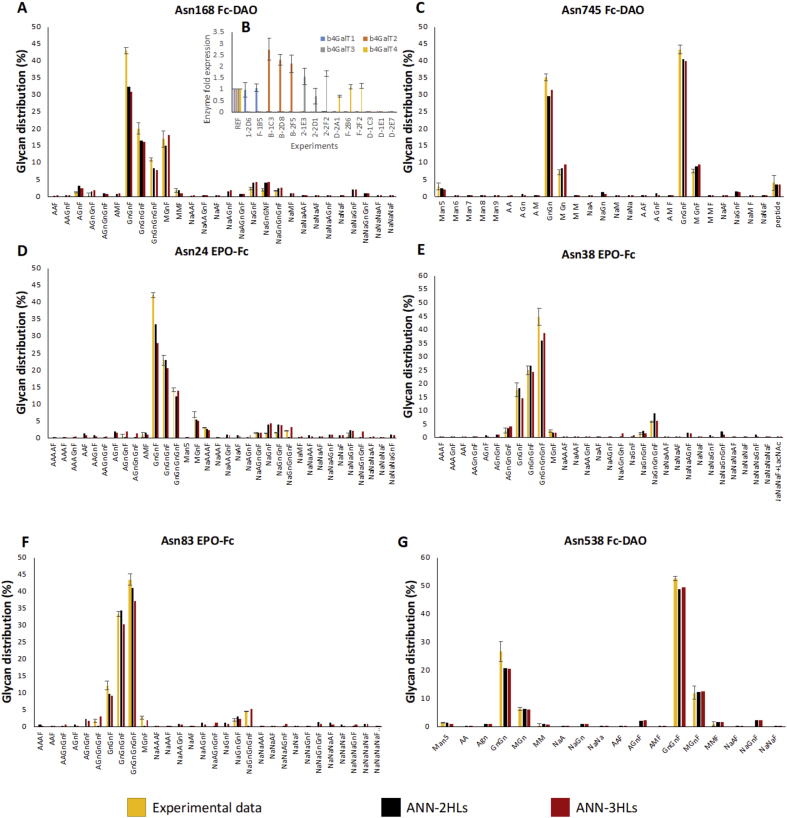
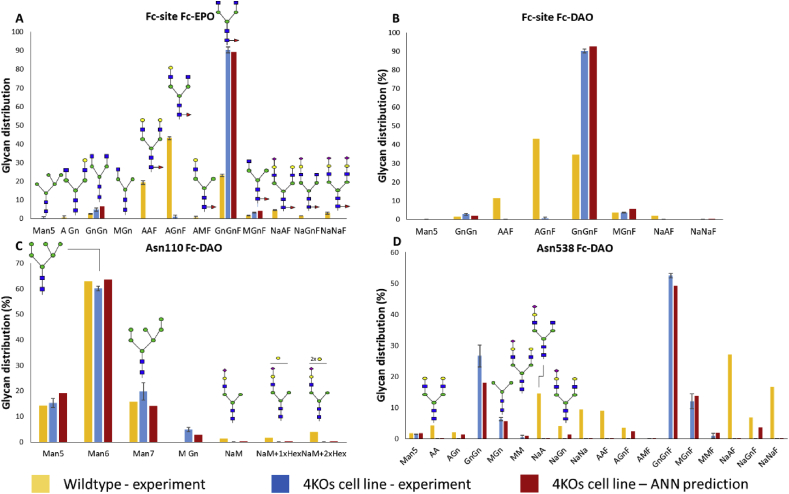
Kinetic models offer incomparable insight on cellular mechanisms controlling protein glycosylation. However, their ability to reproduce site-specific glycoform distributions depends on accurate estimation of a large number of protein-specific kinetic parameters and prior knowledge of enzyme and transport protein levels in the Golgi membrane. Herein we propose an artificial neural network (ANN) for protein glycosylation and apply this to four recombinant glycoproteins produced in Chinese hamster ovary (CHO) cells, two monoclonal antibodies and two fusion proteins. We demonstrate that the ANN model accurately predicts site-specific glycoform distributions of up to eighteen glycan species with an average absolute error of 1.1%, correctly reproducing the effect of metabolic perturbations as part of a hybrid, kinetic/ANN, glycosylation model (HyGlycoM), as well as the impact of manganese supplementation and glycosyltransferase knock out experiments as a stand-alone machine learning algorithm. These results showcase the potential of machine learning and hybrid approaches for rapidly developing performance-driven models of protein glycosylation.
动力学模型为控制蛋白质糖基化的细胞机制提供了无与伦比的见解。然而,它们再现位点特异性糖型分布的能力取决于大量蛋白质特异性动力学参数的准确估计以及高尔基体膜中酶和转运蛋白水平的先验知识。在此,我们提出了一种用于蛋白质糖基化的人工神经网络(ANN),并将其应用于中国仓鼠卵巢(CHO)细胞中产生的四种重组糖蛋白、两种单克隆抗体和两种融合蛋白。我们证明,ANN模型能够准确预测多达18种聚糖种类的位点特异性糖型分布,平均绝对误差为1.1%,作为混合动力学/ANN糖基化模型(HyGlycoM)的一部分,正确再现代谢扰动的影响,以及作为独立机器学习算法的锰补充和糖基转移酶敲除实验的影响。这些结果展示了机器学习和混合方法在快速开发性能驱动的蛋白质糖基化模型方面的潜力。