Bewicz-Binkowska Dorota, Zgorzynska Emilia, Dziedzic Barbara, Walczewska Anna
Department of Cell-to-Cell Communication, Medical University of Lodz, Poland.
Int J Mol Cell Med. 2019 Summer;8(3):232-240. doi: 10.22088/IJMCM.BUMS.8.3.232.
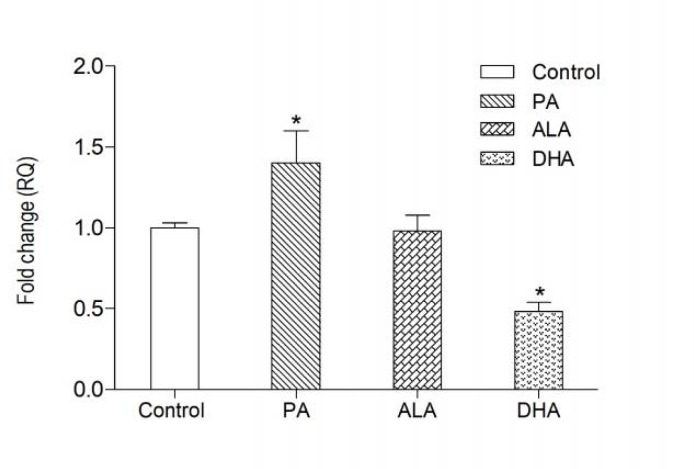
Docosahexaenoic acid (DHA), the most abundant n-3 polyunsaturated fatty acid (n-3PUFA) in the brain, has attracted great importance for a variety of neuronal functions such as signal transduction through plasma membranes, neuronal plasticity, and neuroprotection. Astrocytes that provide structural, functional, and metabolic support for neurons, express ∆6- desaturase encoded by gene that can be, next to the plasma DHA pool, additional source of DHA in the brain. Furthermore, the genetic variations of gene cluster has been found in children with developmental disorders, and are associated with cognitive functions. Since, the regulation of DHA biosynthesis in astrocytes remains poorly studied the aim of this study was to determine the effect of palmitic acid (PA), α-linolenic acid (ALA) or docosahexaenoic acid (DHA), on the transcription of gene in astrocytes and survival of neurons challenged with oxidative compounds after co-culture with astrocytes exposed to DHA. The lipid profile in cell membranes after incubation with fatty acids was determined by gas chromatography, and expression was analyzed using real-time PCR. The viability of neurons cocultured with PUFA-enriched astrocytes was investigated by flow cytometry after staining cells with annexin V-FITC and PI. The results showed that DHA suppressed (P <0.01), PA stimulated (P <0.01), while ALA did not change the gene expression after 24 h incubation of astrocytes with fatty acids. Although mRNA was down-regulated by DHA, its level in astrocytic membranes significantly increased (P <0.01). Astrocytes with DHA-enriched membrane phospholipids markedly enhanced neuronal resistance to cytotoxic compounds and neuronal survival. These results suggest that beneficial effects of supplementation with n-3 PUFA in Alzheimer disease and in psychiatric disorders is caused, in part, by increased efficacy of DHA-enriched astrocytes to protect neurons under adverse conditions in the brain.
二十二碳六烯酸(DHA)是大脑中含量最丰富的n-3多不饱和脂肪酸(n-3PUFA),对多种神经元功能具有重要意义,如通过质膜进行信号转导、神经元可塑性和神经保护。为神经元提供结构、功能和代谢支持的星形胶质细胞表达由 基因编码的∆6-去饱和酶,该酶除了作为质膜DHA库之外,还可以是大脑中DHA的额外来源。此外,在发育障碍儿童中发现了 基因簇的遗传变异,且这些变异与认知功能相关。由于对星形胶质细胞中DHA生物合成的调控研究较少,本研究的目的是确定棕榈酸(PA)、α-亚麻酸(ALA)或二十二碳六烯酸(DHA)对星形胶质细胞中 基因转录以及与暴露于DHA的星形胶质细胞共培养后受到氧化化合物挑战的神经元存活的影响。用气相色谱法测定脂肪酸孵育后细胞膜中的脂质谱,并使用实时PCR分析 表达。在用膜联蛋白V-FITC和PI对细胞染色后,通过流式细胞术研究与富含多不饱和脂肪酸(PUFA)的星形胶质细胞共培养的神经元的活力。结果表明,在脂肪酸孵育星形胶质细胞24小时后,DHA抑制(P<0.01),PA刺激(P<0.01),而ALA未改变 基因表达。尽管DHA使 mRNA下调,但其在星形胶质细胞膜中的水平显著增加(P<0.01)。具有富含DHA的膜磷脂的星形胶质细胞显著增强了神经元对细胞毒性化合物的抗性和神经元存活。这些结果表明,在阿尔茨海默病和精神疾病中补充n-3PUFA的有益作用部分是由于富含DHA的星形胶质细胞在大脑不利条件下保护神经元的功效增加所致。