Abdelmagid Salma A, Clarke Shannon E, Roke Kaitlin, Nielsen Daiva E, Badawi Alaa, El-Sohemy Ahmed, Mutch David M, Ma David Wl
Department of Human Health and Nutritional Sciences, College of Biological Science, University of Guelph, Animal Science/Nutrition Building, 491 Gordon Street, Guelph, ON N1G 2W1 Canada.
Department of Nutritional Sciences, University of Toronto, Toronto, ON Canada.
Nutr Metab (Lond). 2015 Apr 21;12:14. doi: 10.1186/s12986-015-0010-9. eCollection 2015.
There is great interest in the relationship between polyunsaturated fatty acids and health. Yet, the combinatory effect of factors such as sex, ethnicity, genetic polymorphisms and hormonal contraceptives (HC) on the concentrations of these fatty acids is unknown. Therefore, we sought to determine the effects of FADS polymorphisms, and HC use in females, on aggregate desaturase indices (ADI), and plasma docosahexaenoic acid (DHA) concentrations in Caucasian and East Asian males and females.
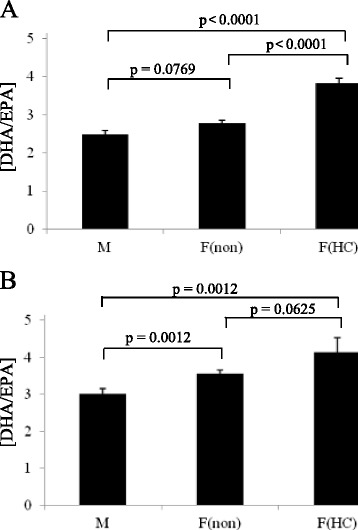
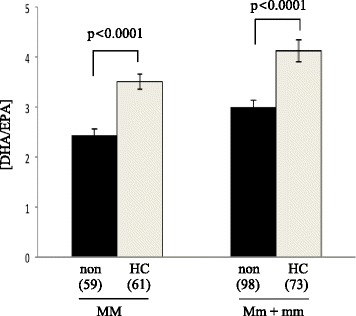
Fasting plasma samples were collected from subjects (Caucasian males: 113 and females: 298; East Asian males: 98 and females: 277) from the Toronto Nutrigenomics and Health Study. Fatty acid concentrations were measured by gas chromatography. ADI were estimated by dividing concentrations of arachidonic acid by linoleic acid (n-6 ADI) and eicosapentaenoic acid (EPA) by α-linolenic acid (n-3 ADI). [DHA/EPA] desaturase index was used to determine effects of FADS2 polymorphisms and HC use on EPA conversion to DHA.
In Caucasians, associations between n-6 ADI and multiple SNP (FADS1 rs174547, FADS2 rs174576, and rs174611 in males; FADS1 rs174547, FADS2 rs174570, rs174576, rs174679, rs174611, rs174593, rs174626, rs2072114, rs2845573, and rs2851682 in females) withstood multiple testing. In East Asian females, 5 SNP-n-6 ADI associations (FADS2 rs174602, rs174626, rs2072114, rs2845573, and rs2851682) withstood multiple testing. One FADS2 SNP was associated with altered [DHA/EPA] desaturase index in Caucasian females only (rs174576, p < 0.0001). HC use had a significant effect on DHA concentrations in Caucasian females only (P < 0.0001).
We demonstrate ethnic- and sex-specific effects of FADS polymorphisms on desaturase indices, and ethnic-specific effect of HC use on plasma DHA concentrations.
多不饱和脂肪酸与健康之间的关系备受关注。然而,性别、种族、基因多态性和激素避孕药(HC)等因素对这些脂肪酸浓度的综合影响尚不清楚。因此,我们试图确定脂肪酸去饱和酶(FADS)基因多态性以及女性使用HC对高加索人和东亚男性及女性的总去饱和酶指数(ADI)和血浆二十二碳六烯酸(DHA)浓度的影响。
从多伦多营养基因组学与健康研究中收集受试者(高加索男性113例,女性298例;东亚男性98例,女性277例)的空腹血浆样本。通过气相色谱法测量脂肪酸浓度。ADI通过将花生四烯酸浓度除以亚油酸(n-6 ADI)以及将二十碳五烯酸(EPA)浓度除以α-亚麻酸(n-3 ADI)来估算。[DHA/EPA]去饱和酶指数用于确定FADS2基因多态性和HC使用对EPA向DHA转化的影响。
在高加索人中,n-6 ADI与多个单核苷酸多态性(SNP)(男性中的FADS1 rs174547、FADS2 rs174576和rs174611;女性中的FADS1 rs174547、FADS2 rs174570、rs174576、rs174679、rs174611 rs174593、rs174626、rs2072114、rs2845573和rs2851682)之间的关联经多重检验后依然显著。在东亚女性中,5个SNP与n-6 ADI的关联(FADS2 rs174602、rs174626、rs2072114、rs2845573和rs2851682)经多重检验后依然显著。仅在高加索女性中,一个FADS2 SNP与[DHA/EPA]去饱和酶指数改变相关(rs174576,p < 0.0001)。仅在高加索女性中,HC使用对DHA浓度有显著影响(P < 0.0001)。
我们证明了FADS基因多态性对去饱和酶指数存在种族和性别特异性影响,以及HC使用对血浆DHA浓度存在种族特异性影响。