Ullah Waqas, Sattar Yasar, Mukhtar Maryam, Abdullah Hafez M, Figueredo Vincent M, Haas Donald C, Fischman David L, Chadi Alraies M
Abington Jefferson Health, Abington, USA.
Icahn school of medicine at Mount Sinai Elmhurst Hospital New York, USA.
Int J Cardiol Heart Vasc. 2020 May 28;28:100540. doi: 10.1016/j.ijcha.2020.100540. eCollection 2020 Jun.
Transcatheter mitral valve repair and replacement (TMVR) is a minimally invasive alternative to conventional open-heart mitral valve replacement (OMVR). The present study aims to compare the burden, demographics, cost, and complications of TMVR and OMVR.
The United States National Inpatient Sample (US-NIS) for the year 2017 was queried to identify all cases of TMVR and OMVR. Categorical and continuous data were analyzed using Pearson chi-square and independent -test analysis, respectively. An adjusted odds ratio (aOR) based on the ordinal logistic regression (OLR) model was calculated to determine the association between outcome variables.
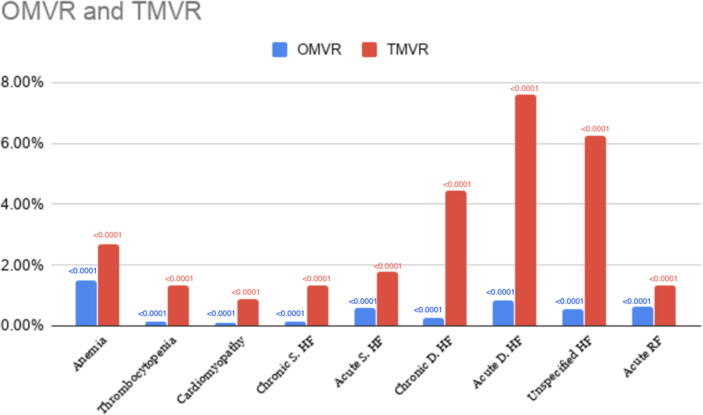
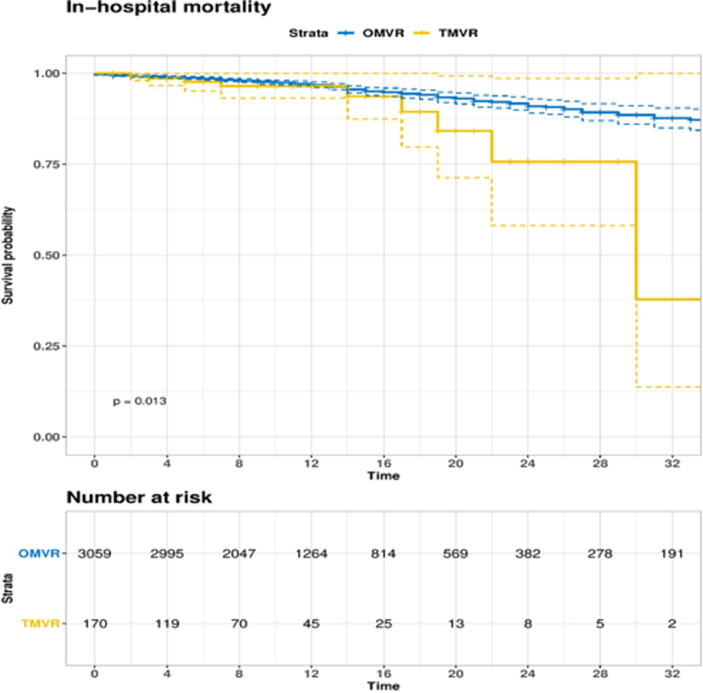
Of 19,580 patients, 18,460 (94%) underwent OMVR and 1120 (6%) TMVR. Mean ages of patients were 63 ± 14 years (OMVR) and 67 ± 13 years (TMVR). Both cohorts were predominantly Caucasian (73% OMVR vs. 74.0% TMVR). The patients who underwent TMVR were more likely to belong to a household with an income in the highest quartile (26.1% vs. 22.0% for OMVR) versus the lowest quartile (22.1% vs. 27.8%). The average number of days from admission to TMVR was less compared to OMVR (2.63 days vs. 3.02 days, p = 0.015). In-hospital length of stay (LOS) was significantly lower for TMVR compared to OMVR (11.56 vs. 14.01 days, p=<0.0001). Adjusted in-hospital mortality taking into account comorbidities showed no significant difference between the two groups (OR 1.2, 0.93-1.68, p = 0.15).
Patients undergoing TMVR were older and more financially affluent. TMVR was more costly but was associated with a shorter hospital stay and similar mortality to OMVR.
经导管二尖瓣修复和置换术(TMVR)是传统开胸二尖瓣置换术(OMVR)的一种微创替代方法。本研究旨在比较TMVR和OMVR的负担、人口统计学特征、成本及并发症。
查询2017年美国国家住院样本(US-NIS)以确定所有TMVR和OMVR病例。分类数据和连续数据分别采用Pearson卡方检验和独立t检验分析。基于有序逻辑回归(OLR)模型计算调整后的优势比(aOR),以确定结局变量之间的关联。
在19580例患者中,18460例(94%)接受了OMVR,1120例(6%)接受了TMVR。患者的平均年龄分别为63±14岁(OMVR)和67±13岁(TMVR)。两个队列主要为白种人(OMVR占73%,TMVR占74.0%)。接受TMVR的患者更有可能来自收入处于最高四分位数的家庭(26.1%,而OMVR为22.0%),而非最低四分位数的家庭(22.1%,而OMVR为27.8%)。与OMVR相比,从入院到TMVR的平均天数更少(2.63天对3.02天,p = 0.015)。TMVR的住院时间(LOS)明显低于OMVR(11.56天对14.01天,p<0.0001)。考虑合并症后的调整后住院死亡率在两组之间无显著差异(OR 1.2, 0.93 - 1.68, p = 0.15)。
接受TMVR的患者年龄更大且经济状况更富裕。TMVR成本更高,但住院时间更短,死亡率与OMVR相似。