Gounaris Antonios K, Grivea Ioanna N, Baltogianni Maria, Gounari Eleni, Antonogeorgos George, Kokori Fedra, Panagiotounakou Polytimi, Theodoraki Martha, Konstantinidi Aikaterini, Sokou Rozeta
Neonatal Clinic-NICU, University General Hospital, 41222 Larissa, Greece.
Neonatal Clinic-NICU, University General Hospital, 451 10 Ioannina, Greece.
J Clin Med. 2020 Jun 1;9(6):1676. doi: 10.3390/jcm9061676.
Caffeine has been commonly used for prevention and treatment of apnea-related symptoms in premature infants. However, its side effects have not been thoroughly studied. We investigated whether caffeine affects gastric motility in very-preterm (VP) neonates.
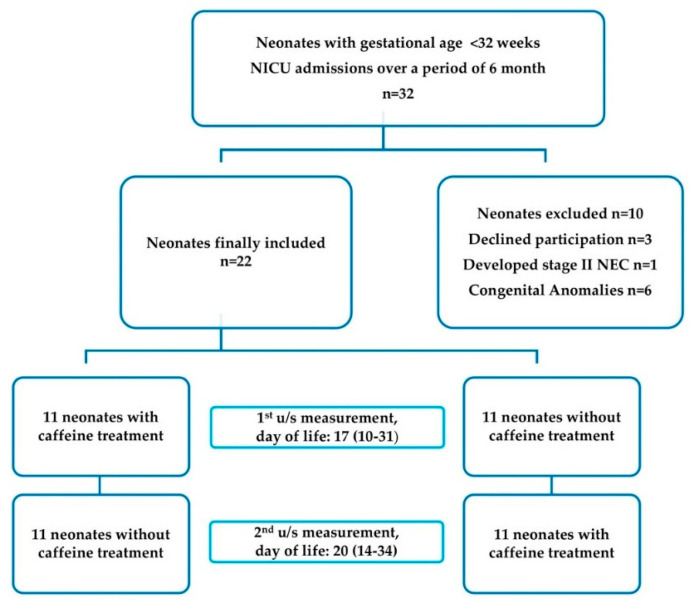
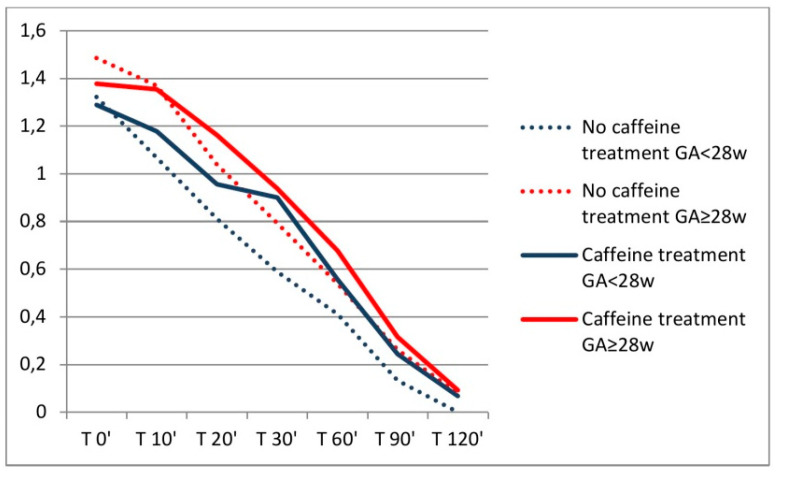
The study is a randomized crossover clinical trial. Twenty-two neonates with mean birth weight (BW) (standard deviation-SD) 1077 (229) g and mean gestational age (GA) (SD) 28.6 (2.1) weeks were recruited. Each neonate had its gastric emptying time checked twice with ultrasound assessment of changes in antral cross sectional area (ACSA). All neonates were sequentially allocated to the caffeine group (A) and the control group (B). Complications from the gastrointestinal tract were documented throughout the study.
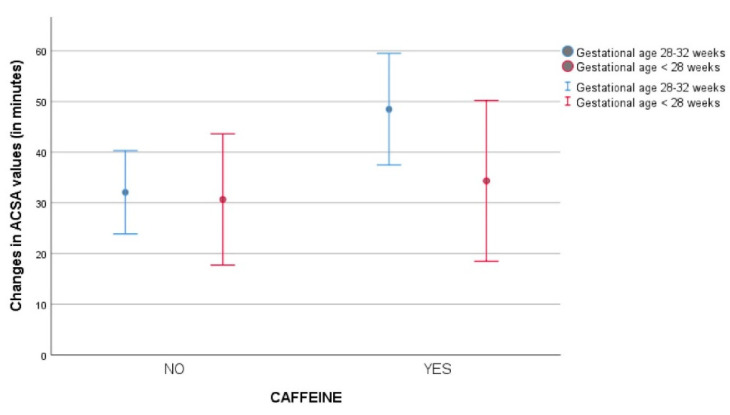
Statistically significant difference was found with regards to the gastric emptying time [median, (range)] between caffeine and control group (p = 0.040). Additionally, in the neonates with BW 1000-1500 g and GA ≥ 28 weeks, the gastric emptying time (minutes) was significantly longer during caffeine treatment [44.5 (36-68.2)] and [40 (34.5-66.5)] respectively, as compared to the gastric emptying time during no caffeine treatment [27 (24.2-30)] ( = 0.002) and [27 (24.5-30)] ( = 0.001). The incidence of gastrointestinal (GI) complications was significantly greater in neonates receiving caffeine [6 (27.%)] as compared with those without caffeine treatment [1 (4.6%)] ( = 0.039).
During caffeine treatment, a significantly delayed gastric emptying time was noted in all study neonates, especially in these with BW 1000-1500 g and those with GA ≥ 28 weeks. Further larger studies are necessary in order to confirm this interesting finding.
咖啡因一直被广泛用于预防和治疗早产儿呼吸暂停相关症状。然而,其副作用尚未得到充分研究。我们调查了咖啡因是否会影响极早产儿(VP)的胃动力。
本研究为随机交叉临床试验。招募了22名平均出生体重(BW)(标准差 - SD)为1077(229)克、平均胎龄(GA)(SD)为28.6(2.1)周的新生儿。通过超声评估胃窦横截面积(ACSA)变化,对每个新生儿的胃排空时间进行两次检查。所有新生儿被依次分配到咖啡因组(A)和对照组(B)。在整个研究过程中记录胃肠道并发症情况。
咖啡因组和对照组在胃排空时间[中位数,(范围)]方面存在统计学显著差异(p = 0.040)。此外,在出生体重为1000 - 1500克且胎龄≥28周的新生儿中,与未使用咖啡因治疗期间的胃排空时间[27(24.2 - 30)](p = 0.002)和[27(24.5 - 30)](p = 0.001)相比,咖啡因治疗期间的胃排空时间(分钟)明显更长,分别为[44.5(36 - 68.2)]和[40(34.5 - 66.5)]。接受咖啡因治疗的新生儿胃肠道(GI)并发症发生率[6(27.%)]明显高于未接受咖啡因治疗的新生儿[1(4.6%)](p = 0.039)。
在咖啡因治疗期间,所有研究新生儿的胃排空时间均显著延迟,尤其是出生体重为1000 - 1500克以及胎龄≥28周的新生儿。需要进一步开展更大规模的研究以证实这一有趣发现。