Barbara Ann Karmanos Cancer Institute and Department of Oncology, Wayne State University School of Medicine, 4100 John R, HWCRC 840.1, Detroit, MI, 48201-2013, USA.
BMC Cancer. 2020 Jun 3;20(1):512. doi: 10.1186/s12885-020-07002-0.
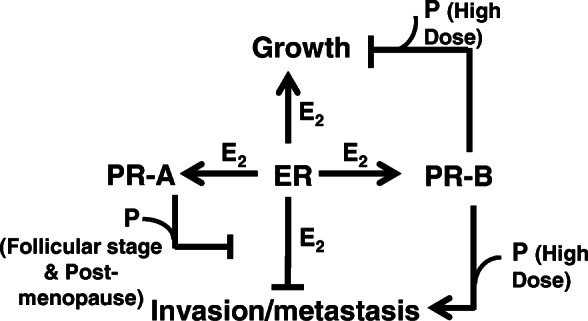
Luminal breast cancer (L-BCa) comprises the majority of incurable, distally metastatic breast cancer cases. Estrogen supports growth of L-BCa cells but suppresses invasiveness. Estrogen also induces the progesterone receptor (PR). Invasiveness and metastasis of L-BCa cells is supported by the short PR isoform (PR-A), in response to the range of pre- and post-menopausal plasma hormone levels, by counteracting the effects of estrogen via micro RNA-mediated cross-talk with the estrogen receptor (ER). PR-B directly supports L-BCa invasion and metastasis and also inhibits tumor growth, both only at high progesterone levels. As public datasets on L-BCa tumors cannot distinguish PR-A, this study was designed to seek clinical evidence for the role of PR-A in metastasis in comparison with PR-B and ER.
Measurement of tumor PR-A, PR-B and ER mRNA expression in 125 treatment-naive primary L-BCa patients with differential node involvement and analysis using linear mixed effects models. Transcriptional activity assays of PR-A and PR-B.
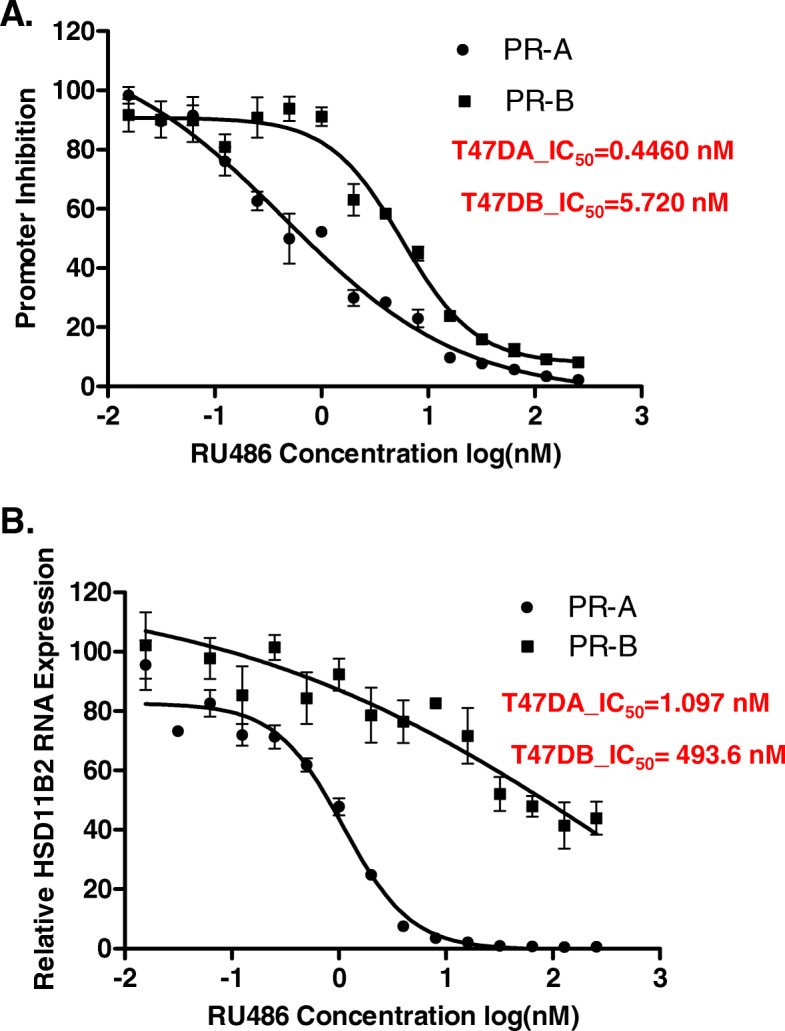
Lymph node involvement was strongly associated with PR-A expression (median, 3-fold higher vs. node-negative), independent of age, pathologic type, tumor grade, HER2 and PR-B. PR-B and ER correlated weakly with PR-A, but whereas PR-B and the PR-A/PR-B ratio were not significantly associated with node involvement, ER weakly negatively correlated with node positivity. PR-A was hypersensitive to mifepristone compared with PR-B.
Taken together with previous mechanistic studies, the findings provide clinical evidence in support of the role of PR-A in L-BCa metastasis. They also suggest the possibility of developing selective PR-A modulators for future interventions in appropriate clinical situations.
腔面型乳腺癌(L-BCa)占不可治愈的远端转移性乳腺癌病例的大多数。雌激素支持 L-BCa 细胞的生长,但抑制其侵袭性。雌激素还诱导孕激素受体(PR)。L-BCa 细胞的侵袭和转移受到短 PR 亚型(PR-A)的支持,这是对绝经前和绝经后血浆激素水平范围的反应,通过与雌激素受体(ER)的 microRNA 介导的交叉对话来抵消雌激素的作用。PR-B 直接支持 L-BCa 的侵袭和转移,并且仅在高孕激素水平下抑制肿瘤生长。由于关于 L-BCa 肿瘤的公共数据集无法区分 PR-A,因此本研究旨在寻求临床证据,证明 PR-A 在转移中的作用与 PR-B 和 ER 相比。
在 125 例未经治疗的原发性 L-BCa 患者中测量肿瘤 PR-A、PR-B 和 ER mRNA 表达,这些患者具有不同的淋巴结受累,并使用线性混合效应模型进行分析。PR-A 和 PR-B 的转录活性测定。
淋巴结受累与 PR-A 表达强烈相关(中位数,与淋巴结阴性相比高 3 倍),与年龄、病理类型、肿瘤分级、HER2 和 PR-B 无关。PR-B 和 ER 与 PR-A 弱相关,但 PR-B 和 PR-A/PR-B 比值与淋巴结受累无显著相关性,而 ER 与淋巴结阳性呈弱负相关。与 PR-B 相比,PR-A 对米非司酮更为敏感。
结合先前的机制研究,这些发现提供了支持 PR-A 在 L-BCa 转移中的作用的临床证据。它们还表明,在适当的临床情况下,有可能开发选择性 PR-A 调节剂用于未来的干预。