Park Chansub, Park Kyeongmee, Kim Jiyoung, Sin Youngjoo, Park Inseok, Cho Hyunjin, Yang Keunho, Bae Byung Noe, Kim Ki Whan, Ahn Sookyung, Gwak Geumhee
Department of Surgery, Sanggye Paik Hospital, College of Medicine, Inje University, 1342 Dongil-ro, Nowon-gu, Seoul, 139-707, Korea.
Department of Pathology, Sanggye Paik Hospital, College of Medicine, Inje University, Seoul, Korea.
World J Surg Oncol. 2016 Sep 13;14(1):244. doi: 10.1186/s12957-016-0999-x.
The luminal subtype of breast cancer is sensitive to anti-estrogen therapy and shows a better prognosis than that of human epidermal growth factor receptor2 (HER2)-enriched or triple-negative breast cancer. However, the luminal type of breast cancer is heterogeneous and can have aggressive clinical features. We investigated the clinical implications of single hormone receptor negativity in a luminal B HER2-negative group.
We collected luminal B HER2-negative breast cancer data that were estrogen receptor (ER) and/or progesterone receptor (PR) positive, Ki 67 high (>14 %), and HER2 negative and divided them into the ER- and PR-positive group and the ER- or PR-negative group. We analyzed the clinical and pathological data and survival according to ER or PR loss.
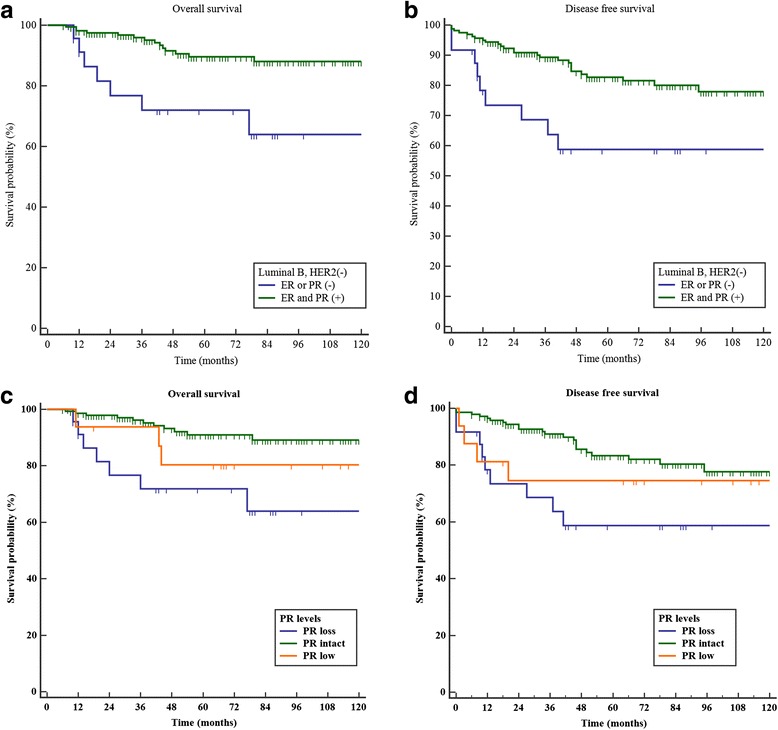
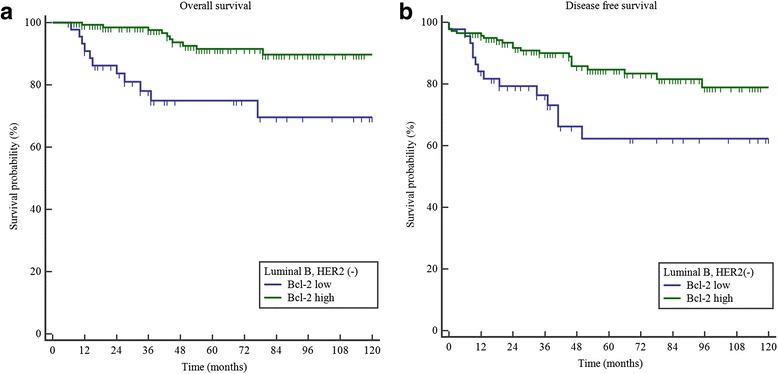
There were no statistical differences in TNM stage, breast and axillary operative methods, or number of tumors between the ER- and PR-positive group and ER- or PR-negative group. However, the ER- or PR-negative group was associated with older age (≥45 years), higher histological grade, lower Bcl-2 expression, and far higher Ki 67 (>50 %). Disease-free survival (DFS) and overall survival (OS) were shorter in the ER- or PR-negative group than that in the ER- and PR-positive group (p = 0.0038, p = 0.0071).
ER- or PR-negative subgroup showed worse prognosis than ER- and PR-positive subgroup in the luminal B HER2-negative group. We could consider the negativity of ER or PR as prognostic marker in luminal B HER2-negative subtype of breast cancer.
乳腺癌的管腔型对抗雌激素治疗敏感,且预后较人表皮生长因子受体2(HER2)富集型或三阴性乳腺癌更好。然而,管腔型乳腺癌具有异质性,可具有侵袭性临床特征。我们研究了管腔B型HER2阴性组中单一激素受体阴性的临床意义。
我们收集了雌激素受体(ER)和/或孕激素受体(PR)阳性、Ki67高表达(>14%)且HER2阴性的管腔B型HER2阴性乳腺癌数据,并将其分为ER和PR阳性组以及ER或PR阴性组。我们根据ER或PR缺失情况分析了临床和病理数据以及生存率。
ER和PR阳性组与ER或PR阴性组在TNM分期、乳腺和腋窝手术方式或肿瘤数量方面无统计学差异。然而,ER或PR阴性组与年龄较大(≥45岁)、组织学分级较高、Bcl-2表达较低以及Ki67远高于50%相关。ER或PR阴性组的无病生存期(DFS)和总生存期(OS)均短于ER和PR阳性组(p = 0.0038,p = 0.0071)。
在管腔B型HER2阴性组中,ER或PR阴性亚组的预后较ER和PR阳性亚组更差。我们可将ER或PR阴性视为管腔B型HER2阴性亚型乳腺癌的预后标志物。