School of Health Sciences, Purdue University, 550 Stadium Mall Drive, Hampton Hall 1263A, West Lafayette, IN, USA.
Purdue University Center for Cancer Research, Purdue University, West Lafayette, IN, USA.
Radiat Oncol. 2020 Jun 3;15(1):141. doi: 10.1186/s13014-020-01585-5.
Murine models are among the most common type of preclinical animal models used to study the human condition, but a wide selection of different mice is currently in use with these differences potentially compromising study results and impairing the ability to reconcile interstudy results. Our goal was to determine how the strain and sex of the mice selection would affect the development of radiation necrosis in our murine model of radiation-induced cerebral necrosis.
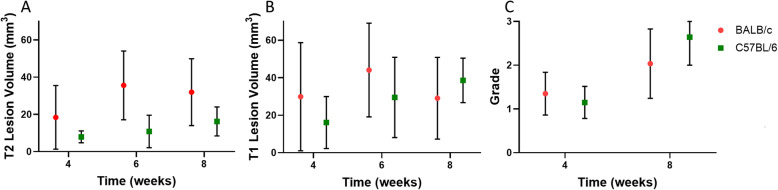
We generated this model by using a preclinical irradiator to irradiate a sub-hemispheric portion of the brain of mice with single-fraction doses of 80 Gy. Eight possible combinations of mice made up of two different with two substrains each (BALB/cN, BALB/cJ, C57BL/6 N, and C57BL/6 J) and both sexes were irradiated in this study. Radiation necrosis development was tracked up to 8 weeks with a 7 T Bruker MRI utilizing T2-weighted and post-contrast T1-weighted imaging. MRI results were compared to and validated with the use of histology which utilized a scale from 0 to 3 in ascending order of damage.
Both time post-irradiation and strain (BALB/c vs C57BL/6) were significant factors affecting radiation necrosis development. Sex was in general not a statistically significant parameter in terms of radiation necrosis development.
Mouse strain thus needs to be considered when evaluating the results of necrosis models. However, sex does not appear to be a variable needing major consideration.
鼠类模型是用于研究人类疾病的最常见的临床前动物模型之一,但目前有多种不同的小鼠被用于研究,这些差异可能会影响研究结果,并阻碍研究结果的一致性。我们的目标是确定小鼠品系和性别选择如何影响我们的辐射诱导脑坏死鼠模型中辐射坏死的发展。
我们使用临床前辐照器对小鼠的半脑半球进行单次 80Gy 剂量的照射,生成了这种模型。在这项研究中,我们用两种不同的亚系(BALB/cN 和 BALB/cJ、C57BL/6N 和 C57BL/6J)的两种品系(BALB/cN、BALB/cJ、C57BL/6N 和 C57BL/6J)的雄性和雌性小鼠共八种组合进行了照射。利用 7T Bruker MRI 进行 T2 加权和对比后 T1 加权成像,在 8 周内追踪辐射坏死的发展。MRI 结果与组织学进行了比较和验证,组织学使用损伤程度递增的 0 到 3 分的评分标准。
辐射后时间和品系(BALB/c 与 C57BL/6)都是影响辐射坏死发展的重要因素。性别通常不是辐射坏死发展的统计学上显著参数。
因此,在评估坏死模型的结果时需要考虑小鼠的品系。然而,性别似乎不是一个需要主要考虑的变量。