Department of Bioengineering, Swanson School of Engineering, University of Pittsburgh, Pittsburgh, PA 15260.
Center for the Neural Basis of Cognition, University of Pittsburgh, Pittsburgh, PA 15260.
eNeuro. 2019 May 1;6(2). doi: 10.1523/ENEURO.0358-18.2019. Print 2019 Mar/Apr.
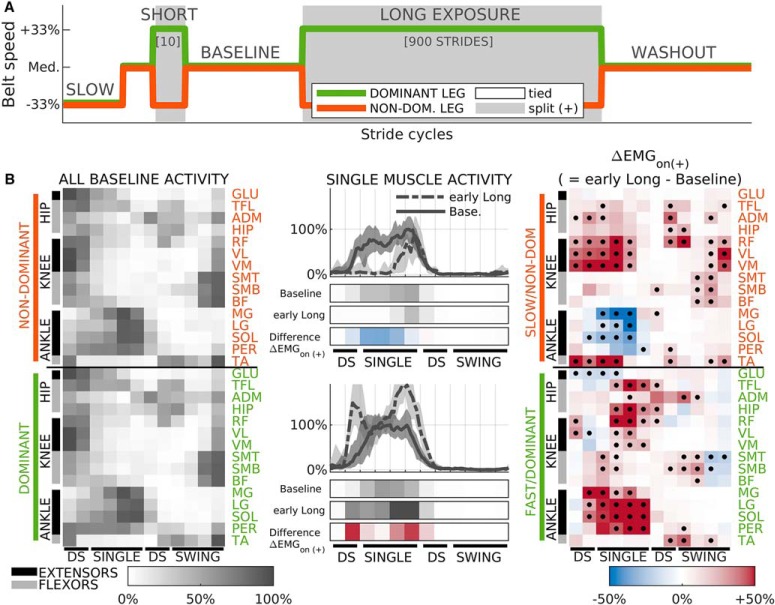
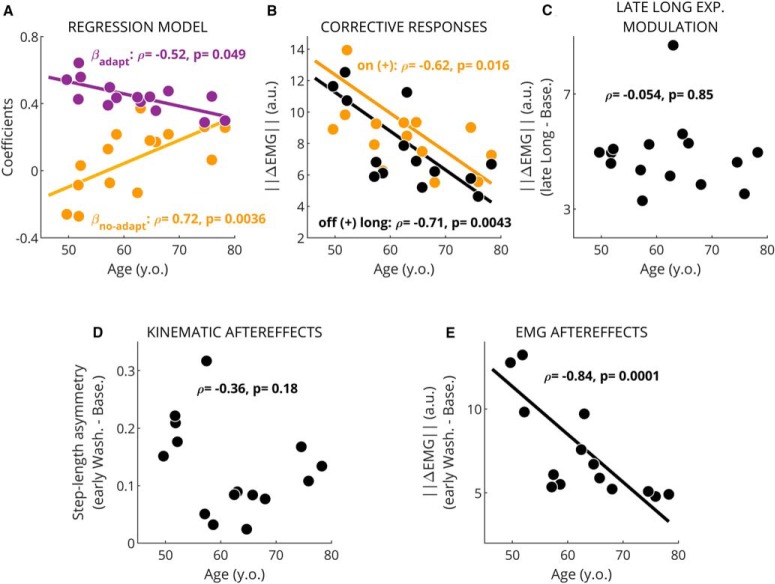
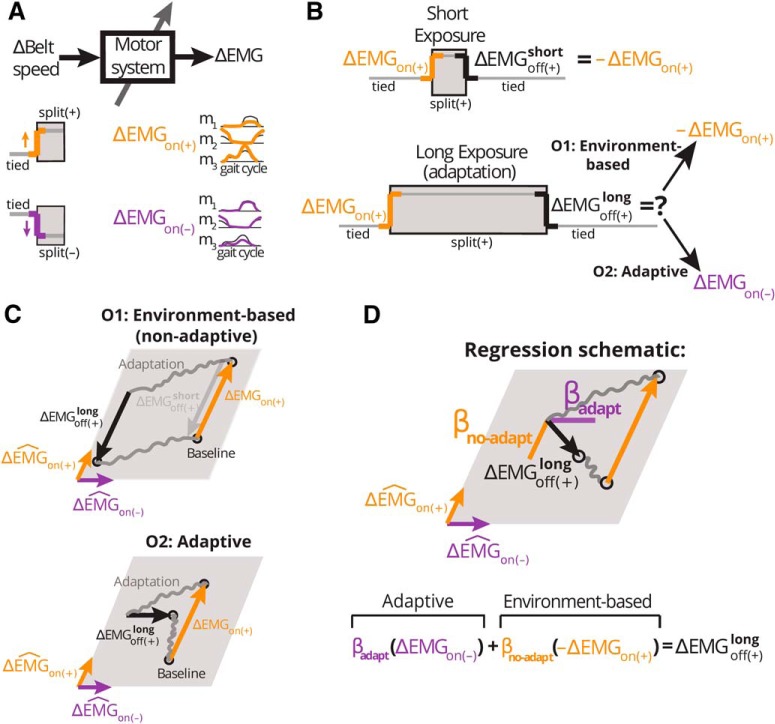
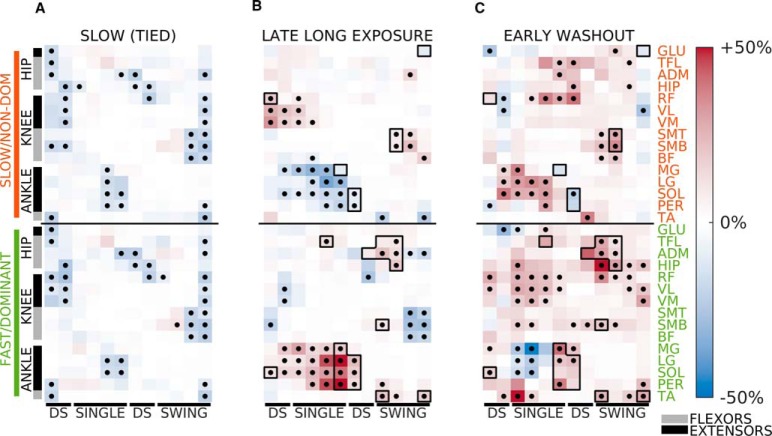
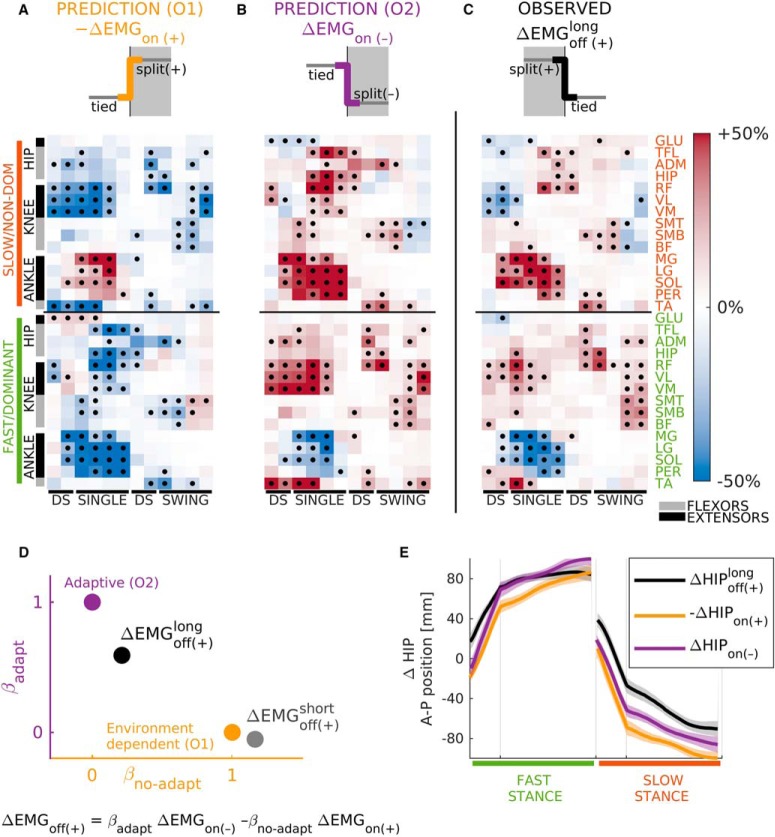
Recent studies suggest that planned and corrective actions are recalibrated during some forms of motor adaptation. However, corrective (also known as reactive) movements in human locomotion are thought to simply reflect sudden environmental changes independently from sensorimotor recalibration. Thus, we asked whether corrective responses can indicate the motor system's adapted state following prolonged exposure to a novel walking situation inducing sensorimotor adaptation. We recorded electromyographic (EMG) signals bilaterally on 15 leg muscles before, during, and after split-belts walking (i.e., novel walking situation), in which the legs move at different speeds. We exploited the rapid temporal dynamics of corrective responses upon unexpected speed transitions to isolate them from the overall motor output. We found that corrective muscle activity was structurally different following short versus long exposures to split-belts walking. Only after a long exposure, removal of the novel environment elicited corrective muscle patterns that matched those expected in response to a perturbation opposite to the one originally experienced. This indicated that individuals who recalibrated their motor system adopted split-belts environment as their new "normal" and transitioning back to the original walking environment causes subjects to react as if it was novel to them. Interestingly, this learning declined with age, but steady state modulation of muscle activity during split-belts walking did not, suggesting potentially different neural mechanisms underlying these motor patterns. Taken together, our results show that corrective motor commands reflect the adapted state of the motor system, which is less flexible as we age.
最近的研究表明,在某些形式的运动适应中,计划和纠正措施会被重新校准。然而,人们认为人类运动中的纠正(也称为反应性)运动只是简单地反映了突然的环境变化,而与感觉运动重新校准无关。因此,我们想知道在长时间暴露于一种新的行走情况(即感觉运动适应)中,纠正反应是否可以表明运动系统的适应状态。我们在 15 条腿部肌肉的双侧记录了肌电图(EMG)信号,在分带行走(即新的行走情况)之前、期间和之后进行了记录,在分带行走中,腿部以不同的速度移动。我们利用纠正反应在意外速度转换时的快速时间动态将其与整体运动输出隔离开来。我们发现,在短时间和长时间暴露于分带行走后,纠正肌肉活动在结构上有所不同。只有在长时间暴露后,去除新环境会引发与最初经历的环境相反的环境引发的纠正肌肉模式,这表明重新校准运动系统的个体将分带环境视为他们的新“正常”,并且返回到原始行走环境会导致他们的反应好像它对他们来说是新的。有趣的是,这种学习能力随着年龄的增长而下降,但在分带行走期间肌肉活动的稳态调节并没有下降,这表明这些运动模式的潜在神经机制可能不同。总之,我们的研究结果表明,纠正运动指令反映了运动系统的适应状态,随着年龄的增长,运动系统的适应性变得不那么灵活。