Department of Preventive Medicine, College of Medicine, University of Tennessee Health Science Center, Memphis, Tennessee, USA.
Department of Oral and Maxillofacial Surgery, College of Dentistry, University of Tennessee Health Science Center, Memphis, Tennessee, USA.
Clin Epigenetics. 2020 Jun 3;12(1):76. doi: 10.1186/s13148-020-00868-8.
A long-term opioid use has been associated with hypermethylation of the opioid receptor mu 1 (OPRM1) promoter. Very little is currently known about the early epigenetic response to therapeutic opioids. Here, we examine whether we can detect DNA methylation changes associated with a few days' use of prescribed opioids. Genome-wide DNA methylation was assayed in a cohort of 33 opioid-naïve participants who underwent standard dental surgery followed by opioid self-administration. Saliva samples were collected before surgery (visit 1), and at two postsurgery visits at 2.7 ± 1.5 days (visit 2), and 39 ± 10 days (visit 3) after the discontinuation of opioid analgesics.
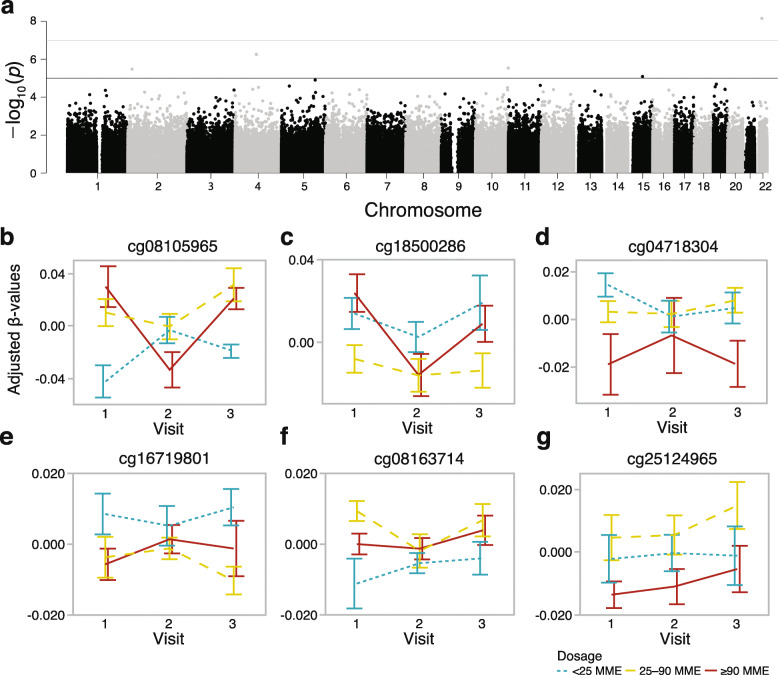
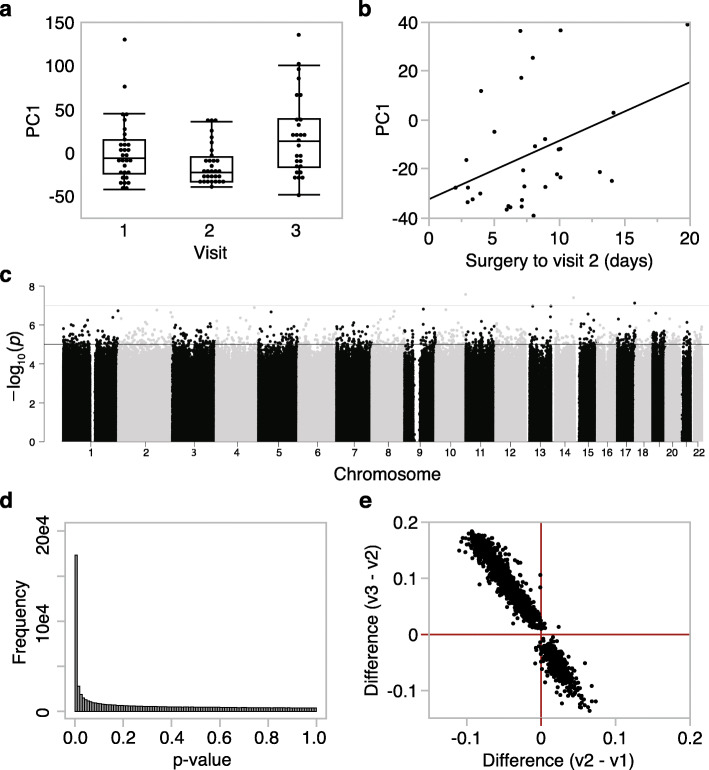
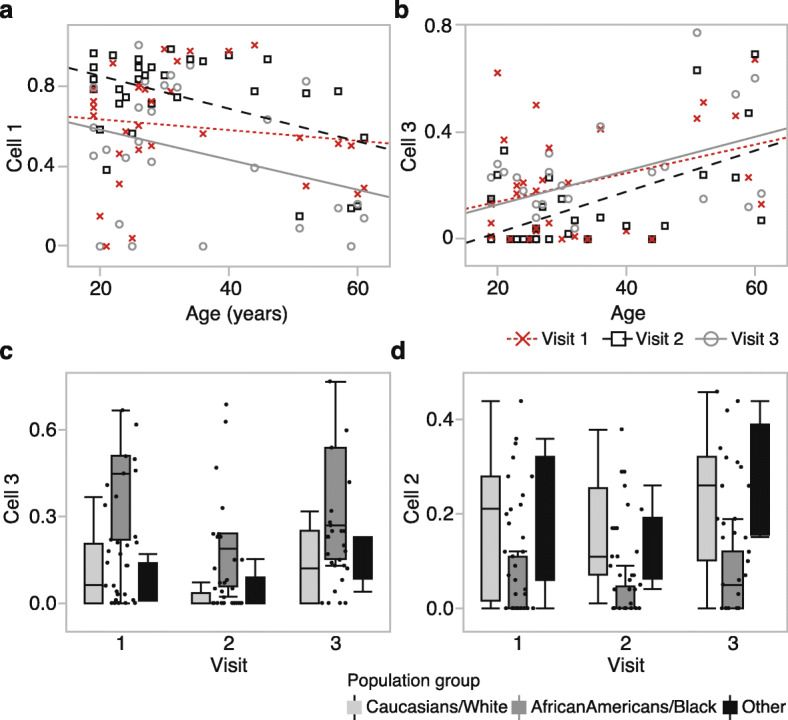
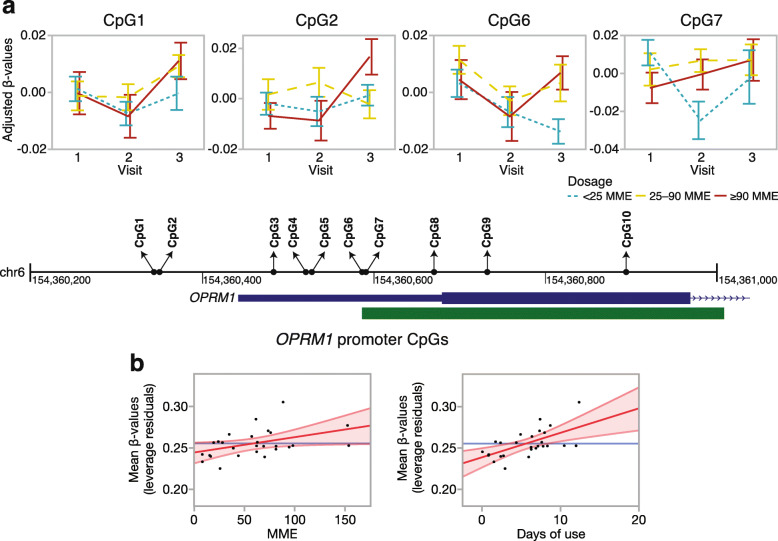
The perioperative methylome underwent significant changes over the three visits that were primarily due to postoperative inflammatory response and cell heterogeneity. To specifically examine the effect of opioids, we started with a candidate gene approach and evaluated 10 CpGs located in the OPRM1 promoter. There was a significant cross-sectional variability in opioid use, and for participants who self-administered the prescribed drugs, the total dosage ranged from 5-210 morphine milligram equivalent (MME). Participants were categorized by cumulative dosage into three groups: < 25 MME, 25-90 MME, and ≥ 90 MME. Using mixed-effects modeling, 4 CpGs had significant positive associations with opioid dose at two-tailed p value < 0.05, and overall, 9 of the 10 OPRM1 promoter CpGs showed the predicted higher methylation in the higher dose groups relative to the lowest dose group. After adjustment for age, cellular heterogeneity, and past tobacco use, the promoter mean methylation also had positive associations with cumulative MME (regression coefficient = 0.0002, one-tailed p value = 0.02) and duration of opioid use (regression coefficient = 0.003, one-tailed p value = 0.001), but this effect was significant only for visit 3. A preliminary epigenome-wide association study identified a significant CpG in the promoter of the RAS-related signaling gene, RASL10A, that may be predictive of opioid dosage.
The present study provides evidence that the hypermethylation of the OPRM1 promoter is in response to opioid use and that epigenetic differences in OPRM1 and other sites are associated with a short-term use of therapeutic opioids.
长期使用阿片类药物与阿片受体 mu1(OPRM1)启动子的高甲基化有关。目前,人们对治疗性阿片类药物的早期表观遗传反应知之甚少。在这里,我们研究了是否可以检测到与使用处方阿片类药物几天相关的 DNA 甲基化变化。对 33 名阿片类药物-naïve 参与者进行了全基因组 DNA 甲基化分析,这些参与者接受了标准牙科手术,然后自行服用阿片类药物。在手术前(第 1 次就诊)以及术后 2.7±1.5 天(第 2 次就诊)和停用阿片类镇痛药后 39±10 天(第 3 次就诊)采集唾液样本。
三次就诊期间围手术期甲基组发生了显著变化,主要是由于术后炎症反应和细胞异质性所致。为了专门研究阿片类药物的影响,我们首先采用候选基因方法评估了位于 OPRM1 启动子内的 10 个 CpG。由于阿片类药物的使用存在明显的横断面变异性,对于自行服用规定药物的参与者,总剂量范围为 5-210 毫克吗啡等效物(MME)。根据累积剂量,参与者分为三组:<25 MME、25-90 MME 和≥90 MME。使用混合效应模型,有 4 个 CpG 在双侧 p 值<0.05 时有显著的正相关,总体而言,10 个 OPRM1 启动子 CpG 中有 9 个显示出与最低剂量组相比,在较高剂量组中更高的甲基化。在校正年龄、细胞异质性和过去吸烟史后,启动子平均甲基化也与累积 MME(回归系数=0.0002,单侧 p 值=0.02)和阿片类药物使用时间(回归系数=0.003,单侧 p 值=0.001)呈正相关,但这种影响仅在第 3 次就诊时显著。初步的全基因组关联研究发现,RAS 相关信号基因 RASL10A 启动子中的一个 CpG 可能与阿片类药物剂量相关。
本研究提供的证据表明,OPRM1 启动子的高甲基化是对阿片类药物使用的反应,而 OPRM1 和其他部位的表观遗传差异与短期使用治疗性阿片类药物有关。