Velayos María, Muñoz-Serrano Antonio Jesús, Estefanía-Fernández Karla, Sarmiento Caldas Ma Carmen, Moratilla Lapeña Lucas, López-Santamaría Manuel, López-Gutiérrez Juan Carlos
Servicio de Cirugía Pediátrica. Hospital Universitario La Paz, Madrid, España.
Servicio de Cirugía Pediátrica. Hospital Universitario La Paz, Madrid, España.
An Pediatr (Engl Ed). 2020 Aug;93(2):118-122. doi: 10.1016/j.anpedi.2020.04.022. Epub 2020 May 11.
Acute appendicitis (AA) is the most common abdominal surgical emergency. No specific studies have been found that evaluate the impact of the coronavirus 2 (SARS-Cov-2) pandemic on AA and its surgical management. An analysis was made on the influence of this new pathology on the clinical course of AA.
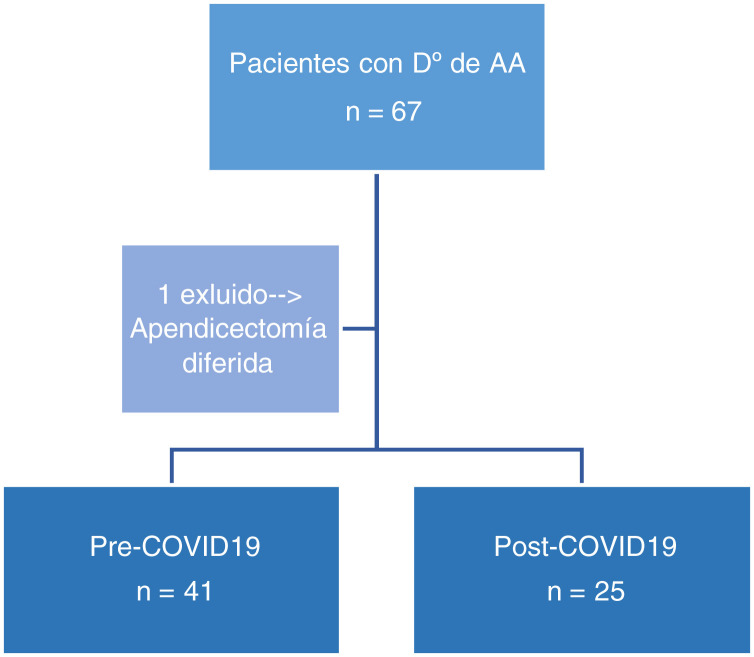
Retrospective observational study was conducted on patients operated on for AA from January to April 2020. They were classified according to the time of the appendectomy, before the declaration of the state of alarm (pre-COVID-19), and after its declaration (post-COVID-19) in Spain, one the most affected countries in the world. An evaluation was made of demographic variables, duration of symptoms, type of appendicitis, surgical time, hospital stay, and postoperative complications.
The study included 66 patients (41 pre-COVID-19; 25 post-COVID-19) with mean age of 10.7 ± 3 and 9.3 ± 3.1; P = .073, respectively. Fever was found in a higher number of post-COVID-19 patients (52 vs. 19.5%; P = 0.013), as well as a higher CRP (72.7 ± 96.2 vs. 31.3 ± 36.2 mg/dL; P = 0.042). This group presented with a higher proportion of complicated appendicitis when compared to pre-COVID-19 (32 vs. 7.3%; P = 0.015). The mean hospital stay was longer in the post-COVID-19 group (5.6 ± 5.9 vs. 3.2 ± 4.3 days; P = 0.041). No differences were found in the time of onset of symptoms or surgical time.
The SARS-Cov-2 pandemic influenced the time of diagnosis of appendicitis, as well as its course, and mean hospital stay. Peritonitis was more frequently seen. As a result of the significant circumstances, delaying diagnosis and treatment of AA during SARS-Cov-2 pandemic, inappropriate management of this common surgical disorder has been noticed.
急性阑尾炎(AA)是最常见的腹部外科急症。尚未发现有专门研究评估2019冠状病毒病(SARS-CoV-2)大流行对急性阑尾炎及其外科治疗的影响。本研究分析了这种新发病理对急性阑尾炎临床病程的影响。
对2020年1月至4月因急性阑尾炎接受手术的患者进行回顾性观察研究。根据阑尾切除术时间,将患者分为西班牙宣布进入警戒状态之前(COVID-19之前)和之后(COVID-19之后),西班牙是世界上受影响最严重的国家之一。评估了人口统计学变量、症状持续时间、阑尾炎类型、手术时间、住院时间和术后并发症。
该研究纳入了66例患者(COVID-19之前41例;COVID-19之后25例),平均年龄分别为10.7±3岁和9.3±3.1岁;P=0.073。COVID-19之后的患者发热人数更多(52%对19.5%;P=0.013),C反应蛋白(CRP)也更高(72.7±96.2对31.3±36.2mg/dL;P=0.042)。与COVID-19之前相比,该组复杂阑尾炎的比例更高(32%对7.3%;P=0.015)。COVID-19之后组的平均住院时间更长(5.6±5.9天对3.2±4.3天;P=0.041)。症状出现时间或手术时间没有差异。
SARS-CoV-2大流行影响了阑尾炎的诊断时间、病程及平均住院时间。腹膜炎更为常见。由于这些重大情况,在SARS-CoV-2大流行期间急性阑尾炎的诊断和治疗被延迟,已注意到对这种常见外科疾病的处理不当。