Bo Yuxia, Qiu Shirley, Mulloy Rory P, Côté Marceline
Department of Biochemistry, Microbiology and Immunology, University of Ottawa, Ottawa, Canada.
Ottawa Institute of Systems Biology, University of Ottawa, Ottawa, Canada.
J Virol. 2020 Jul 30;94(16). doi: 10.1128/JVI.01002-20.
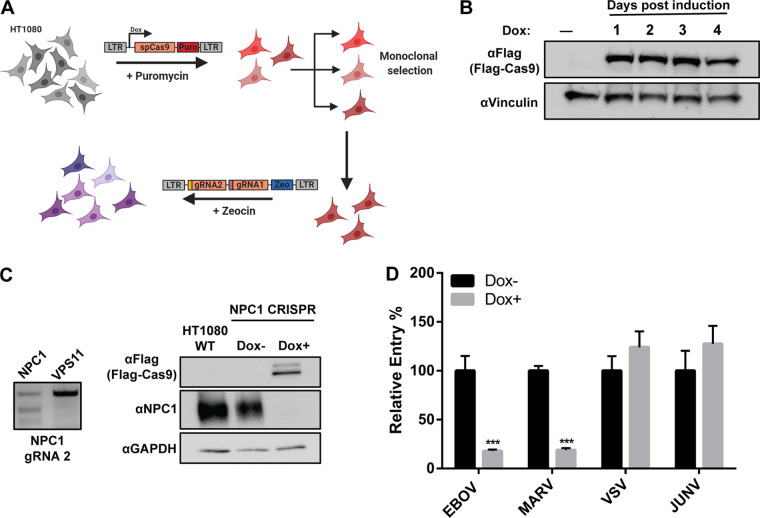
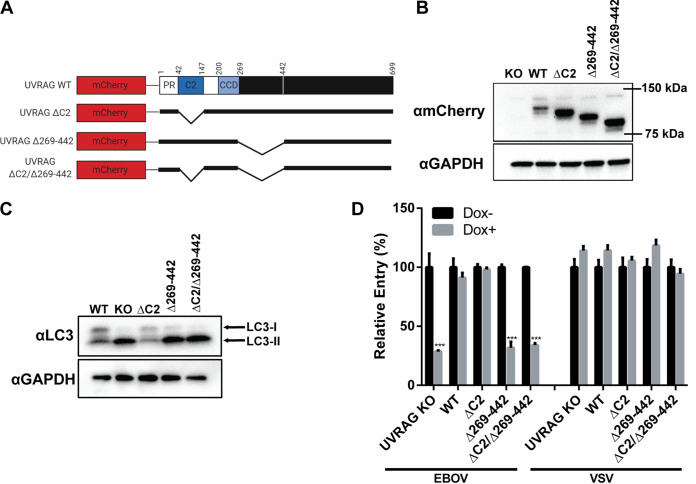
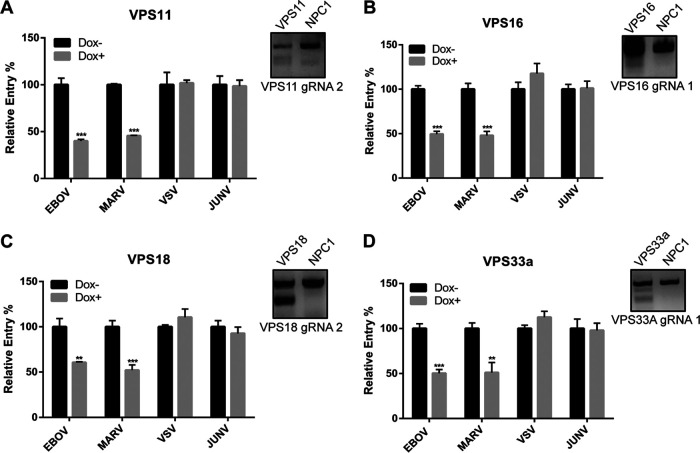
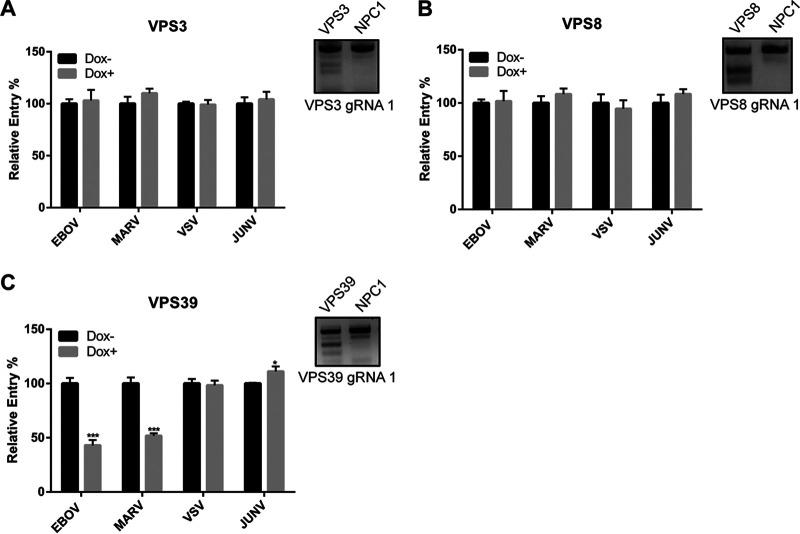
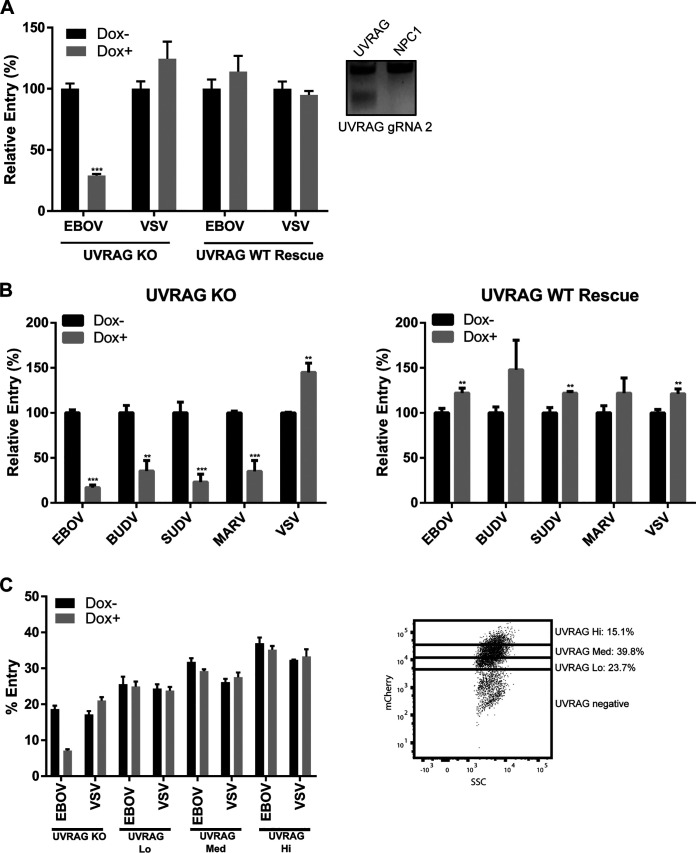
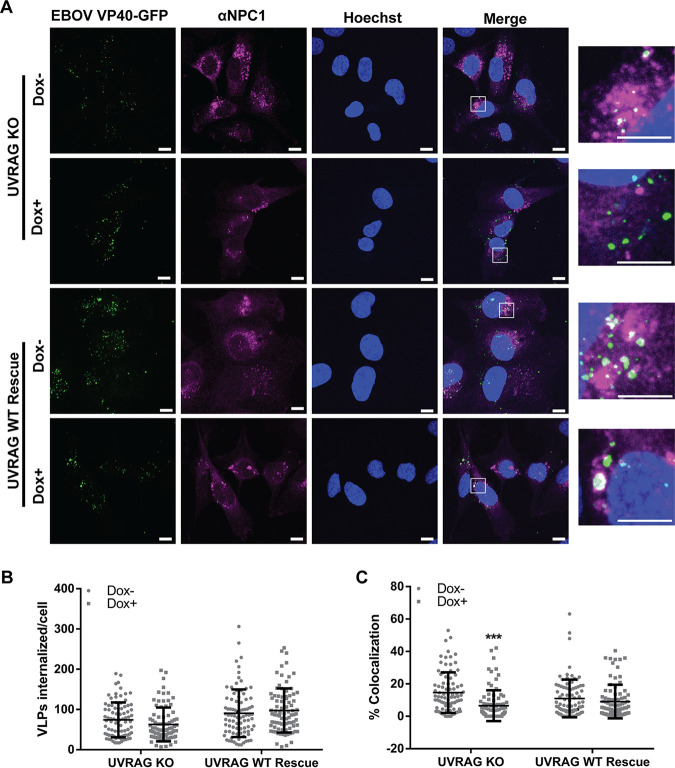
Ebola virus (EBOV) entry requires internalization into host cells and extensive trafficking through the endolysosomal network in order to reach late endosomal/lysosomal compartments that contain triggering factors for viral membrane fusion. These triggering factors include low-pH-activated cellular cathepsin proteases, which cleave the EBOV glycoprotein (GP), exposing a domain which binds to the filoviral receptor, the cholesterol transporter Niemann-Pick C1 (NPC1). Here, we report that trafficking of EBOV to NPC1 requires expression of the homotypic fusion and protein sorting (HOPS) tethering complex as well as its regulator, UV radiation resistance-associated gene (UVRAG). Using an inducible clustered regularly interspaced short palindromic repeats (CRISPR)/Cas9 system, we demonstrated that depletion of HOPS subunits as well as UVRAG impairs entry by all pathogenic filoviruses. UVRAG depletion resulted in reduced delivery of EBOV virions to NPC1 cellular compartments. Furthermore, we show that deletion of a domain on UVRAG known to be required for interaction with the HOPS complex results in impaired EBOV entry. Taken together, our studies demonstrate that EBOV requires both expression of and coordination between the HOPS complex and UVRAG in order to mediate efficient viral entry. Ebola viruses (EBOV) and other filoviruses cause sporadic and unpredictable outbreaks of highly lethal diseases. The lack of FDA-approved therapeutics, particularly ones with panfiloviral specificity, highlights the need for continued research efforts to understand aspects of the viral life cycle that are common to all filoviruses. As such, viral entry is of particular interest, as all filoviruses must reach cellular compartments containing the viral receptor Niemann-Pick C1 to enter cells. Here, we present an inducible CRISPR/Cas9 method to rapidly and efficiently generate knockout cells in order to interrogate the roles of a broad range of host factors in viral entry. Using this approach, we showed that EBOV entry depends on both the homotypic fusion and protein sorting (HOPS) tethering complex in coordination with UV radiation resistance-associated gene (UVRAG). Importantly, we demonstrate that the HOPS complex and UVRAG are required by all pathogenic filoviruses, representing potential targets for panfiloviral therapeutics.
埃博拉病毒(EBOV)进入宿主细胞需要内化,并通过内溶酶体网络进行广泛运输,以到达含有病毒膜融合触发因子的晚期内体/溶酶体区室。这些触发因子包括低pH激活的细胞组织蛋白酶,其切割EBOV糖蛋白(GP),暴露出一个与丝状病毒受体胆固醇转运蛋白尼曼-皮克C1(NPC1)结合的结构域。在此,我们报告EBOV运输至NPC1需要同型融合和蛋白分选(HOPS)拴系复合体及其调节因子紫外线辐射抗性相关基因(UVRAG)的表达。使用可诱导的成簇规律间隔短回文重复序列(CRISPR)/Cas9系统,我们证明HOPS亚基以及UVRAG的缺失会损害所有致病性丝状病毒的进入。UVRAG的缺失导致EBOV病毒粒子向NPC1细胞区室的递送减少。此外,我们表明,缺失UVRAG上已知与HOPS复合体相互作用所需的结构域会导致EBOV进入受损。综上所述,我们的研究表明,EBOV需要HOPS复合体和UVRAG的表达及协调作用,以介导有效的病毒进入。埃博拉病毒(EBOV)和其他丝状病毒会引发偶发性且不可预测的高致死性疾病爆发。缺乏FDA批准的治疗方法,尤其是具有泛丝状病毒特异性的治疗方法,凸显了持续开展研究工作以了解所有丝状病毒共有的病毒生命周期方面的必要性。因此,病毒进入尤为令人关注,因为所有丝状病毒都必须到达含有病毒受体尼曼-皮克C1的细胞区室才能进入细胞。在此,我们提出一种可诱导的CRISPR/Cas9方法,用于快速有效地生成基因敲除细胞,以探究多种宿主因子在病毒进入中的作用。使用这种方法,我们表明EBOV进入依赖于同型融合和蛋白分选(HOPS)拴系复合体与紫外线辐射抗性相关基因(UVRAG)的协同作用。重要的是,我们证明所有致病性丝状病毒都需要HOPS复合体和UVRAG,这代表了泛丝状病毒治疗的潜在靶点。