Department of Integrative Structural and Computational Biology, The Scripps Research Institute, La Jolla, CA 92037, USA.
Department of Immunology and Microbiology, The Scripps Research Institute, La Jolla, CA 92037, USA.
Sci Adv. 2020 Apr 15;6(16):eaaz6225. doi: 10.1126/sciadv.aaz6225. eCollection 2020 Apr.
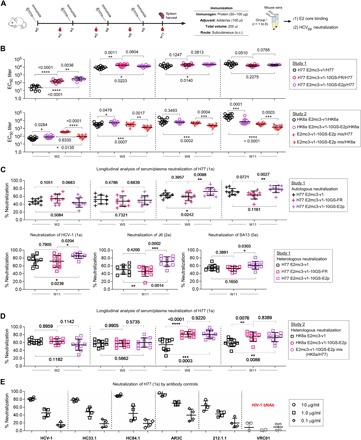
Hepatitis C virus (HCV) envelope glycoproteins E1 and E2 are responsible for cell entry, with E2 being the major target of neutralizing antibodies (NAbs). Here, we present a comprehensive strategy for B cell-based HCV vaccine development through E2 optimization and nanoparticle display. We redesigned variable region 2 in a truncated form (tVR2) on E2 cores derived from genotypes 1a and 6a, resulting in improved stability and antigenicity. Crystal structures of three optimized E2 cores with human cross-genotype NAbs (AR3s) revealed how the modified tVR2 stabilizes E2 without altering key neutralizing epitopes. We then displayed these E2 cores on 24- and 60-meric nanoparticles and achieved substantial yield and purity, as well as enhanced antigenicity. In mice, these nanoparticles elicited more effective NAb responses than soluble E2 cores. Next-generation sequencing (NGS) defined distinct B cell patterns associated with nanoparticle-induced antibody responses, which target the conserved neutralizing epitopes on E2 and cross-neutralize HCV genotypes.
丙型肝炎病毒 (HCV) 包膜糖蛋白 E1 和 E2 负责细胞进入,其中 E2 是中和抗体 (NAb) 的主要靶标。在这里,我们通过 E2 优化和纳米颗粒展示提出了一种基于 B 细胞的 HCV 疫苗开发的综合策略。我们在源自基因型 1a 和 6a 的 E2 核心上重新设计了可变区 2 的截断形式 (tVR2),从而提高了稳定性和抗原性。三种优化后的 E2 核心与人类跨基因型 NAb (AR3s) 的晶体结构揭示了修饰后的 tVR2 如何在不改变关键中和表位的情况下稳定 E2。然后,我们将这些 E2 核心展示在 24 聚体和 60 聚体纳米颗粒上,实现了高产量和高纯度,并增强了抗原性。在小鼠中,这些纳米颗粒引起了比可溶性 E2 核心更有效的 NAb 反应。下一代测序 (NGS) 定义了与纳米颗粒诱导的抗体反应相关的独特 B 细胞模式,这些反应针对 E2 上的保守中和表位并交叉中和 HCV 基因型。