Department of Biochemistry, Duke University Medical Center, Durham, NC, USA.
Department of Neurobiology, Duke University Medical Center, Durham, NC, USA.
Sci Adv. 2020 May 6;6(19):eaba0310. doi: 10.1126/sciadv.aba0310. eCollection 2020 May.
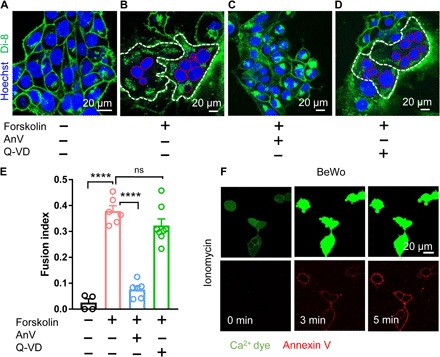
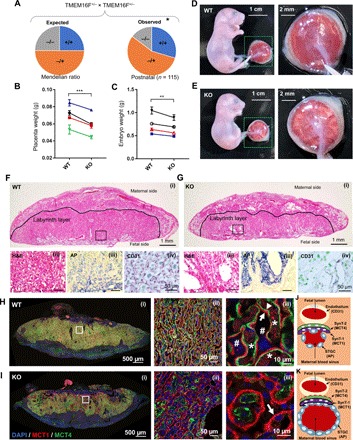
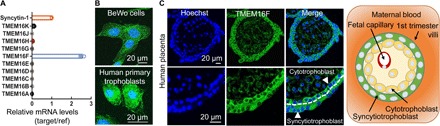
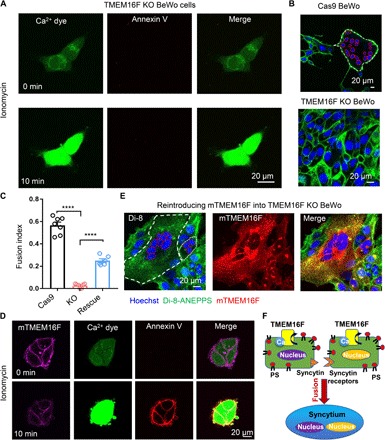
Cell-cell fusion or syncytialization is fundamental to the reproduction, development, and homeostasis of multicellular organisms. In addition to various cell type-specific fusogenic proteins, cell surface externalization of phosphatidylserine (PS), a universal eat-me signal in apoptotic cells, has been observed in different cell fusion events. Nevertheless, the molecular underpinnings of PS externalization and cellular mechanisms of PS-facilitated cell-cell fusion are unclear. Here, we report that TMEM16F, a Ca-activated phospholipid scramblase (CaPLSase), plays an essential role in placental trophoblast fusion by translocating PS to cell surface independent of apoptosis. The placentas from the TMEM16F knockout mice exhibit deficiency in trophoblast syncytialization and placental development, which lead to perinatal lethality. We thus identified a new biological function of TMEM16F CaPLSase in trophoblast fusion and placental development. Our findings provide insight into understanding cell-cell fusion mechanism of other cell types and on mitigating pregnancy complications such as miscarriage, intrauterine growth restriction, and preeclampsia.
细胞融合或合胞作用是多细胞生物繁殖、发育和内稳态的基础。除了各种细胞类型特异性的融合蛋白外,在不同的细胞融合事件中,还观察到了磷脂酰丝氨酸(PS)的细胞表面外化,PS 是凋亡细胞中通用的“吃我”信号。然而,PS 外化的分子基础和 PS 促进细胞间融合的细胞机制尚不清楚。在这里,我们报告 TMEM16F,一种钙激活的磷脂翻转酶(CaPLSase),通过将 PS 转位到细胞表面而不依赖于细胞凋亡,在胎盘滋养层融合中发挥重要作用。TMEM16F 敲除小鼠的胎盘表现出滋养层融合和胎盘发育缺陷,导致围产期致死。因此,我们鉴定了 TMEM16F CaPLSase 在滋养层融合和胎盘发育中的新生物学功能。我们的发现为理解其他细胞类型的细胞融合机制以及减轻流产、宫内生长受限和子痫前期等妊娠并发症提供了思路。