Department of Infectious Diseases, Institute of Biomedicine, Sahlgrenska Academy, University of Gothenburg, Guldhedsgatan 10A, 413 46, Göteborg, Sweden.
Department of Clinical Microbiology, Sahlgrenska University Hospital, Göteborg, Region Västra Götaland, Sweden.
Dig Dis Sci. 2021 May;66(5):1556-1564. doi: 10.1007/s10620-020-06368-2. Epub 2020 Jun 3.
Noninvasive methods to assess treatment response in eosinophilic esophagitis are needed.
Our aim was to determine whether a blood-based biomarker panel centered on immune parameters could identify histologic response to treatment in eosinophilic esophagitis patients.
A pilot study involving adult patients with active eosinophilic esophagitis recruited at two Ear, Nose, Throat clinics in Sweden was designed. The patients (n = 20) donated blood and esophageal biopsies and filled in three questionnaires before and after a 2-month course of topical corticosteroids. Blood samples were analyzed for absolute levels of granulocytes and T cells and the fractions of eosinophils expressing 10 different surface markers by flow cytometry. All data were analyzed by multivariate methods of pattern recognition.
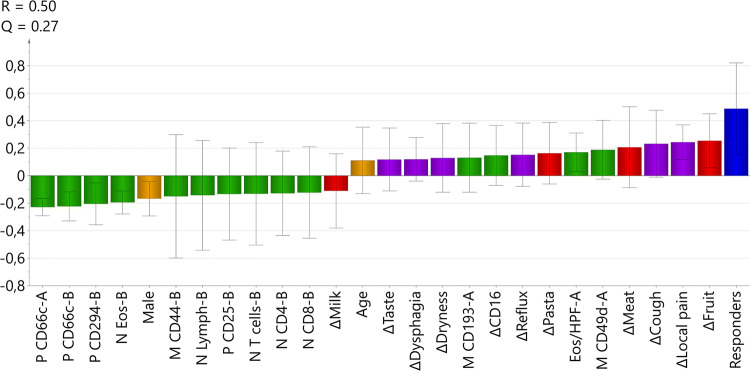
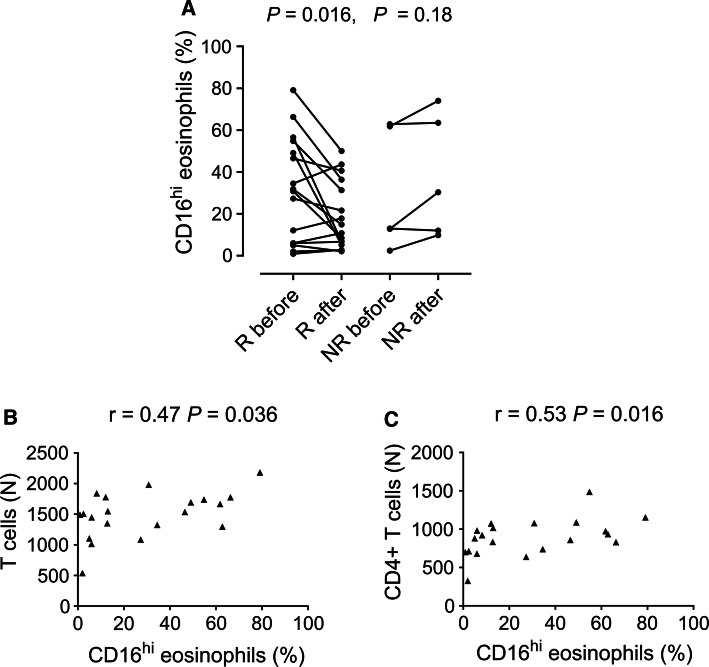
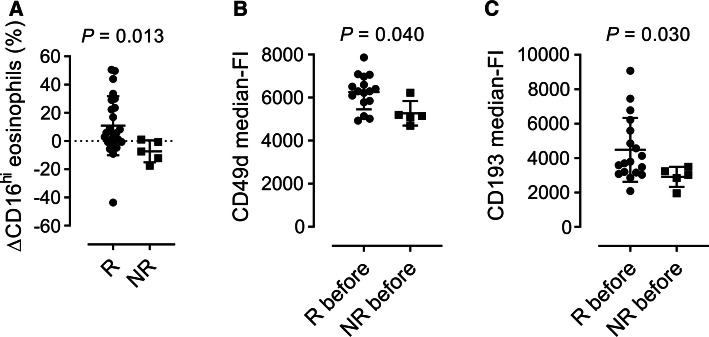
Multivariate modeling revealed that a combination of 13 immune parameters and 10 patient-reported outcome scores were required to create a model capable of separating responders (n = 15) from non-responders (n = 5). Questions regarding symptoms of esophageal dysfunction and capacity to eat certain foods from two of the questionnaires were discriminatory in the multivariate model, as were absolute counts of T cells, eosinophils, and eosinophil expression of activation markers and cell adhesion molecules.
A combination of blood-based immune parameters and directed questions may prove helpful to monitor response to treatment, perhaps reducing the need for repeat endoscopies in eosinophilic esophagitis patients in the future.
需要非侵入性方法来评估嗜酸性食管炎的治疗反应。
我们旨在确定以免疫参数为中心的基于血液的生物标志物谱是否可以识别嗜酸性食管炎患者对治疗的组织学反应。
设计了一项涉及在瑞典两家耳鼻喉科诊所招募的患有活动性嗜酸性食管炎的成年患者的试点研究。这些患者(n=20)在接受为期 2 个月的局部皮质类固醇治疗前后捐献血液和食管活检,并填写了三份问卷。通过流式细胞术分析血液样本中粒细胞和 T 细胞的绝对水平以及表达 10 种不同表面标志物的嗜酸性粒细胞的分数。所有数据均通过模式识别的多元方法进行分析。
多元建模显示,需要结合 13 种免疫参数和 10 种患者报告的结果评分,才能创建能够区分应答者(n=15)和无应答者(n=5)的模型。两个问卷中有关食管功能障碍症状和食用某些食物能力的问题在多元模型中具有区分性,T 细胞、嗜酸性粒细胞以及激活标志物和细胞黏附分子表达的绝对计数也是如此。
基于血液的免疫参数和定向问题的组合可能有助于监测治疗反应,也许将来会减少嗜酸性食管炎患者重复内镜检查的需求。