Department of Infectious Diseases, Institute of Biomedicine, Sahlgrenska Academy, University of Gothenburg, Guldhedsgatan 10A, 413 46, Gothenburg, Sweden.
Department of Otorhinolaryngology, Head and Neck Surgery, Institute of Clinical Sciences, Sahlgrenska Academy, University of Gothenburg, Gröna Stråket 9, 413 45, Gothenburg, Sweden.
Dysphagia. 2022 Apr;37(2):286-296. doi: 10.1007/s00455-021-10277-5. Epub 2021 Mar 8.
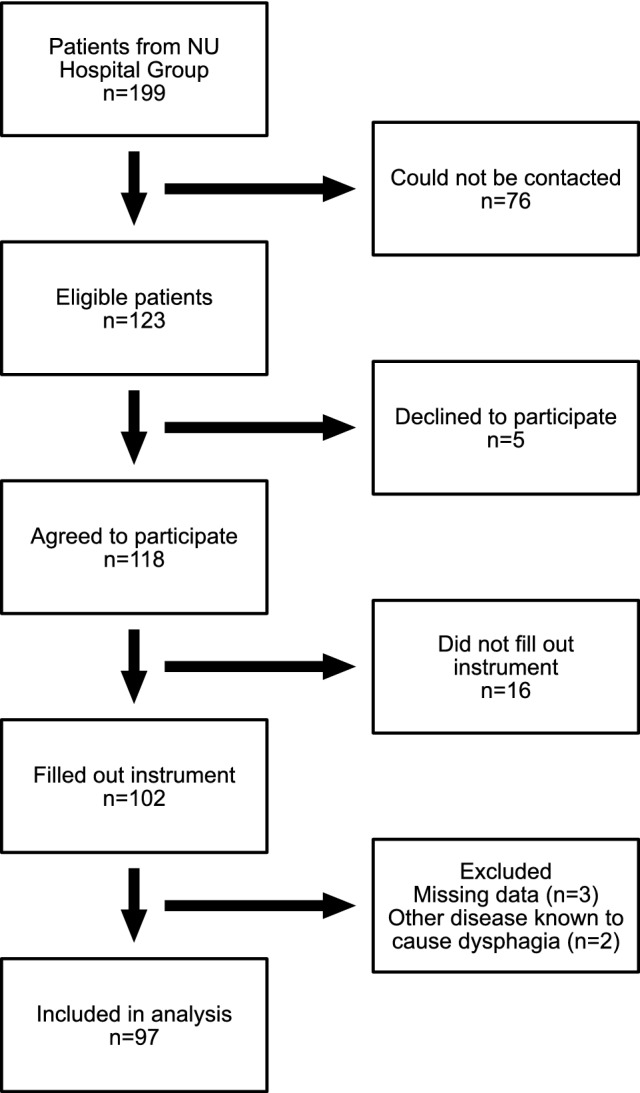
The lack of a Swedish patient-reported outcome instrument for eosinophilic esophagitis (EoE) has limited the assessment of the disease. The aims of the study were to translate and validate the Eosinophilic Esophagitis Activity Index (EEsAI) to Swedish and to assess the symptom severity of patients with EoE compared to a nondysphagia control group. The EEsAI was translated and adapted to a Swedish cultural context (S-EEsAI) based on international guidelines. The S-EEsAI was validated using adult Swedish patients with EoE (n = 97) and an age- and sex-matched nondysphagia control group (n = 97). All participants completed the S-EEsAI, the European Organization for Research and Treatment of Cancer Quality of Life Questionnaire-Oesophageal Module 18 (EORTC QLQ-OES18), and supplementary questions regarding feasibility and demographics. Reliability and validity of the S-EEsAI were evaluated by Cronbach's alpha and Spearman correlation coefficients between the domains of the S-EEsAI and the EORTC QLQ-OES18. A test-retest analysis of 29 patients was evaluated through intraclass correlation coefficients. The S-EEsAI had sufficient reliability with Cronbach's alpha values of 0.83 and 0.85 for the "visual dysphagia question" and the "avoidance, modification and slow eating score" domains, respectively. The test-retest reliability was sufficient, with good to excellent intraclass correlation coefficients (0.60-0.89). The S-EEsAI domains showed moderate correlation to 6/10 EORTC QLQ-OES18 domains, indicating adequate validity. The patient S-EEsAI results differed significantly from those of the nondysphagia controls (p < 0.001). The S-EEsAI appears to be a valid and reliable instrument for monitoring adult patients with EoE in Sweden.
缺乏用于嗜酸性粒细胞性食管炎 (EoE) 的瑞典患者报告结局工具限制了对该疾病的评估。本研究的目的是将嗜酸性粒细胞性食管炎活动指数 (EEsAI) 翻译并验证为瑞典语,并评估 EoE 患者的症状严重程度与无吞咽困难对照组相比。EEsAI 根据国际指南进行翻译和改编以适应瑞典文化背景 (S-EEsAI)。使用瑞典成年 EoE 患者 (n = 97) 和年龄和性别匹配的无吞咽困难对照组 (n = 97) 验证了 S-EEsAI。所有参与者均完成了 S-EEsAI、欧洲癌症研究与治疗组织生活质量问卷-食管模块 18 (EORTC QLQ-OES18),以及关于可行性和人口统计学的补充问题。通过 S-EEsAI 各领域与 EORTC QLQ-OES18 之间的 Cronbach's alpha 和 Spearman 相关系数评估 S-EEsAI 的可靠性和有效性。对 29 名患者的测试-重测分析通过组内相关系数进行评估。S-EEsAI 具有足够的可靠性,Cronbach's alpha 值分别为 0.83 和 0.85,用于“视觉吞咽困难问题”和“回避、修改和缓慢进食评分”领域。测试-重测可靠性足够,组内相关系数良好至优秀 (0.60-0.89)。S-EEsAI 领域与 6/10 EORTC QLQ-OES18 领域中度相关,表明有效性足够。患者 S-EEsAI 结果与无吞咽困难对照组有显著差异 (p < 0.001)。S-EEsAI 似乎是一种用于监测瑞典 EoE 成年患者的有效且可靠的工具。