Sarbinowska Joanna, Wiatrak Benita, Waśko-Czopnik Dorota
Department of Gastroenterology and Hepatology, Wroclaw Medical University, Borowska 213, 50-556 Wroclaw, Poland.
Department of Pharmacology, Wroclaw Medical University, Mikulicza-Radeckiego 2, 50-345 Wroclaw, Poland.
Biomolecules. 2021 Jun 15;11(6):890. doi: 10.3390/biom11060890.
Invasive and costly endoscopic diagnosis is obligatory for the diagnosis and monitoring of eosinophilic esophagitis (EoE). This study aims to evaluate the usefulness of serum biomarkers involved in eosinophil-mediated inflammation in the management of EoE.
A prospective cohort study was conducted in 58 patients with dysphagia. Each participant completed a health questionnaire, underwent esophagogastroduodenoscopy with esophageal biopsy for histopathological examination and assessment of total, inflammatory and fibrostenotic Eosinophilic Esophagitis Reference Score (EREFS). Serum levels of interleukin 5 (IL-5), interleukin 13 (IL-13), transforming growth factor β1 (TGF-β1), major basic protein (MBP), and eotaxin 3 were determined by enzyme immunoassays. Total of 16 patients meeting the histological criteria for EoE were treated with proton pump inhibitors for 8 weeks, and then the same diagnostics was performed again.
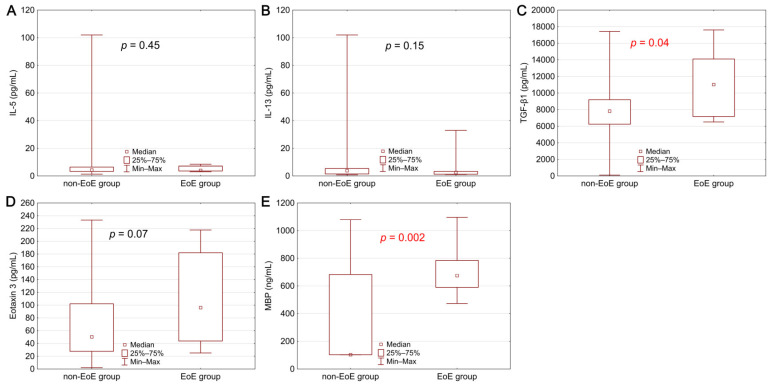
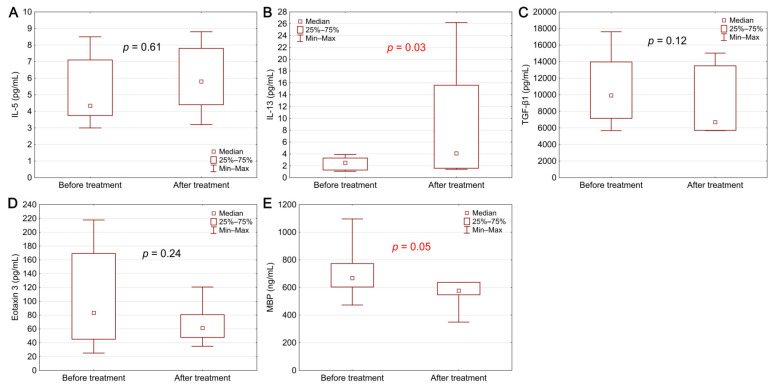
Statistically significantly higher concentrations of MBP and TGF-β1 were demonstrated in the group of patients with EoE, while MBP and eotaxin 3 correlated with the peak eosinophil count (PEC). Baseline MBP levels and eotaxin 3 after treatment significantly positively correlated with EREFS. There was a negative correlation between IL-13 and fibrostenotic EREFS. Additionally, after treatment, a negative correlation TGF-β1 was noted with the inflammatory EREFS and a positive correlation with the fibrostenotic EREFS.
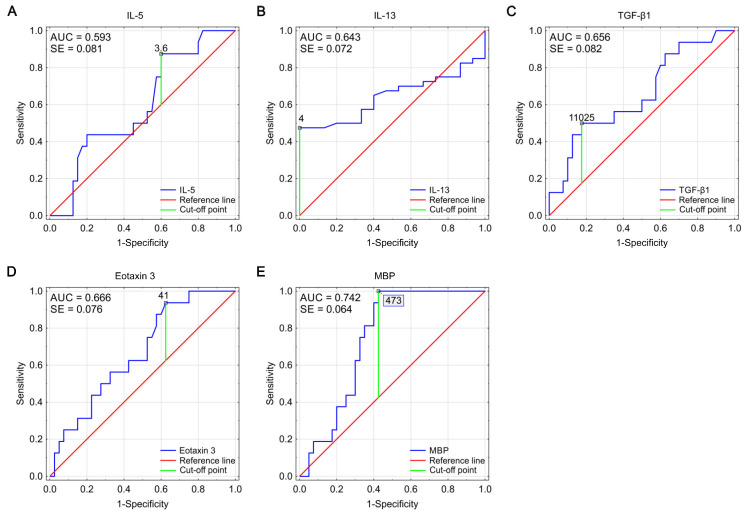
The potential role of MBP in predicting the diagnosis of EoE, eotaxin 3 in predicting the advancement and correlation of IL-13 and TGF-β1 in differentiating the inflammatory and fibrotic course of the disease may facilitate the management and individualization of EoE therapy.
侵入性且昂贵的内镜诊断对于嗜酸性食管炎(EoE)的诊断和监测是必不可少的。本研究旨在评估参与嗜酸性粒细胞介导炎症的血清生物标志物在EoE管理中的实用性。
对58例吞咽困难患者进行了一项前瞻性队列研究。每位参与者完成一份健康问卷,接受食管胃十二指肠镜检查并取食管活检进行组织病理学检查以及评估总体、炎症性和纤维狭窄性嗜酸性食管炎参考评分(EREFS)。通过酶免疫测定法测定血清白细胞介素5(IL-5)、白细胞介素13(IL-13)、转化生长因子β1(TGF-β1)、主要碱性蛋白(MBP)和嗜酸性粒细胞趋化因子3的水平。16例符合EoE组织学标准的患者接受质子泵抑制剂治疗8周,然后再次进行相同的诊断。
EoE患者组中MBP和TGF-β1的浓度在统计学上显著更高,而MBP和嗜酸性粒细胞趋化因子3与嗜酸性粒细胞峰值计数(PEC)相关。治疗后基线MBP水平和嗜酸性粒细胞趋化因子3与EREFS显著正相关。IL-13与纤维狭窄性EREFS之间存在负相关。此外,治疗后,TGF-β1与炎症性EREFS呈负相关,与纤维狭窄性EREFS呈正相关。
MBP在预测EoE诊断中的潜在作用、嗜酸性粒细胞趋化因子3在预测疾病进展中的作用以及IL-13和TGF-β1在区分疾病炎症和纤维化过程中的相关性可能有助于EoE治疗的管理和个体化。