Oregon Health & Science University, Portland, Oregon.
OHSU-PSU School of Public Health, Portland, Oregon.
JAMA Netw Open. 2020 Jun 1;3(6):e206874. doi: 10.1001/jamanetworkopen.2020.6874.
Use of effective contraception decreases unintended pregnancy. It is not known whether Medicaid expansion under the Affordable Care Act increased use of contraception for women who are underserved in the US health care safety net.
To evaluate the association of Medicaid expansion under the Affordable Care Act with changes in use of contraception among patients at risk of pregnancy at US community health centers, with the hypothesis that Medicaid expansion would be associated with increases in use of the most effective contraceptive methods (long-acting reversible contraception).
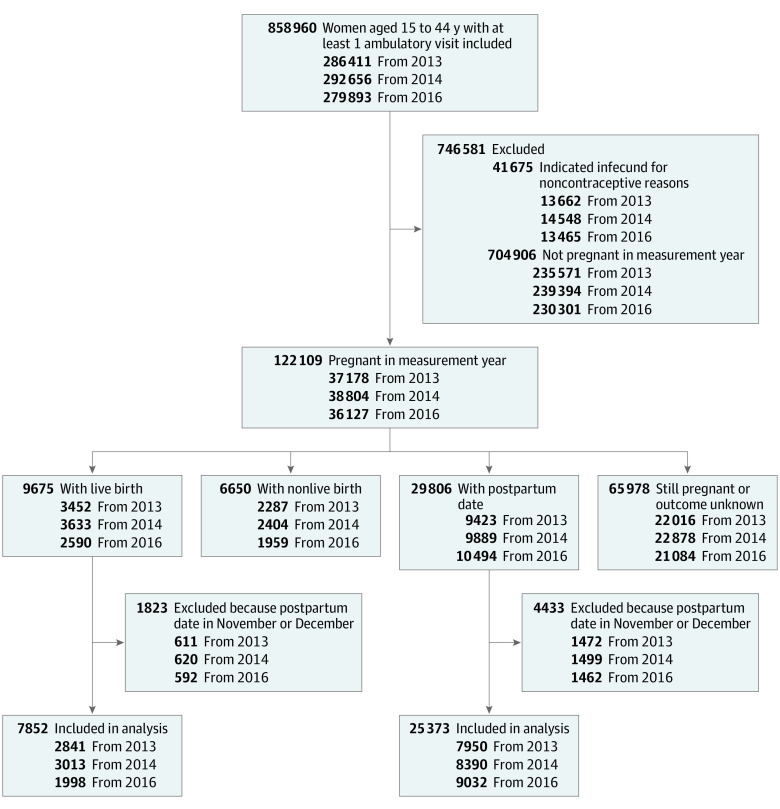
DESIGN, SETTING, AND PARTICIPANTS: This was a participant-level retrospective cross-sectional study comparing receipt of contraception before (2013) vs immediately after (2014) and a longer time after (2016) Medicaid expansion. Electronic health record data from a clinical research network of community health centers across 24 states were included. The sample included all female patients ages 15 to 44 years at risk for pregnancy, with an ambulatory care visit at a participating community health center during the study period (315 clinics in expansion states and 165 clinics in nonexpansion states).
Medicaid expansion status (by state).
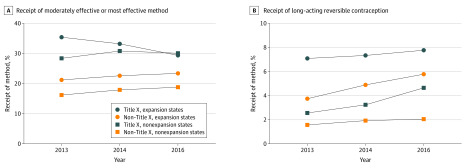
Two National Quality Forum-endorsed contraception quality metrics, calculated annually: the proportion of women at risk of pregnancy who received (1) either a moderately effective or most effective method (hormonal and long-acting reversible contraception) methods and (2) the most effective method (long-acting reversible contraception).
The sample included 310 132 women from expansion states and 235 408 women from nonexpansion states. The absolute adjusted increase in use of long-acting reversible contraceptive methods was 0.58 (95% CI, 0.13-1.05) percentage points greater among women in expansion states compared with nonexpansion states in 2014 and 1.19 (95% CI, 0.41-1.96) percentage points larger in 2016. Among adolescents, the association was larger, particularly in the longer term (2014 vs 2013: absolute difference-in-difference, 0.80 [95% CI, 0.30-1.30] percentage points; 2016 vs 2013: absolute difference, 1.79 [95% CI, 0.88-2.70] percentage points). Women from expansion states who received care at a Title X clinic had the highest percentage of women receiving most effective contraceptive methods compared with non-Title X clinics and nonexpansion states.
In this study, Medicaid expansion was associated with an increase in use of long-acting reversible contraceptive methods among women at risk of pregnancy seeking care in the US safety net system, and gains were greatest among adolescents.
使用有效的避孕措施可以降低非意愿妊娠的发生。目前尚不清楚《平价医疗法案》下的医疗补助(Medicaid)扩面是否增加了美国医疗保障安全网中服务不足的女性对避孕措施的使用。
评估《平价医疗法案》下的医疗补助扩面与美国社区卫生中心有妊娠风险的患者避孕措施使用变化之间的关联,假设医疗补助扩面将与最有效的避孕方法(长效可逆避孕措施)的使用增加相关。
设计、地点和参与者:这是一项参与者水平的回顾性横断面研究,比较了在医疗补助扩面之前(2013 年)、之后(2014 年)和之后较长时间(2016 年)接受避孕措施的情况。研究纳入了来自 24 个州临床研究网络中社区卫生中心的电子健康记录数据。样本包括所有年龄在 15 至 44 岁之间有妊娠风险的女性,她们在研究期间在参与社区卫生中心进行了门诊就诊(扩张州有 315 个诊所,非扩张州有 165 个诊所)。
医疗补助扩面情况(按州划分)。
每年计算两个国家质量论坛认可的避孕质量指标:有妊娠风险的女性中(1)使用了中度有效或最有效的方法(激素和长效可逆避孕措施)和(2)使用了最有效的方法(长效可逆避孕措施)的比例。
样本包括来自扩张州的 310132 名女性和来自非扩张州的 235408 名女性。与非扩张州相比,扩张州在 2014 年和 2016 年使用长效可逆避孕措施的比例分别增加了 0.58(95%置信区间,0.13-1.05)和 1.19(95%置信区间,0.41-1.96)个百分点。在青少年中,这种关联更大,尤其是在较长时间内(2014 年与 2013 年相比:绝对差异,0.80[95%置信区间,0.30-1.30]个百分点;2016 年与 2013 年相比:绝对差异,1.79[95%置信区间,0.88-2.70]个百分点)。与非 Title X 诊所和非扩张州相比,来自扩张州并在 Title X 诊所接受治疗的女性使用最有效的避孕方法的比例最高。
在这项研究中,医疗补助扩面与美国安全网系统中寻求治疗的有妊娠风险的女性使用长效可逆避孕措施的增加有关,青少年中的增幅最大。