Department of Obstetrics, The First Affiliated Hospital of China Medical University, Shenyang, Liaoning, China (mainland).
Department of Ultrasound, Shengjing Hospital of China Medical University, Shenyang, Liaoning, China (mainland).
Med Sci Monit. 2020 Jun 4;26:e921997. doi: 10.12659/MSM.921997.
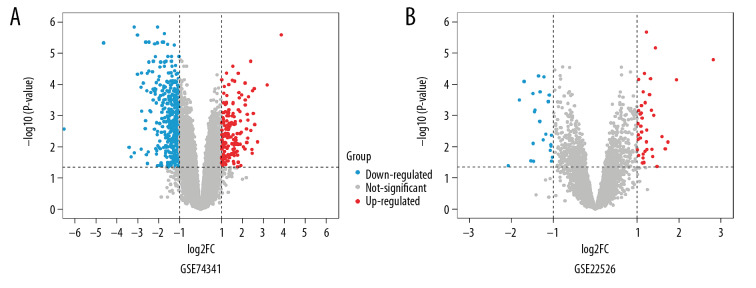
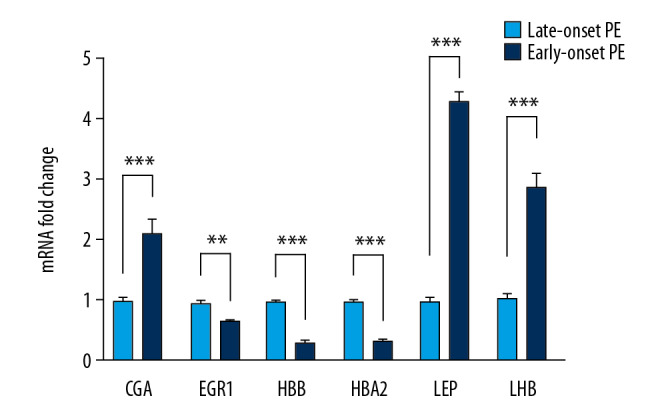
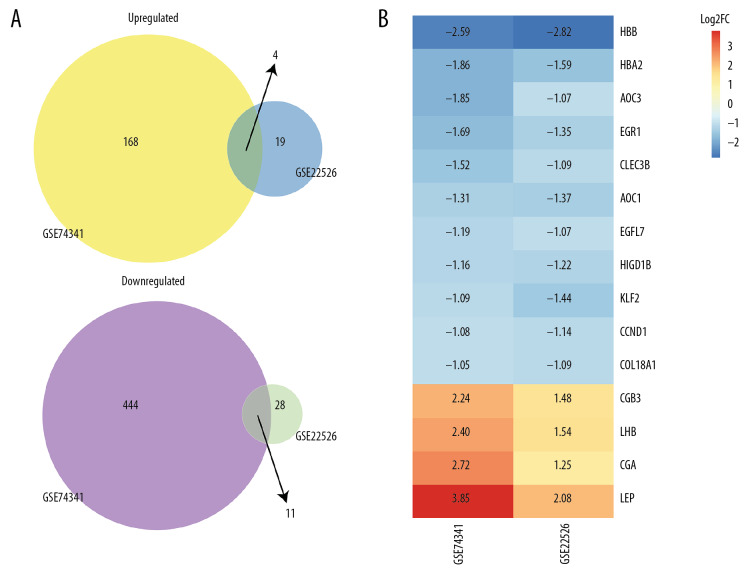
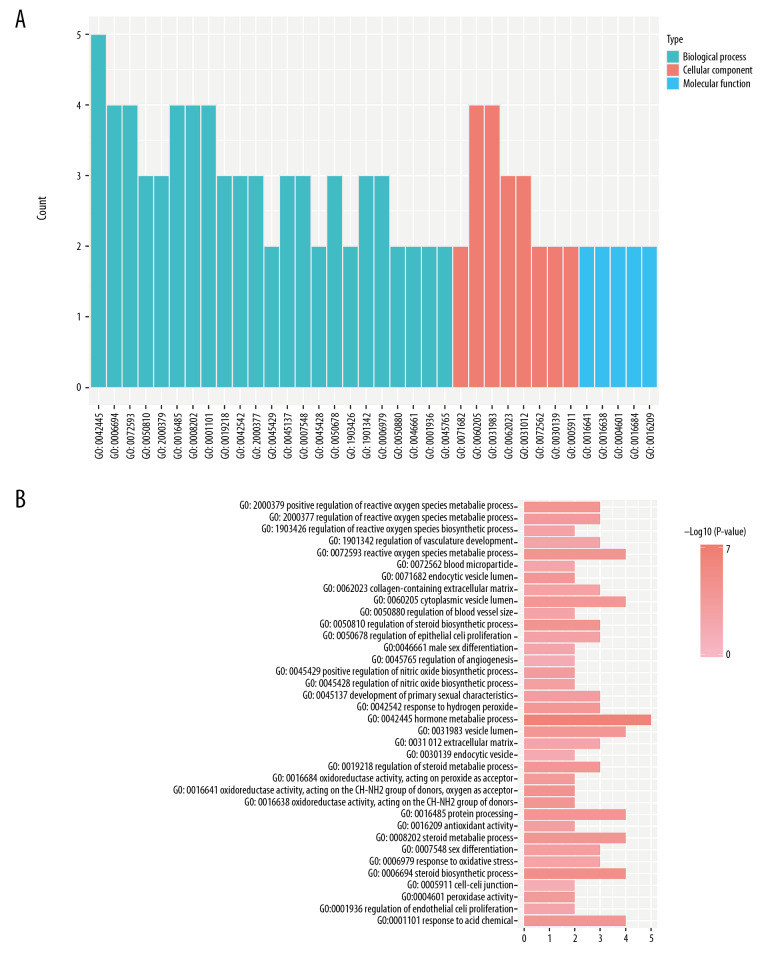
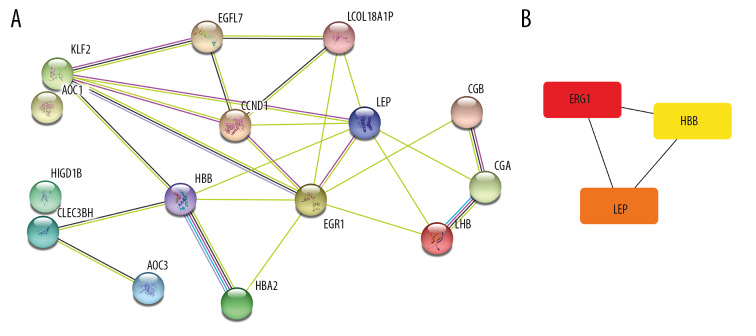
BACKGROUND Pre-eclampsia (PE) can be divided into 2 sub-groups: early-onset and late-onset PE. Although these sub-groups show overlapping molecular and cellular mechanisms and similar clinical manifestations, they are regarded as 2 different phenotypes with heterogeneous manifestations. The pathophysiological mechanisms underlying early-onset and late-onset PE still remain unclear. Therefore, the present study aimed to identify the key genes and pathways related to early-onset and late-onset PE, and to investigate the molecular mechanisms that are involved in gene regulation. MATERIAL AND METHODS Our analysis involved the Gene Expression Series (GSE) 74341 and GSE22526 from the National Center of Biotechnology Information (NCBI) Gene Expression Omnibus Database. These 2 microarray datasets included 15 patients with early-onset PE and 15 patients with late-onset PE. RESULTS Our analyses identified 15 differentially expressed genes (DEGs), including CGA, EGR1, HBB, HBA2, LEP, and LHB. Gene Ontology (GO) functional annotation showed that the biological functions of these DEGs were mainly associated with steroid biosynthetic, oxidative stress, angiogenesis, and sex differentiation. Signaling pathway analyses showed that these DEGs were mainly involved in the prolactin signaling pathway, hormone metabolism, the AMPK signaling pathway, and the FoxO signaling pathway. Protein-protein interaction (PPI) network analysis identified 4 genes with the highest degree of interaction. The hub genes for this selection of DEGS were EGR1, LEP, and HBB. CONCLUSIONS Integrated bioinformatic analyses provide us with a new approach to further understand the pathophysiology and molecular mechanisms underlying early-onset and late-onset PE. The DEGs identified in this study represent potential biomarkers for the early diagnosis of PE and may provide significant options the treatment of these 2 subtypes of PE.
子痫前期(PE)可分为早发型和晚发型。尽管这两种亚组表现出重叠的分子和细胞机制以及相似的临床表现,但它们被认为是具有不同表现的两种不同表型。早发型和晚发型 PE 的病理生理机制仍不清楚。因此,本研究旨在确定与早发型和晚发型 PE 相关的关键基因和途径,并探讨涉及基因调控的分子机制。
我们的分析涉及来自国家生物技术信息中心(NCBI)基因表达综合数据库的基因表达系列(GSE74341)和 GSE22526。这两个微阵列数据集包括 15 例早发型 PE 患者和 15 例晚发型 PE 患者。
我们的分析确定了 15 个差异表达基因(DEGs),包括 CGA、EGR1、HBB、HBA2、LEP 和 LHB。基因本体论(GO)功能注释表明,这些 DEGs 的生物学功能主要与类固醇生物合成、氧化应激、血管生成和性别分化有关。信号通路分析表明,这些 DEGs 主要参与催乳素信号通路、激素代谢、AMPK 信号通路和 FoxO 信号通路。蛋白质-蛋白质相互作用(PPI)网络分析确定了 4 个具有最高互作程度的基因。该选择的 DEGs 的枢纽基因是 EGR1、LEP 和 HBB。
综合生物信息学分析为进一步了解早发型和晚发型 PE 的病理生理学和分子机制提供了一种新方法。本研究中鉴定的 DEGs 代表了 PE 早期诊断的潜在生物标志物,并为这两种 PE 亚型的治疗提供了重要选择。