Queen Mary School, Medical College of Nanchang University, Nanchang, China.
Jiangxi Provincial Key Laboratory of Preventive Medicine, School of Public Health, Nanchang University, Nanchang, China.
PLoS One. 2020 Jun 4;15(6):e0234062. doi: 10.1371/journal.pone.0234062. eCollection 2020.
Hepatocellular carcinoma (HCC) is one of the most lethal and malignant tumours worldwide. New therapeutic targets for HCC are urgently needed. CYCLOPS (copy number alterations yielding cancer liabilities owing to partial loss) genes have been noted to be associated with cancer-targeted therapies. Therefore, we intended to explore the effects of the CYCLOPS gene RBM17 on HCC oncogenesis to determine if it could be further used for targeted therapy.
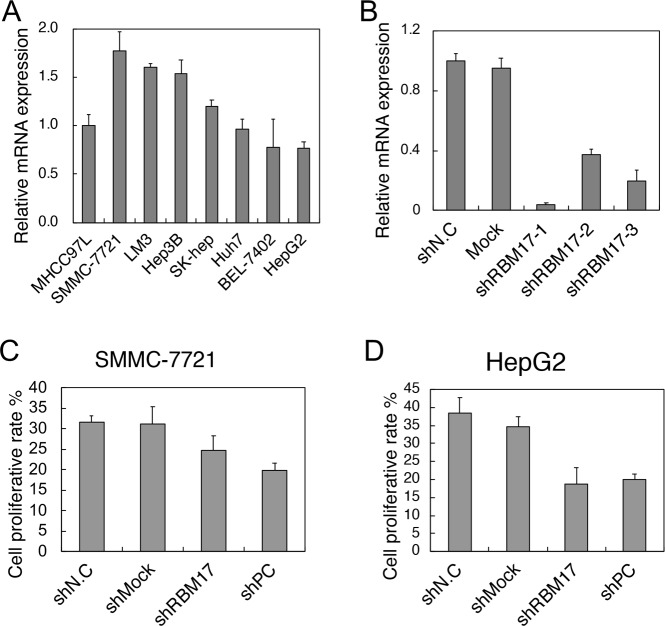
We collected data on 12 types of cancer from the Cancer Genome Atlas (TCGA) and Gene Expression Omnibus (GEO) queries for comparison with adjacent non-tumour tissues. RBM17 expression levels, clinicopathological factors and survival times were analysed. RNAseq data were downloaded from the Encyclopaedia of DNA Elements database for molecular mechanism exploration. Two representative HCC cell models were built to observe the proliferation capacity of HCC cells when RBM17 expression was inhibited by shRBM17. Cell cycle progression and apoptosis were also examined to investigate the pathogenesis of RBM17.
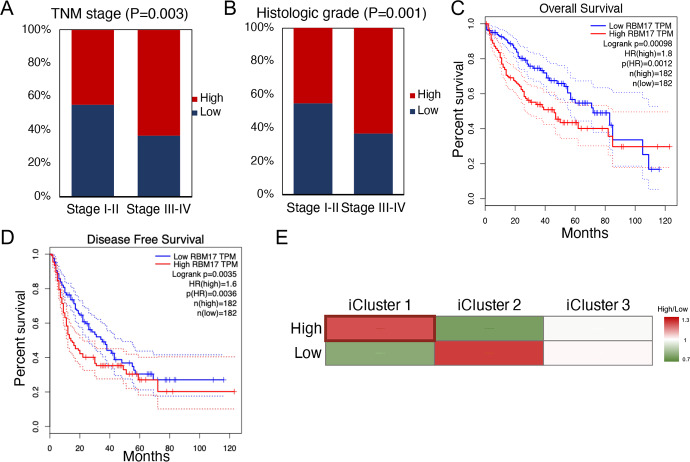
Based on 6,136 clinical samples, RBM17 was markedly overexpressed in most cancers, especially HCC. Moreover, data from 442 patients revealed that high RBM17 expression levels were related to a worse prognosis. Overexpression of RBM17 was related to the iCluster1 molecular subgroup, TNM stage, and histologic grade. Pathway analysis of RNAseq data suggested that RBM17 was involved in mitosis. Further investigation revealed that the proliferation rates of HepG2 (P = 0.003) and SMMC-7721 (P = 0.030) cells were significantly reduced when RBM17 was knocked down. In addition, RBM17 knockdown also arrested the progression of the cell cycle, causing cells to halt at the G2/M phase. Increased apoptosis rates were also found in vitro.
These results suggest that RBM17 is a potential therapeutic target for HCC treatment.
肝细胞癌(HCC)是全球最致命和恶性的肿瘤之一。迫切需要新的 HCC 治疗靶点。已经注意到 CYCLOPS(由于部分缺失导致癌症负担的拷贝数改变)基因与癌症靶向治疗有关。因此,我们旨在探讨 CYCLOPS 基因 RBM17 对 HCC 发生的影响,以确定其是否可进一步用于靶向治疗。
我们从癌症基因组图谱(TCGA)和基因表达综合数据库(GEO)查询中收集了 12 种癌症的数据,与相邻非肿瘤组织进行比较。分析 RBM17 表达水平、临床病理因素和生存时间。从 DNA 元件百科全书数据库下载 RNAseq 数据,以探索分子机制。构建两个代表性的 HCC 细胞模型,观察 shRBM17 抑制 RBM17 表达时 HCC 细胞的增殖能力。还检查了细胞周期进程和细胞凋亡,以研究 RBM17 的发病机制。
基于 6136 个临床样本,RBM17 在大多数癌症中明显过表达,尤其是 HCC。此外,来自 442 名患者的数据表明,高 RBM17 表达水平与预后较差有关。RBM17 的过表达与 iCluster1 分子亚组、TNM 分期和组织学分级有关。RNAseq 数据的通路分析表明,RBM17 参与有丝分裂。进一步研究表明,当 RBM17 被敲低时,HepG2(P=0.003)和 SMMC-7721(P=0.030)细胞的增殖率显著降低。此外,RBM17 敲低还使细胞周期停滞在 G2/M 期,导致细胞停滞不前。还在体外发现凋亡率增加。
这些结果表明,RBM17 是 HCC 治疗的潜在治疗靶点。