Mital Sasha, Wolff Jessica, Carroll Jennifer J
National Center for Injury Control and Prevention, Centers for Disease Control and Prevention, 4770 Buford Highway, Atlanta, GA 30341, United States.
National Center for Injury Control and Prevention, Centers for Disease Control and Prevention, 4770 Buford Highway, Atlanta, GA 30341, United States.
Drug Alcohol Depend. 2020 Aug 1;213:108088. doi: 10.1016/j.drugalcdep.2020.108088. Epub 2020 May 24.
Rates of opioid overdose (OD) have risen to unprecedented numbers and more than half of incarcerated individuals meet the criteria for substance use disorder, placing them at high risk. This review describes the relationship between incarceration history and OD.
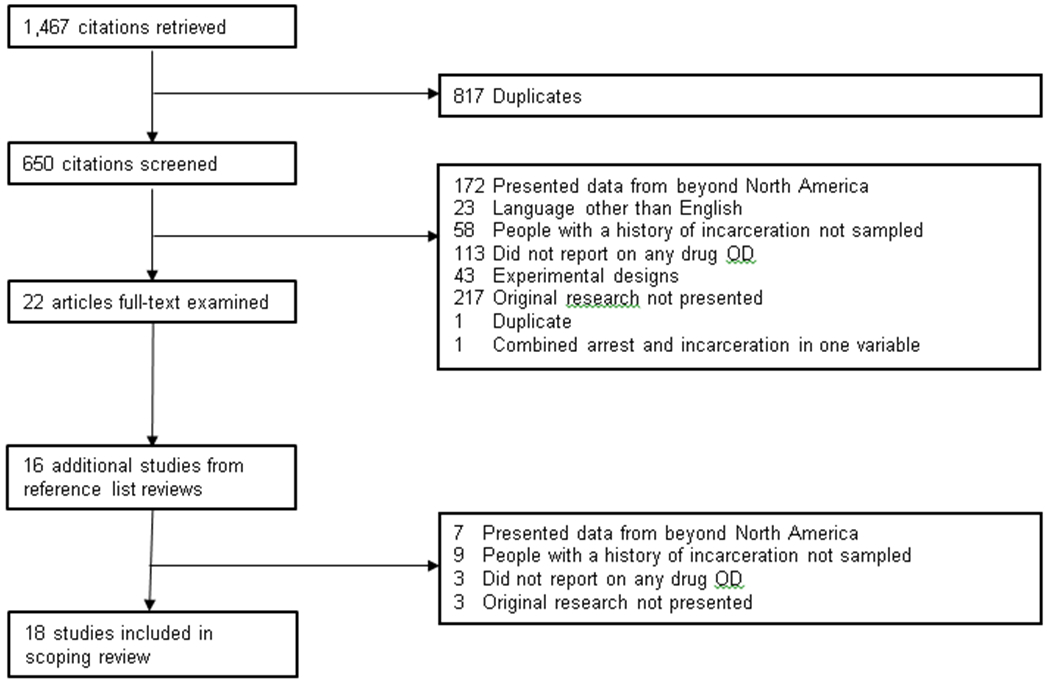
A scoping review was conducted and criteria for inclusion were: set in North America, published in English, and non-experimental study of formerly incarcerated individuals. Due to inconsistent definitions of opioid OD, we included all studies examining OD where opioids were mentioned.
The 18 included studies were all published in 2001 or later. Four associations between incarceration history and OD were identified: (1) six studies assessed incarceration history as a risk factor for OD and four found a significantly higher risk of OD among individuals with a history of incarceration compared to those without; (2) nine studies examined the rate of OD compared to the general population: eight found a significantly higher risk of fatal OD among those with a history of incarceration and three documented the highest risk of death immediately following release; (3) six studies found demographic, substance use and mental health, and incarceration-related risk factors for OD among formerly incarcerated individuals; and (4) four studies assessed the proportion of deaths due to OD and found a range from 5 % to 57 % among formerly incarcerated individuals.
Findings support the growing call for large-scale implementation of evidence-based OD prevention interventions in correctional settings and among justice-involved populations to reduce OD burden in this high-risk population.
阿片类药物过量(OD)率已升至前所未有的数字,超过一半的被监禁者符合物质使用障碍的标准,使他们处于高风险之中。本综述描述了监禁史与阿片类药物过量之间的关系。
进行了一项范围综述,纳入标准为:研究设定在北美,以英文发表,且为对曾被监禁者的非实验性研究。由于阿片类药物过量的定义不一致,我们纳入了所有提及阿片类药物并研究过量情况的研究。
纳入的18项研究均发表于2001年或之后。确定了监禁史与阿片类药物过量之间的四种关联:(1)六项研究将监禁史评估为阿片类药物过量的风险因素,四项研究发现有监禁史的个体相比无监禁史的个体,阿片类药物过量风险显著更高;(2)九项研究将阿片类药物过量率与普通人群进行比较:八项研究发现有监禁史的个体中致命性阿片类药物过量风险显著更高,三项研究记录了释放后立即出现的最高死亡风险;(3)六项研究发现了曾被监禁者中阿片类药物过量的人口统计学、物质使用和心理健康以及与监禁相关的风险因素;(4)四项研究评估了阿片类药物过量导致的死亡比例,发现曾被监禁者中的比例在5%至57%之间。
研究结果支持了越来越多的呼声,即在惩教机构和涉及司法系统的人群中大规模实施基于证据的阿片类药物过量预防干预措施,以减轻这一高风险人群的阿片类药物过量负担。