Human Histology and Embryology Section, Department of Surgery, Dentistry, Pediatrics and Gynecology, Medical School, University of Verona, Veneto, 37134 Verona, Italy.
Burns Department, Shenzhen Second People's Hospital, University of Shenzhen, Guangdong 518000, China.
Cells. 2020 Jun 2;9(6):1386. doi: 10.3390/cells9061386.
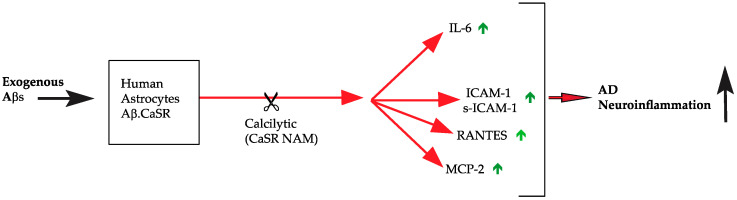
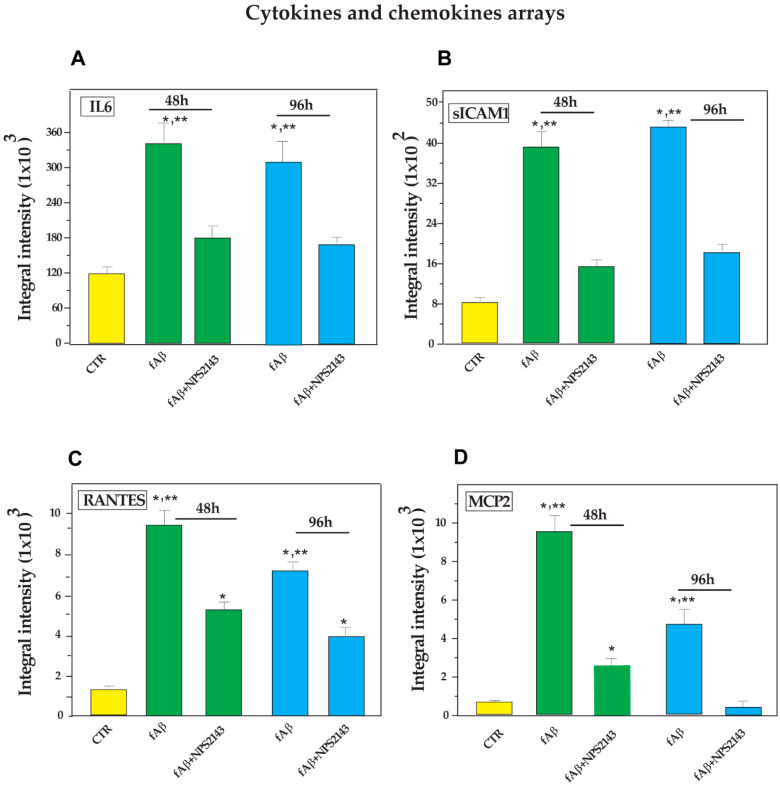
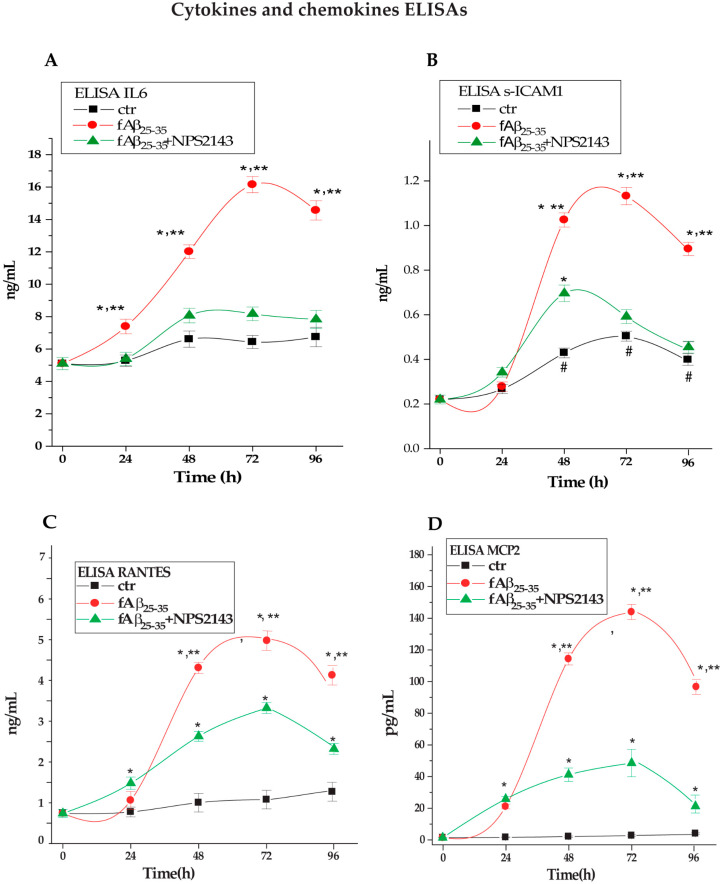
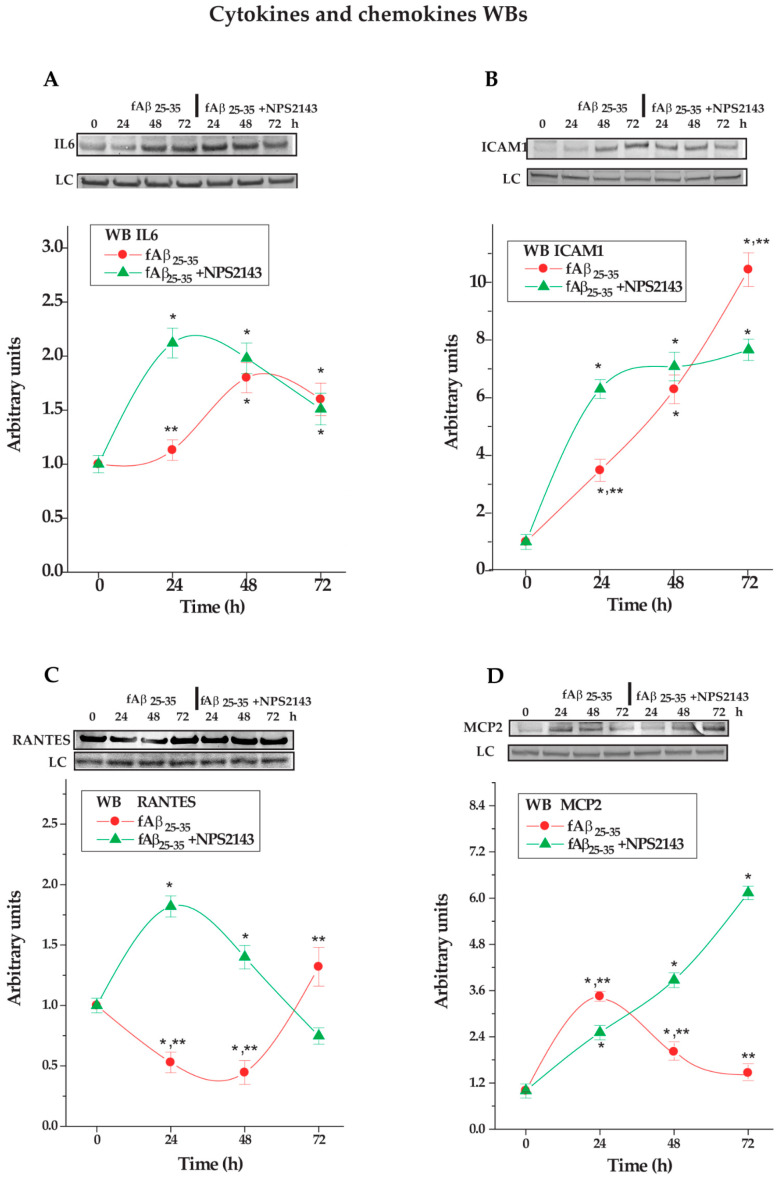
Available evidence shows that human cortical neurons' and astrocytes' calcium-sensing receptors (CaSRs) bind Amyloid-beta (Aβ) oligomers triggering the overproduction/oversecretion of several Alzheimer's disease (AD) neurotoxinseffects calcilytics suppress. We asked whether AβCaSR signaling might also play a direct pro-neuroinflammatory role in AD. Cortical nontumorigenic adult human astrocytes (NAHAs) in vitro were untreated (controls) or treated with Aβ±NPS 2143 (a calcilytic) and any proinflammatory agent in their protein lysates and growth media assayed via antibody arrays, enzyme-linked immunosorbent assays (ELISAs), and immunoblots. Results show Aβ•CaSR signaling upregulated the synthesis and release/shedding of proinflammatory interleukin (IL)-6, intercellular adhesion molecule-1 (ICAM-1) (holoprotein and soluble [s] fragment), Regulated upon Activation, normal T cell Expressed and presumably Secreted (RANTES), and monocyte chemotactic protein (MCP)-2. Adding NPS 2143 (i) totally suppressed IL-6's oversecretion while remarkably reducing the other agents' over-release; and (ii) more effectively than Aβ alone increased over controls the four agents' distinctive intracellular accumulation. Conversely, NPS 2143 did not alter Aβ-induced surges in IL-1β, IL-3, IL-8, and IL-16 secretion, consequently revealing their Aβ•CaSR signaling-independence. Finally, Aβ±NPS 2143 treatments left unchanged MCP-1's and TIMP-2's basal expression. Thus, NAHAs Aβ•CaSR signaling drove four proinflammatory agents' over-release that NPS 2143 curtailed. Therefore, calcilytics would also abate NAHAs' Aβ•CaSR signaling direct impact on AD's neuroinflammation.
现有证据表明,人类皮质神经元和星形胶质细胞的钙敏感受体(CaSR)与淀粉样β(Aβ)寡聚体结合,触发几种阿尔茨海默病(AD)神经毒素的过度产生/分泌。我们想知道 Aβ-CaSR 信号是否也在 AD 中发挥直接的促神经炎症作用。体外未处理(对照)或用 Aβ+NPS 2143(一种钙敏感受体激动剂)和任何促炎剂处理的皮质非肿瘤性成人人类星形胶质细胞(NAHAs)在其蛋白裂解物和生长培养基中通过抗体阵列、酶联免疫吸附测定(ELISA)和免疫印迹进行检测。结果表明,Aβ-CaSR 信号上调了促炎细胞因子白细胞介素(IL)-6、细胞间黏附分子-1(ICAM-1)(全蛋白和可溶性[s]片段)、活化正常 T 细胞表达和假定分泌(RANTES)和单核细胞趋化蛋白(MCP)-2的合成和释放/脱落。添加 NPS 2143(i)完全抑制了 IL-6 的过度分泌,同时显著减少了其他试剂的过度释放;(ii)比 Aβ 单独更有效地增加了四个试剂的独特细胞内积累。相反,NPS 2143 不会改变 Aβ 诱导的白细胞介素-1β、白细胞介素-3、白细胞介素-8 和白细胞介素-16 分泌的激增,从而揭示了它们对 Aβ-CaSR 信号的独立性。最后,Aβ+NPS 2143 处理未改变 MCP-1 和 TIMP-2 的基础表达。因此,NAHAs 的 Aβ-CaSR 信号驱动了四种促炎试剂的过度释放,而 NPS 2143 则抑制了这些释放。因此,钙敏感受体激动剂也会减轻 NAHAs 的 Aβ-CaSR 信号对 AD 神经炎症的直接影响。